

5 Reasons Why Supergirl Flopped At The Box Office

To say that "Supergirl" had a rough start at the box office would be an understatement. The latest entry in the new DC Universe from Warner Bros. and DC Studios dramatically underperformed against already muted expectations on its opening weekend, resulting in one of the most catastrophic debuts for a superhero movie in the modern era.
Directed by Craig Gillespie ("Dumb Money"), "Supergirl" opened to just $37.1 million domestically to go with an even worse $25.5 million internationally, adding up to a $62.6 million global launch. Pre-release estimates made it look like "Supergirl" might not fly very high at the box office, but the movie came in far below what were already pretty rough numbers. Less than two weeks ago, DC's latest was targeting a domestic debut between $47 and $60 million.
As it stands, the big-budget take on the Girl of Steel opened roughly in the same neighborhood as "Shazam! Fury of the Gods," one of the biggest box office bombs in superhero history. That sequel opened to $65.5 million worldwide, en route to just $134 million worldwide against a $125 million budget. "Supergirl" also opened below "The Marvels" ($46.1 million), which finished its run as the lowest-grossing MCU movie ever, winding up with just $206 million worldwide. The comparisons are not good at the moment.
So, what went wrong here? How did Warner Bros. and DC Studios make such a grave miscalculation after the success of last summer's "Superman" movie? We're going to look at the biggest reasons why "Supergirl" flopped at the box office on its opening weekend. Let's get into it.
Supergirl was met with a very mixed response

The critical response to "Supergirl" wasn't exactly what DC Studios co-heads James Gunn and Peter Safran had in mind when they gave the movie the greenlight. It was met with a very mixed response, which absolutely didn't help the movie's chances on opening weekend, especially as crowd-pleasers like "Toy Story 5," which once again ruled the box office with a $70 million second weekend, were out there for audiences to choose from.
As of this writing, Craig Gillespie's entry in the DC Universe holds a 55% critical approval rating on Rotten Tomatoes, and a not-so-great 78% audience rating. Even worse, it earned a B- on CinemaScore, one of the worst scores for a big-budget superhero movie in quite some time. Movies this expensive have to be crowd-pleasers by definition to make their money back, and this one didn't hit the mark for a lot of people.
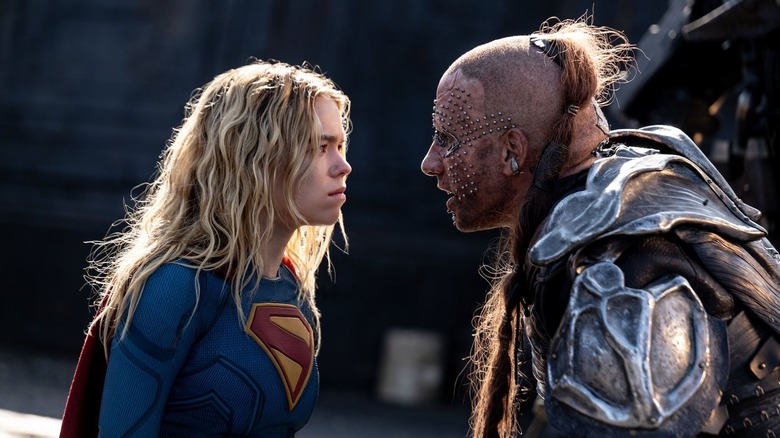
/FIlm's BJ Colangelo praised Milly Alcock as the "self-destructive savior of the DCU" in her "Supergirl" review. For whatever negativity exists out there, critics seemed to agree that Alcock was well-cast in the lead role, as was Jason Momoa as Lobo. It's just that the movie around them didn't rise to the level of their greatness, which translated to a lack of interest from general moviegoers.
Unfortunately, in light of the response, its chances of holding well in the coming weeks are slim to none. It's more likely to go from bad to worse. Word of mouth won't be good, and most fans are going to take the wait-to-stream approach.
The budget for Supergirl was too big

Put plainly, the budget for this movie was far too high. "Supergirl" carries a $170 million budget, meaning it needs to make a lot at the box office to justify its existence. Keep in mind, studios like Warner Bros. don't make massive, expensive summer tentpole movies just to break even. These are supposed to be the money-makers. With a price tag this high, we're talking about a movie that needed to make at least $425 million globally to be considered a success. At this point, it's highly unlikely it will even get close to $200 million.
From a dispassionate business POV, setting aside any feelings about what's right or wrong from a cultural perspective, it probably would have made more sense to budget this movie like the Harley Quinn flick "Birds of Prey," which still met a grim fate at the box office but made $205 million against a budget closer to $80 million, which saved it from being a disaster. Make no mistake: "Supergirl" is a disaster.
Is it fair that male superheroes like Batman and Spider-Man regularly justify budgets in the $200 million range while female superheroes don't? No, it isn't. Marvel and DC dropped the ball pretty hard on making female-fronted superhero movies during the boom the genre experienced in the 2010s, with DC's "Wonder Woman" not coming out until 2017 and Marvel's "Captain Marvel" not coming out until 2019.
Unfortunately, the financial realities are what they are, and any untested theatrical franchise based on a comic book character can't come out of the gate with a massive budget. It's a recipe for catastrophe. This is about the realities of the marketplace as it exists. Budgets this high need to be reserved for the rarest of rare surefire bets. Period.
Supergirl isn't as big as Batman, Superman, or Wonder Woman

In the pandemic era, superheroes haven't been as reliable as they once were, but generally speaking, it's the heavy-hitters that have maintained relevance with audiences. As it relates to DC, that means the big three: Batman, Superman, and Wonder Woman. Setting aside the disaster that was "Wonder Woman 1984," 2022's "The Batman" was a huge hit and last year's "Superman" was the biggest comic book movie of 2025 at the box office, ultimately nabbing $618 million worldwide.
"Supergirl" was fighting an uphill battle in the sense that she's not on the same level as those other characters. That's not to say that she's not popular, but she's just not in the same class. "Batman" has had enduring star power at the box office, dating back to Tim Burton's "Batman" in 1989. The hits have far outweighed the misses in that character's theatrical canon. "Superman" has been a slightly more mixed bag, but broadly, if the movie is "good," audiences turn up. The same goes for "Wonder Woman."
Yes, "Supergirl" had a long-running series on The CW as well as a movie in the '80s, but that didn't necessarily help when it came to getting audiences on board for this new movie — especially since it was about introducing yet another new version of the character. (Remember, Sasha Calle played a version of Supergirl in 2023's "The Flash.")
At a base level, the average, occasional moviegoer isn't as motivated by something like "Supergirl" as they are by "The Batman" or "Superman." If the movie had received an extraordinary response from critics? Who knows. But that's not the way things shook out.
DC hasn't ever earned consistent trust with audiences

Pretty much ever since DC started taking its superheroes and translating them from the page to the silver screen, it's been an up and down ride. Whereas the Marvel Cinematic Universe enjoyed nearly a decade-long run with very few speed bumps, operating as a well-oiled, crowd-pleasing machine throughout the 2010s, DC has never enjoyed sustained success in that way. Thus, they never gained consistent trust with audiences. So, "Supergirl" didn't garner any benefit of the doubt from fans or casual audiences.
Christopher Nolan's "The Dark Knight" was too good to be ignored, but "Batman Begins" was only a modest hit because audiences did not like "Batman & Robin." "Superman: The Movie" was a resounding success, but "Superman IV: The Quest for Peace" was the end result of diminishing returns for that interaction of the franchise. For every "Wonder Woman," there is a "Wonder Woman 1984." For every "Shazam!", there is a "Shazam! Fury of the Gods."
DC has simply never had a long enough string of successes that satisfied both critics and audiences to earn trust. "Justice League" was a box office disaster that doomed the DCEU because it upset Zack Snyder fans, leading to the whole "release the Snyder Cut" movement that cast a shadow over DC for years. For every win, there is a loss. For every success, there is a mess to clean up.
Even movies like "Suicide Squad," which were successful, almost served to do more harm than good in the long term because it kind of created a "fool me once" mentality. This isn't the primary reason why "Supergirl" failed, but the lack of consistency meant a lot of people took the wait-and-see approach.
Superhero movies are no longer automatic, must-see events
It's true now and it's been true for a few years: Superhero movies are no longer must-see cinematic events for most audiences. At least not automatically. The days where a movie like "Venom" could coast to more than $800 million worldwide are truly behind us. My biggest takeaway from the box office in 2023 was that the age of superhero dominance was over.
That year, DC's entire cinematic slate bombed, with "The Flash," "Shazam! Fury of the Gods," "Blue Beetle," and "Aquaman and the Lost Kingdom" all falling well short of expectations. Now, here we are nearly three years later and it's only getting more true by the day. As sobering evidence of that fact, "Supergirl" opened smaller than the infamous disaster that was "Morbius" ($39 million opening/$167 million worldwide). Sony claims "Morbius" turned a profit, but even if that's true, it's only because its budget was much smaller, in the $70 million range.
Marvel's 2025 box office proved that the MCU has fallen from grace as well, with "Thunderbolts*" and "Captain America: Brave New World" falling far short of expectations. Even "The Fantastic Four: First Steps" ($521 million worldwide) did good but not great business. The bar for success has been lowered, and the bar for "must-see" movies for audiences has been raised a great deal.
Case in point, Zack Snyder's "Man of Steel," which kicked off DC's messy cinematic universe, made $668 million worldwide in 2013. That's $50 million less than "Superman" did last year, yet it was viewed as relatively disappointing at the time. Times have changed, and "Supergirl" is further evidence of how much. These movies can be outright ignored, and that makes them increasingly risky propositions.
"Supergirl" is in theaters now.