

10 Best Horror Movies About Relationships, Ranked

When director Curry Barker sat down to discuss his breakout horror feature "Obsession" with /Film, he explained why the genre attracted him more than others. "A romance has rules," he told us. "You can't do this, you can't do that, because then it's a horror." Avoiding that escalation is what keeps most filmmakers in safe, neatly categorized boxes, but enthusiastically chasing it has made Barker one of the most promising directors of the year.
On some level, the most stirring horror comes when directors are able to show how terrifying escalation in a relationship is just as plausible as the desirable alternative. The dream relationship that you thought would fix your life may only unravel it, or the lover you thought you could trust is really a stranger with access to the deepest parts of your mind, body, and soul.
From a blood-soaked rom-com to a nightmarish "meet the parents" and more, we think these are the 10 best films about relationships, each showing how scary love can be.
10. Warm Bodies (2013)
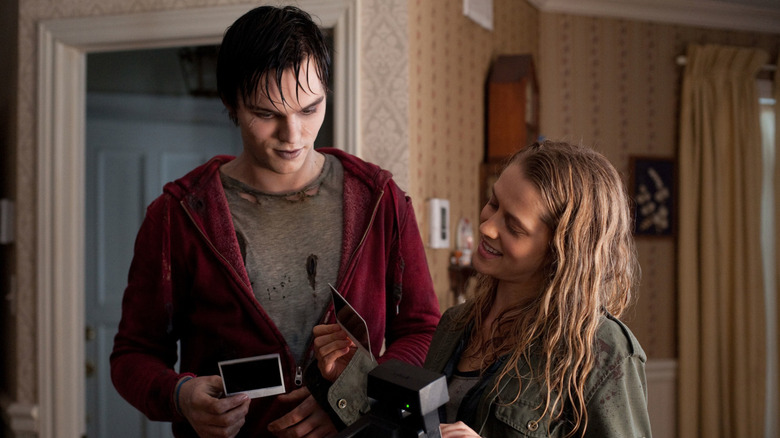
The vast majority of this list is made up of films that mine dread from real, nightmarish relationship drama. It's arguably the best — or at least the scariest — use of the theme in horror. That said, we did want to honor an underrated horror romantic comedy that ultimately inspires one to fall in love.
Written and directed by "Tell Me Lies" executive producer Jonathan Levine (and adapted from 2010 novel by Isaac Marion), "Warm Bodies" is a zombified yet surprisingly optimistic riff on "Romeo and Juliet," starring Nicholas Hoult as an undead lover-boy who falls for a human survivor (Teresa Palmer) after eating her boyfriend's (Dave Franco) brains. The early-2010s rom-com (or zom-com) vibes and Hoult's leading performance (he's clearly having a lot of fun with the role) are enough to make this film a creepy, cozy movie night treat.
In the 2020s, however, "Warm Bodies" feels like its taken on entirely new meaning. The zombies' banal social existence was always an obvious metaphor for the mundanity of world without love of any kind, where emotions are punished (literally in the film, via the "Bonies" that kill anything with a heartbeat) and your relationships are reduced to performative grunts and tired repetitions of activities you barely remember or enjoy. Now, as new audiences discover the film through streamers like Netflix, they might find these qualities evoking the experience of trying to form community in a world where adult social interactions largely take place in increasingly stratified, online communities.
Social atomization in general has pushed us further into ourselves, as we wander about like Hoult's "R," silently narrating our lives as we try to make sense of them. In "Warm Bodies," love and community turns that running commentary into genuine introspection, helping R to develop humanity in an inhuman world.
9. Companion (2025)

The AI-girlfriend trend is here, both at the movies and in the real world. The pre-AI outlier "Her" aside (which, actually, makes a pretty decent companion movie to "Companion"), recent films like 2022's "Don't Worry Darling" explore why men in particular are so drawn to the idea of a partner that has no desire or ability to resist them.
"Companion" is fundamentally a story about control within what is, essentially, a deeply abusive relationship between the narcissistic Josh (Jack Quaid) and the woman of his dreams, who just so happens to be a fully controllable robot named Iris, played by Sophie Thatcher. When Iris comes to Josh (it's worth noting that Josh is not Iris' creator, as he might've been in earlier takes on this companion-bot premise, but an un-extraordinary consumer renting her from an equally un-extraordinary robotics corporation), she arrives with no autonomy or complications. She will presumably do whatever Josh asks without argument or hesitation — and that still isn't enough for him. He delights in being able to modify her intelligence with the drag of a finger and insists that she see him as "nice" when she's finally able to wrest herself from his mental grip.
Josh's overarching plot to use Iris as a defenseless patsy for murder-robbery scheme muddies the film's ideas and holds back its potential as a commentary on power dynamics within relationships. Still, it has enough to say about reclaiming one's personhood after being tied to someone who would prefer them inert and thoughtless.
8. Together (2025)
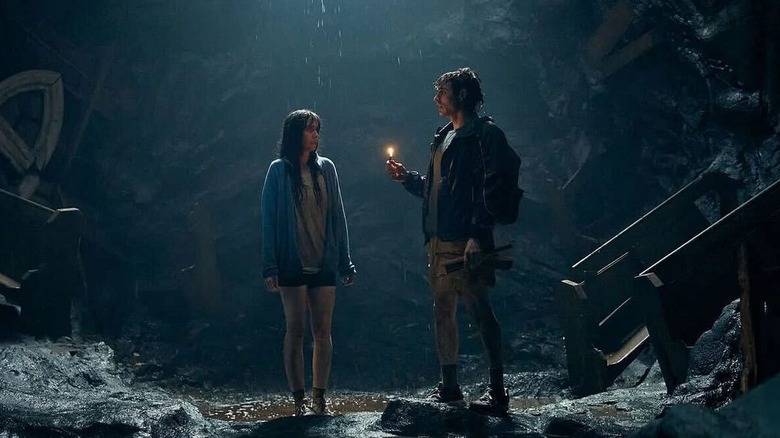
Michael Shanks' "Together" is a deeply uncomfortable film to watch with a partner — and that's not just because it plays with a kind of body horror that would make "The Substance" fans squirm. Real life husband and wife Dave Franco and Allison Brie star as Tim and Millie, a young couple in a long-term, codependent relationship threatened by their separate life goals. When Millie convinces city-rocker Tim to move with her to the countryside for her career, they accidentally catalyze a supernatural process that physically compels them to become one — literally.
What makes the film truly stick from the perspective of relationships is how it forces the protagonists to seriously consider what most would regard as the ultimate embodiment of toxic codependency. Tim and Millie are, in some ways, in a much more complicated situation than other protagonists on this list, their predicament asking them to consider whether or not losing parts of themselves would really be such a bad thing, given the fatal alternative.
One could read the film as a metaphor for the necessary sacrifices (often related to personal autonomy) that they might be asked to make in a long term relationship, but it could also be read as two people giving into the fear that, after so many years of absorbing and losing themselves to each other, they might not have much in the way of individual lives left that would be worth living. In either case, it's actually a great film through which to discuss (with a loved one or yourself) what should actually hold people together in a romantic relationship.
7. The Invisible Man (2020)
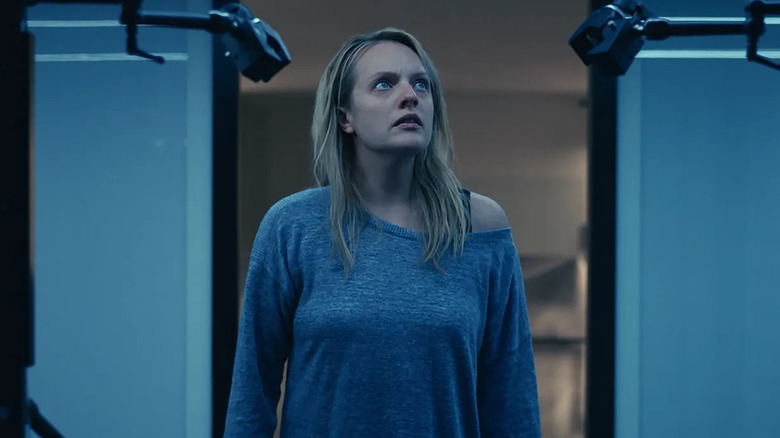
Leigh Whannell's 2020 take on "The Invisible Man" went down as one of the year's best horror movies for a reason. It stars Elisabeth Moss as Cecilia, a woman who escapes an abusive relationship with a tech CEO (Oliver Jackson-Cohen), who subsequently fakes his own death to violently stalk and torment her using an advanced camouflage suit.
The brilliance of Whannell's "Invisible Man" is that it uses the premise and the title as something of a dark double entendre — it refers to the titular villain while gesturing toward the film's central theme of believability. Throughout "The Invisible Man," the major obstacle Cecilia continuously faces is getting anyone to take her claims seriously. Explaining to anyone that she's being attacked by a presumed-dead man wearing a suit they can't see is impossible. Worse yet, the man himself, Adrian, is completely aware of this fact and enjoying it as part of his sadistic revenge plot. He even turns Cecilia into the villain in the film's infamous restaurant scene.
Adrian is a metaphor for how most abusers are "invisible"– people who are able to hide the injuries they inflict upon their partners (physically and psychologically) as they present themselves to the world as compassionate or even admirable. "The Invisible Man" was hailed as Universal's best monster movie in years, and it even managed to put up strong box office numbers before the pandemic shut theaters down in the spring. While we're still waiting to see if Whannell will pay off that cliffhanger ending in a sequel, the film stands as an intelligent and timely exploration of the dangers victims face when pursuing safety and accountability from their abusers.
6. It Follows (2014)

"It Follows" has widely been praised as helping to kickstart the modern era of "elevated" horror, alongside such films as "The Babadook" and "The Conjuring." Maika Monroe gives a breakout performance as a college student who learns, after a sexual encounter, that she has been marked for death by a supernatural entity that will follow her on foot for the rest of her days. Her only hope of staving off the inevitable is to redirect the entity through sex.
On the surface, "It Follows" is widely read as a metaphor for the dangers associated with sex, particularly in the form of sexually transmitted infections and diseases. That's an understandable take — it is literally about something dangerous transmitted through sexual intercourse — but it's only one side of the much broader idea that intimacy has consequences, whether or not we can see them at first. One non-STI example of this is the effect on a person's reputation. People, especially young women, are taught to be afraid of their sexual history following them after the relationship ends. "It Follows" has also been compared to the trauma that haunts victims of abuse as they get close to new people.
At the same time, "It Follows" resonates as a kind of coming-of-age story. The sudden introduction of fatal consequences to something that should be as joyful as sex forces the young ensemble to confront mortality. With each death, the film feels less like it's about the characters trying to stop this entity and more about them slowly realizing they can't. They'll spend the rest of their lives knowing it's out there, with no one to share the burden with but the people they dare to let in.
5. Obsession (2026)
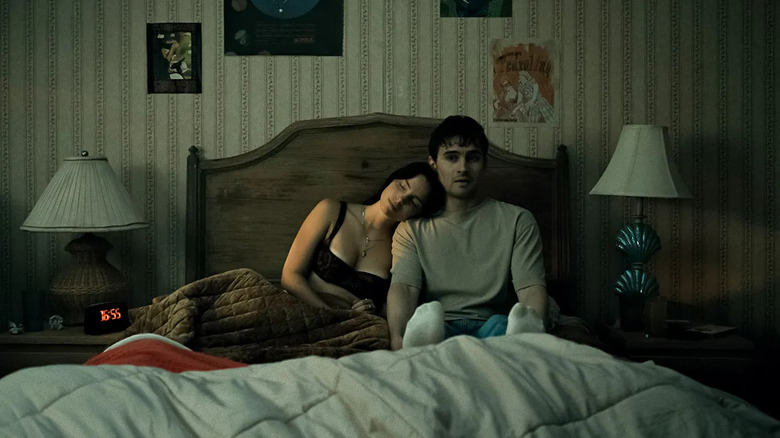
It's more than fair to argue that "Obsession" isn't so much a movie about a relationship but rather a man who wants so desperately to be in one that he turns his crush into the monster he always was deep down. Curry Barker's 2026 theatrical directorial debut has been the horror sensation of the summer so far, so consider this a soft spoiler warning if you're hoping to experience it with as little foreknowledge as possible.
Most audiences have been quick to characterize "Obsession" as a story about a man stripping a woman of her autonomy in the same vein as "Companion." Bear (Michael Johnston), an unambitious and petrified music store clerk, buys a dubiously "magical" wishing totem from a crystal shop, and finds that it actually succeeds in making his work-crush, Nikki (Inde Navarrette) fall madly in love with him. At least, that's how it seems. The real horror of the film is that Bear basically traps Nikki inside of her own body with a seemingly demonic entity that performs obsessive love for Bear.
Throughout the film, the most subtle and fascinating parts of "Obsession" depict the insidiousness of coercive behavior. From the first scene, Bear is so obsessed with the real Nikki that he hides certain aspects of himself and performs others in an attempt to extract a confession of love from her, rather than simply be honest with how he's feeling and accept rejection. In this way, he traps himself in his own body. The film then inverts the dynamic and makes it literal, as the demon exerts greater control over Bear's life and relationships. "Obsession" plants questions in the viewer's brain about what authenticity looks like in a relationship and what a person needs to solve in themselves before entering one.
4. The Fly (1986)
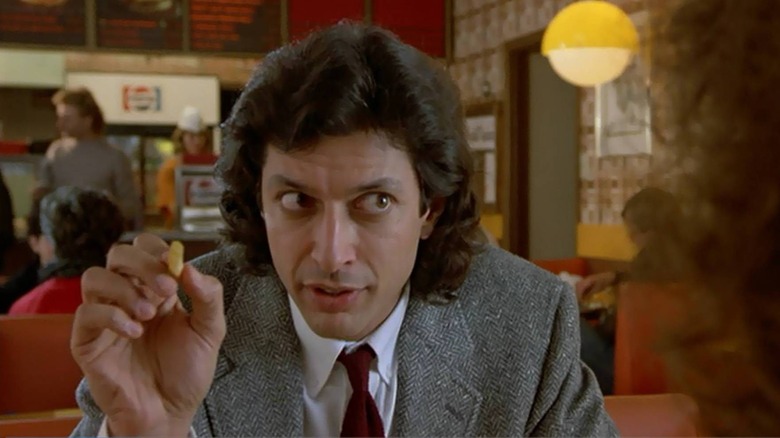
David Cronenberg's "The Fly" is arguably the greatest body horror film of all time, but that doesn't mean it slacks off when it comes to psychological dread. The visuals would hold little weight if the audience weren't invested in the tragedy of Jeff Goldblum's Seth Brundle, a scientist who accidentally fuses himself with a fly.
"The Fly" is most commonly seen as a film about illness – the horror of watching a loved one deteriorate physically and psychologically, as they express that pain in ways that are difficult to understand from the outside. Critics have pointed to AIDS specifically, given that the film was made during the epidemic of the '80s. However, it's more useful to see it as a broader metaphor for degenerative illnesses at large, if one were to take this point of view, as the specific pain it evokes maps on to that wrought by diseases ranging from Alzheimer's to ALS.
There is also an alternative, retrospective read that younger viewers will certainly catch themselves falling into as they watch "The Fly" for the first time. With hindsight, Brundle's journey of deterioration psychologically resembles someone falling for the self-improvement promises of the manosphere. Insecurity leads him to impulsively try his machine, which he later describes as a purifying process in which he is remade for the better. Unfortunately, in remaking himself, he unwittingly invited toxic elements into his body. There's even something eerily recognizable about his last-ditch attempt to fuse his girlfriend and child into himself once his monstrous transformation becomes apparent, hoping they can restore the humanity he lost.
3. Possession (1981)
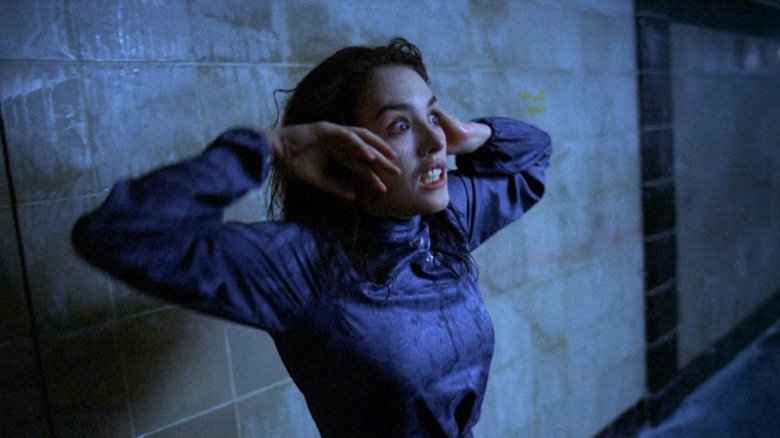
"Possession" is almost as difficult to describe as it is to watch. It took decades for the 1981 film to become the cult classic that it is today, in large part because of how unrelentingly punishing it is. That feeling extends beyond its gore, violence, and graphically disgusting sexual sequences (trust us here, there's really nothing that can prepare you for witnessing this movie) and explodes through its depiction of a dying marriage.
Sam Neill plays Mark, a Cold War spy whose wife, Anna (Isabelle Adjani), takes a lover in his absence. When she insists that the two bring their relationship to an end, his life slowly unravels as he discovers the true, inhuman extent of her extramarital affair and his own failures as a husband. Remarkably, "Possession" renders the dissolution of marriage in such a way that it registers in the intimate and grotesque simultaneously — it's emotionally legible and dramatically effective as it is stomach-churning to watch. The most vivid component of the film is how it distills the grief of realizing someone you once loved has suddenly become a complete stranger — someone capable of doing unspeakable things to escape their relationship, if only to end up in something eerily familiar in the end.
"Possession" won't be for everyone. It doesn't comment on relationships in the more direct, obvious ways the rest of the films on this list do — each moment is challenging and deeply interpretive, as well as borderline antagonistic in its visceral presentation. Yet it's because of that quality that "Possession" is so undeniable, so striking, and simply impossible to stop thinking about, whether or not you immediately appreciate it.
2. Let the Right One In (2008)
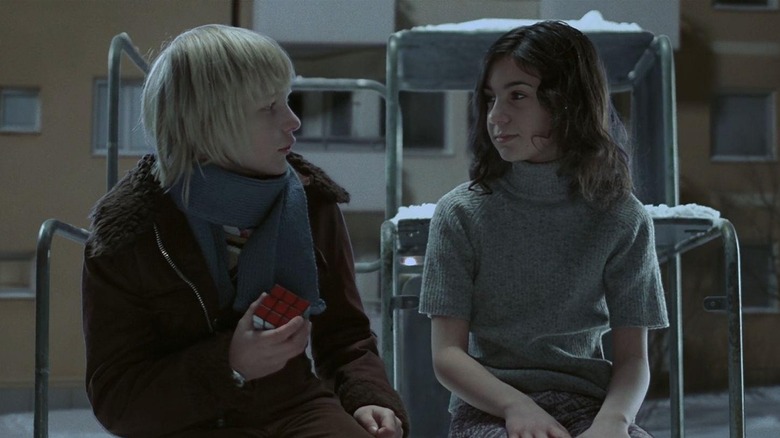
If "Warm Bodies" left horror fans with a bad taste in their mouths, it might've been because "Let the Right One In" showed how horror films can be genuinely romantically moving without sacrificing the terror and dread that make the genre unique. The 2008 Swedish film from Tomas Alfredson explores the relationship between Oskar (Kåre Hedebrant), an isolated 12-year-old boy who fantasizes about killing the boys who relentlessly bully him, and Eli (Lina Leandersson), a vampire hundreds of years his senior, despite looking like an adolescent girl.
If that "age-gap" gives you pause, it both is and isn't the point of the movie. The relationship between Oskar and Eli is emotionally intimate, yet simultaneously innocent (minus the whole murdering thing) and child-like. At the same time, "Let the Right One In" is very much interested in the psychological distance between these characters. How can Oskar truly love Eli if he can just barely understand who or what she might be?
The classic vampire trope, that they need to be invited in before they're allowed to enter a person's home, is invoked to imply that the larger tragedy might be standing on the other side of the door, alone. Alternatively, it proposes that being on one's own isn't as dangerous as giving yourself to a potentially unknowable entity, though, what else is love if not that? "Let the Right One In" is plenty scary in horror movie terms, but it's the questions it poses about what it means to really know and love someone that unsettle the viewer long after the credits roll.
1. Get Out (2017)
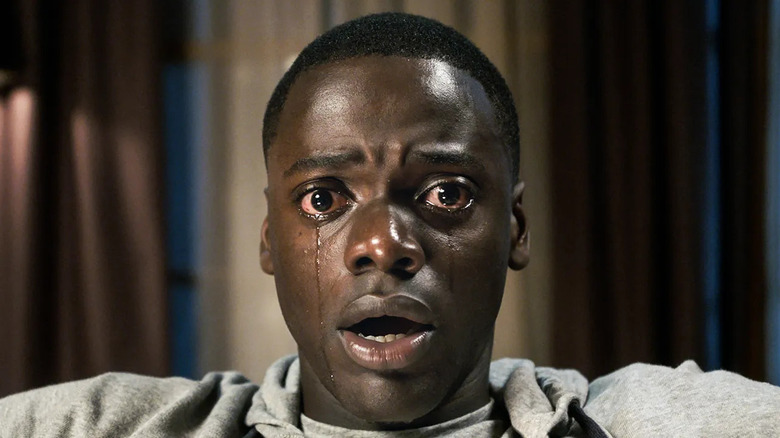
Of all the films on this list, readers are most likely to already understand the deeper context of the themes of "Get Out." The film has been endlessly dissected since its release nearly a decade ago, and it has since become a major cultural reference point, especially in discussions regarding interracial relationships between Black and white people.
Daniel Kaluuya's Chris Washington travels with his long-term girlfriend, Rose (future "M3GAN" star Alison Williams), to meet her family at a secluded, ancestral home in upstate New York, where he soon discovers that their entire relationship has been a grooming process for his body to be sold and taken over by the highest bidder. Director Jordan Peele (who made possibly the strongest directorial debut of the 2010s with this film) has described "Get Out" as an allegory for slavery and the pervasive impact it has on modern society.
But one of the most lasting horrors of the film is how the family's sadistic, racist plot is concealed by his faith in Rose. Chris is the opposite of oblivious or unguarded when he arrives at the house, attuned to backhanded compliments and fetishizing remarks, yet he stays because he believes in love. With that choice, Peele's film exemplifies why horror films are such fertile ground to explore relationships. Love is, after all, either the thing that keeps real horror at bay or allows it to hide in plain sight.