

15 Best Sci-Fi Movies For People Who Hate Sci-Fi

There's something special about 21st-century science fiction. Its dominance over pop culture, which can sometimes feel exhausting, has nonetheless led to some of the most unpredictable films of the contemporary era.
The speculative genre exploded in popularity throughout the '70s and '80s, expanding its fanbase to include most casual moviegoers caught by the worlds of "Star Wars" or "Star Trek." It has since become one of, if not the most maximally saturated genre in popular fiction, to the extent that viewers would be forgiven for feeling like they've already seen everything it has to offer.
If you feel interested in returning to the genre, despite occasional fatigue, the past two decades are filled with movies that use scientific curiosity in genuinely refreshing ways. Whether you find yourself more partial to indie-arthouse dramas, action thrillers, absurd satires, or mysteries, there's a story out there for every flavor of sci-fi-hater.
Here are the best sci-fi movies for people who hate sci-fi.
Eternal Sunshine of the Spotless Mind

"Eternal Sunshine of the Spotless Mind" is hardly even thought of as a sci-fi movie. Ask anyone who's seen it, and they'll likely describe it as one of the most devastating yet cathartic breakup movies of all time.
Directed by Michel Gondry from a script by Charlie Kaufman, this 2004 romantic drama stars Jim Carrey as a heartbroken man who learns that his ex-girlfriend (Academy Award-nominee Kate Winslet) has had her memories of their relationship erased. He reactively decides to do the same, and the film follows his vivid reverse-recall of their entire love story — from breakup to meet-cute – as each memory disappears from his mind.
Kaufman eschews his usual level of delightfully convoluted storytelling in his Oscar-winning screenplay for a story so focused on prioritizing emotional truth that it denies explaining its central conceit through some distracting, sci-fi subplot. Even the mechanics of memory are thankfully loose – neither Gondry nor Kaufman were interested in the dizzying attention to reverse-recall in Christopher Nolan's "Memento." They wanted to play down both that conceit and the sci-fi premise to work through a meditatively mundane metaphor about forcing yourself to move on.
Her
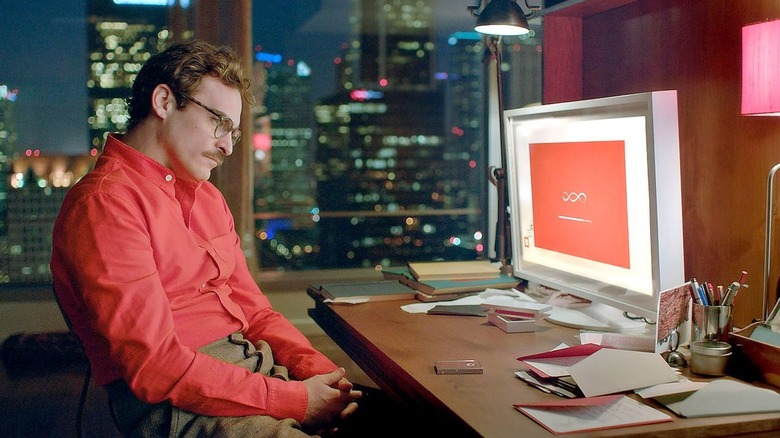
If there's any reason to avoid "Her" at first glance, it might be because its premise hits a little too close to actual reality than it does science fiction. In 2013, Spike Jonze imagined a not-too-distant future where artificially intelligent companions would become so advanced that they could replace a human relationship — Joaquin Phoenix stars as a single man who falls in love with a voice in his phone.
For hardcore sci-fi fans and those who will, understandably, only be able to take the film on its most literal terms given the state of human-A.I. relationships, "Her" may resonate less than its unofficial, spiritual horror-successor "Companion." But we would argue that Jonze didn't win the Academy Award for Best Original Screenplay because he imagined something credible and imminent — he won because a human-A.I. relationship is merely the most effective means for him to break down and explore the dynamics of human relationships at a fundamental level. His vision of the future is actually quite optimistic, not because it argues that a robot could optimize connection, but because it asks us to see how love can continue to surprise and excite us, despite how much we may think we understand it.
The Lobster

At this point, Yorgos Lanthimos has a reputation for making sci-fi/fantasy-adjacent films ("Poor Things," "Bugonia") that captivate critics and confuse audiences. "The Lobster" is, in many ways, every bit as inscrutable (at points) as the most head-scratching scenes of those films — yet there's an earnest simplicity in the visual presentation and writing that makes "The Lobster" less alienating.
Inspired by Lanthimos' own soft existential spiraling, "The Lobster" is a dark romantic comedy that takes place in a near-future where romantic relationships are an absolute necessity. Colin Farrell plays a recently-divorced man who is put in the unenviable position of having to find a life-partner in 45 days at a reclusive hotel – if he doesn't, he will be turned into a lobster.
It's a credit to Lanthimos' obvious skill as a filmmaker by that point that Farrell didn't think starring in "The Lobster" was a risk. It's the sort of film nerds like us usually have to beg people to give a chance — instead, it earned Lanthimos an Oscar nomination and helped establish him among American audiences as an exciting new auteur in the film industry.
Arrival

"Arrival" leans harder toward sci-fi than other entries on this list, so we'll lead with the hard sell. It was nominated for eight Academy Awards, including Best Picture, features a career-high performance from national treasure Amy Adams (who somehow makes first-contact with quasi-amorphous aliens more emotionally compelling than, y'know, her first contact with the most recognizable alien in all of fiction), and was directed by genre master Denis Villeneuve.
While Villeneuve has impacted pop culture mostly through his lauded takes on "Blade Runner" and "Dune" (both of which would be decent options for sci-fi haters with a little more aesthetic leeway), "Arrival" reminds us more of his talent for thrilling, tragic character studies, as seen in "Sicario" and "Prisoners." Adams plays a linguist who is recruited by the U.S. military to help develop a means of communication between humanity and their new extraterrestrial visitors. Without spoiling anything, its ending (which had to be changed slightly after the release of Christopher Nolan's "Interstellar") delivers on a subtle, allegorical thematic undercurrent that pays off deeper investment beyond the surface-level potential-alien-invasion drama.
The Prestige
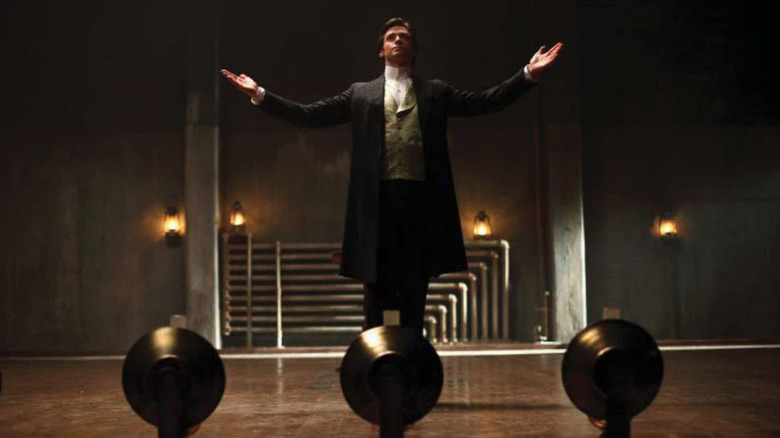
Obviously, we couldn't name-check Christopher Nolan in two separate sections without paying tribute to one of the most transcendent sci-fi filmmakers out there. It's honestly quite strange how popular his genre films are, despite being infamously alienating. We haven't included "Inception," "Interstellar," or "Tenet" on here, but those films have been devoured by casual filmgoers at large, seemingly regardless of their affection for science fiction.
We're talking to someone less receptive than the average viewer, however. For them, we'd like to recommend "The Prestige," one of Nolan's more modest efforts, financially speaking, which nonetheless stands among the upper echelons of his filmography in terms of critical reception. Christian Bale and Hugh Jackman co-star as dueling 19th-century magicians, whose existential desperation to out-magic one another takes them to the very edges of known science – and their own morality.
We shouldn't say anything beyond that. More than any other Nolan film, "The Prestige" is, fittingly, written around reveals, effectively functioning as the filmmaker's unique take on the mystery genre. If a fast-paced, star-studded period thriller about malevolent magicians sounds the least bit interesting, put your phone away and go in blind.
Galaxy Quest
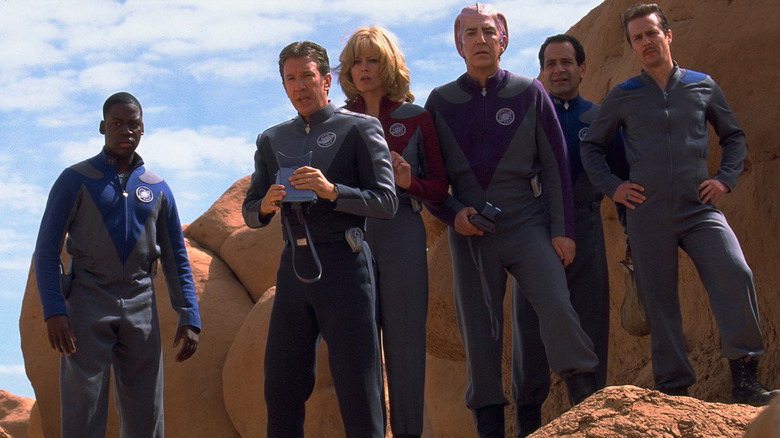
"Galaxy Quest" is a bit of a tricky inclusion on this list. One might consider it diametrically opposed to the kinds of films we're recommending, so steeped in sci-fi culture that you need to be a fan to appreciate its brilliant commentary on fandom. It's certainly true that those who grew up watching "Star Trek" will have an entirely different relationship to this film than someone who doesn't know Worf from a Wookie — but that person will still be able to enjoy it as a one-of-a-kind satire about Hollywood, the entertainment industry, and pop culture myth-making.
The ensemble cast of Tim Allen, Sigourney Weaver, Alan Rickman, Tony Shalhoub, Sam Rockwell, and Daryl Mitchell play the cast of a fictional '80s sci-fi show that is clearly meant to be a parody of "Star Trek." Having spent the subsequent years of their career reduced to catchphrase-shouting mascots reluctantly haunting fan conventions, they are provided an unexpected purpose by an alien race who believes them to be the intergalactic heroes they played on TV.
"Galaxy Quest" benefits from how much geek-culture has merged with pop culture at large. Even someone casually aware of Comic Con or the J.J. Abrams "Star Trek" movies will be able to appreciate many of the film's sight gags and hidden references.
The Martian

Ironically, we move away from the alien subgenre with a film titled "The Martian." That title refers to Mark Watney, a fictional, human astronaut and botanist played by Matt Damon in the 2015 Ridley Scott film. It is based on a novel written by Andy Weir (the author of "Project Hail Mary," who famously got his start publishing chapters through a personal blog) set in a near-future in which humanity has been able to land on Mars.
The film took a painstaking approach to its scientific accuracy — so much so that Scott himself had a hard time wrapping his head around it all. With all due respect to Weir's research, none of it really needs to matter to the average viewer's enjoyment of the film. "The Martian" is ultimately a high-concept riff on a desert-island survival story — think "Cast Away," where the protagonist has to forage through abandoned NASA tech instead of packages. Each step in Watney's interplanetary odyssey is emotionally legible even if the science is flying over your head. The danger, victories, defeats, and hope are all you need to hold on to.
Source Code
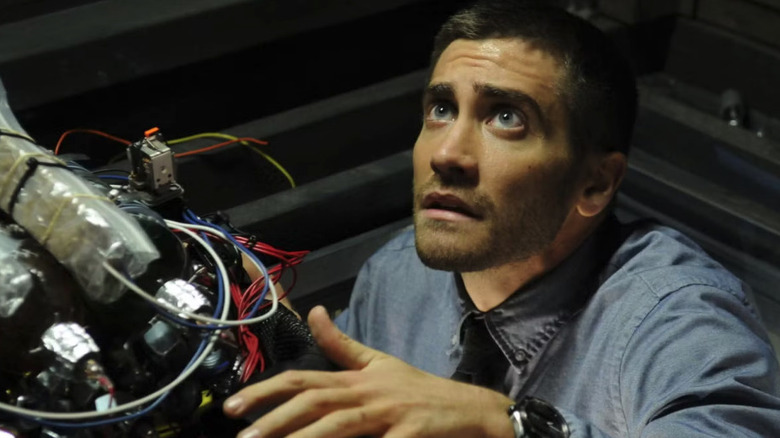
The disappointing "Warcraft" adaptation notwithstanding, Duncan Jones is one of the most underrated genre filmmakers out there. He has talent for twisting familiar premises enough that they not only subvert the viewer's expectation but tilt the movie into entirely unexpected subgenres.
In "Source Code," the protagonist and the audience are thrown into the thick of the plot without any of the exposition you'd normally get in a high-concept sci-fi film like this. All Jake Gyllenhaal's Colter Stevens knows is that he's awoken on a train, sitting across from a woman (Michelle Monaghan) who is convinced he's someone else. Shortly thereafter, the train explodes — and Stevens wakes up again.
The most you'd want to know about "Source Code" going in is that it essentially functions as a time-loop action thriller, where Stevens uses each subsequent loop to solve where he is and why. It never gets bogged down in the details because Stevens and the viewer are intentionally denied them, making any sci-fi revelations an engaging part of the unraveling mystery as opposed to genre-based window dressings.
Moon
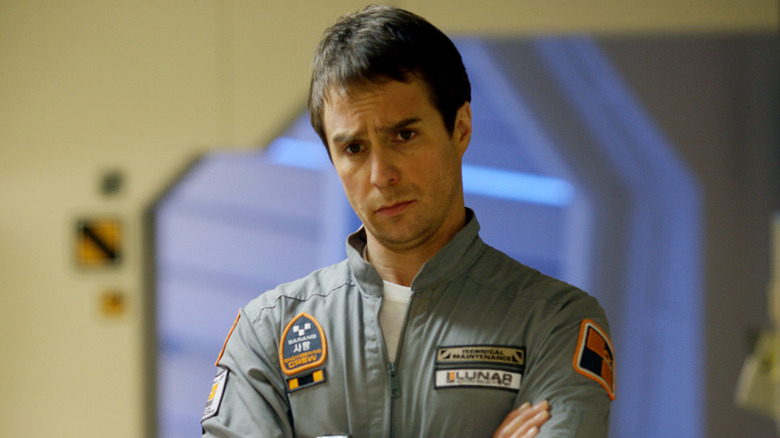
Before Duncan Jones entered the "Source Code," the filmmaker made his directorial debut with the 2009 feature "Moon." While many sci-fi films can be overblown to the point of emotional obstruction (like, say, Bong Joon Ho's "Mickey 17"), "Moon" is as quiet and personal as a sci-fi film can be without betraying the genre entirely.
Sam Rockwell stars in what is essentially a one-man drama about existential purpose, personhood, and emotional isolation. He plays an astronaut stationed on the Moon by a private mining company, nearing the end of a three-year rotation during which he has only had a crude android assistant for company. Of course, just when it seems like he'll be able to coast the remainder of his time and return home to his wife and children with his sanity mostly intact, things go sideways — and he winds up finding a stranded, dying astronaut that looks just like him.
"Moon" is widely considered Jones' best film. His tight story and directing remix the foundational ideas of "Blade Runner" in a way that feels more immediate and accessible.
Children of Men
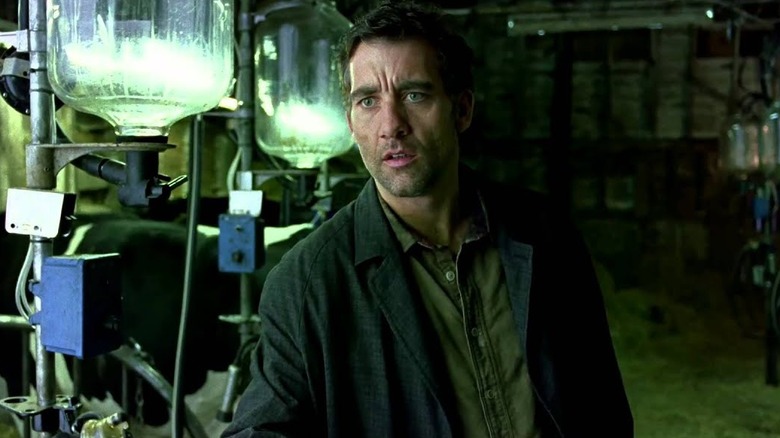
No one grounds science fiction as effectively as Alfonso Cuarón. Almost a decade after he stripped the Wizarding World of the childlike wonder of Chris Columbus, instead imbuing it with the raw teen angst and danger that made "Harry Potter and the Prisoner of Azkaban" a turning point in the franchise, he won an Academy Award for directing "Gravity." A non-sci-fi-fan-friendly film in its own right, it became one of the most talked-about films of the 2010s. However, for this list, we went with what is arguably Cuarón's quieter, yet most enduring directorial achievement — "Children of Men."
It isn't only here because it's aesthetically one of the lowest-tech sci-fi movies out there (behind the camera, however, they literally were inventing new technology to capture Cuarón's ambitious shots). The 2006 dystopian thriller is a masterpiece that uniquely confronts the hidden consequences of one of the most dangerous problems facing humanity today — an existential lack of imagination.
In the year 2027, a disillusioned former activist is shaken from apathy in the face of authoritarianism when he is recruited to escort the only pregnant woman in the world. If you can accept that premise, "Children of Men" will take you on a journey of hardship and hope that feels more urgent than most contemporary dramas.
Sorry to Bother You
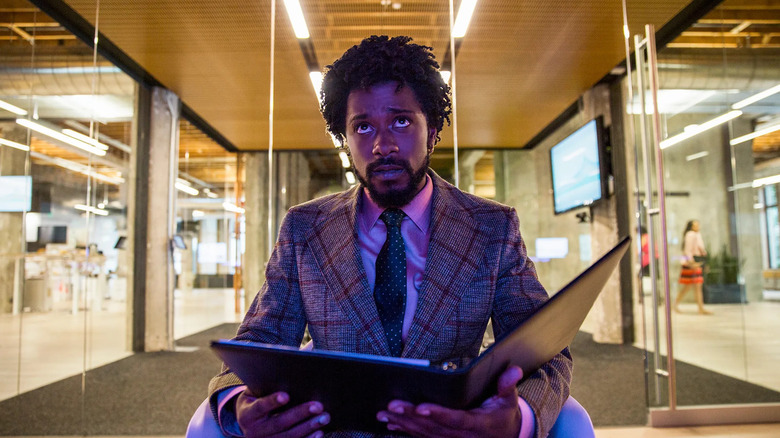
Of all the movies we've included on this list, this is the one we're most apprehensive about. To put it bluntly, "Sorry to Bother You" is a film so deliberately wild, unpredictable, and antagonistic, that it has the real potential to piss you off by the end, regardless of whether or not you agree with its message. At the same time, it's for that very same reason – plus the singular, confident creative execution of Boots Riley — that it might become one of your favorite movies of all time, regardless of whether or not you like sci-fi.
For the majority of the film, "Sorry to Bother You" operates in the register of an absurd satire set in an exaggerated version of a very near future. Riley explores themes of race, labor, and activism primarily through the eyes of Cassius Green (Lakeith Stanfield), a Black man struggling to pay bills and find purpose in Oakland, who decides to take a survival gig as a telemarketer. When he discovers he has a talent for using a "white voice" (David Cross) to excel past his sales targets, he finds new doors opened within a bizarre corporate world ready to give him everything he wants and more.
Ex Machina
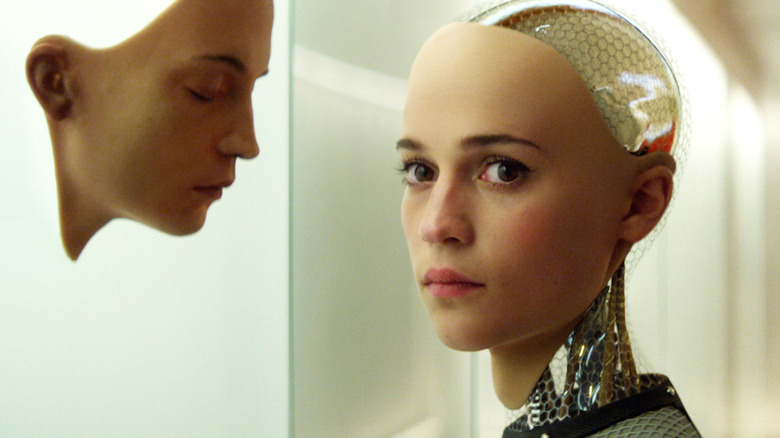
Though "Dune" made Denis Villeneuve the most financially and culturally successful master of modern sci-fi, Alex Garland is arguably the most prolific and consistently excellent voice in the genre right now. After a decade of working as a screenwriter and reportedly ghost-directing 2012's "Dredd," the "28 Days Later" scribe made his directorial debut with "Ex Machina."
The 2014 film traffics in more traditional sci-fi aesthetics (it even won an Academy Award for its depiction of advanced technology), but you shouldn't let that stop you from experiencing one of the greatest and most human psychological thrillers of the 2010s. It follows two men (Oscar Isaac and Domhnall Gleeson) as they interface with a humanoid A.I. (Alicia Vikander) advancing faster than they can predict. "Ex Machina" works because A.I. isn't what drives the anxiety — rather, human hubris and megalomaniacal ambition do. In an age when CEOs seem ambivalent about the technological collapse of humanity, "Ex Machina" cements itself as one of the defining A.I. movies of the 21st century.
Snowpiercer

Having mentioned Bong Joon Ho earlier, we have to make a case for his major contribution to modern sci-fi. Yes, "Mickey 17" and the lesser-known "Okja" are almost certainly the kind of movies sci-fi-haters should avoid unless they feel they can sustain themselves off their absurd black comedy (or, in the former's case, a wealth of Robert Pattinsons). On the other hand, Bong's pre-"Parasite" flick "Snowpiercer" is far more consistent, rewarding, and coherent, and is an especially strong choice for those of you who enjoy mainstream action films.
Starring a Marvel-era Chris Evans, "Snowpiercer" is a dystopian action thriller that takes place in a distant future, in which all that remains of humanity (in the wake of an ecological disaster) survives on a massive, constantly running locomotive. The story begins at the end — more specifically, the caboose, where the poorest "passengers" are stuffed into claustrophobic cars and fed roaches. Evans' antihero leads a literal class-war toward the front engine, resulting in violence, death, and the discovery of the train's true nature.
Colossal
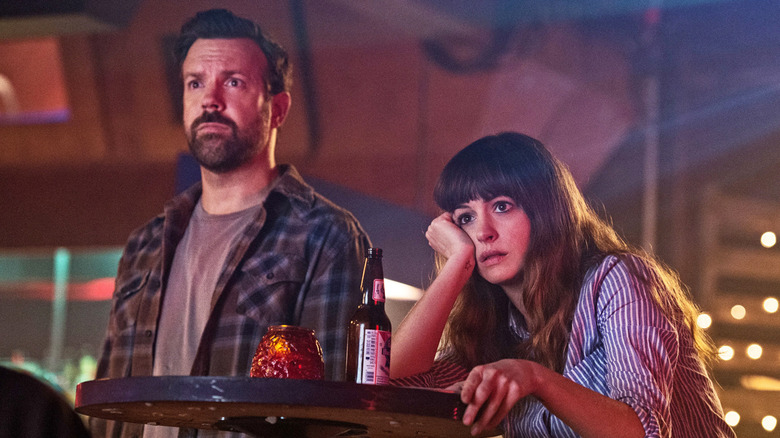
Before we risk getting totally weird with our final pick, we'll offer one more film that uses sci-fi tropes so sparingly it only technically counts within the genre. In fact, if there's one genre it directly subverts, it's romantic comedy.
In "Colossal" (written and directed by Nacho Vigalondo), Anne Hathaway stars as Gloria, a writer struggling with an addiction disorder who is forced to move back to her hometown after she is kicked out by her ex-boyfriend (Dan Stevens). Though being home forces her to confront her past, it also offers some unexpected rewards — namely, her reconnection with her childhood friend, Oscar (Jason Sudeikis), and the revelation that she can control a skyscraper-sized monster in Seoul, South Korea, by walking into a public park.
As strange as that premise is, "Colossal" is the most grounded film on this list. Save for a few moments of Kaiju action, it's a low-budget human dramedy about a woman healing from emotional trauma in a small town.
Under the Skin

In its opening scene, "Under the Skin" will feel like a sci-fi movie to most viewers. From that moment onward, however, it aggressively evolves into something else entirely — far more unsettling, uncomfortable, and unnerving to witness than the extraterrestrial horrors of "Alien."
Before Jonathan Glazer would win an Academy Award for his historical drama film "The Zone of Interest" (which showcases his ability to create disturbing imagery and upsetting atmospheres without conventional genre tropes), he took a similarly subversive, humanistic approach to directing "Under the Skin." The 2014 film follows Scarlett Johansson as a mysterious extranormal being who encounters various men while attempting to understand her environment.
The film is best enjoyed with as little pretext as possible, as a key part of the psychological experience lies in the viewer attempting to decipher Johansson's entrancing character as she attempts to do the same to the humans on screen. While it leans into both the sci-fi and horror genres, it deliberately eschews their most tired story beats to keep the audience uncertain until the very end.