

10 Similarities Between Stranger Things And Stephen King Books
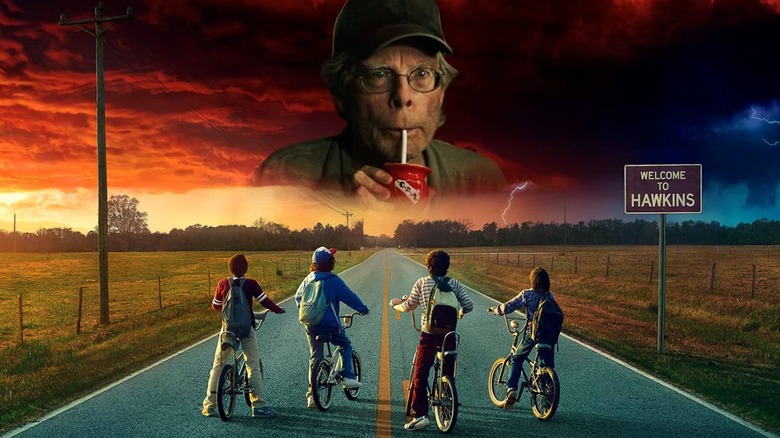
David Harbour may have thought Netflix would cancel "Stranger Things" after one season, but anyone who saw it knew it was destined for greatness. After premiering in the summer of 2016, the fantasy TV series about a mother searching for her lost son and a group of youngsters befriending a girl with telekinetic powers became ubiquitous in pop culture. A big reason for that success was how the show wore its influences on its sleeve. It was definitely an original series not based on any pre-existing intellectual property, but it felt like something people had seen before. Notably, it felt like 1980s adventure movies, like "E.T. the Extra-Terrestrial" and "The Goonies." The show also owes a massive debt to the collective works of Stephen King.
King has left an indelible mark on horror with such classics as "It," "Carrie," "The Shining," and "Salem's Lot," to name a few. The man's bibliography is prolific, so you don't have to search far to find other books, movies, and TV shows paying homage to him. But while other works may have a quick King reference and move on, "Stranger Things" really steals borrows a lot from the horror maestro.
You can find King's fingerprints in every season of "Stranger Things." Some details can be hand-waved away as facets of the supernatural horror genre, but others feel like the Duffer Brothers owe King some royalty checks (not that he needs the extra money).
Here are 10 similarities between "Stranger Things" and Stephen King books.
Stranger Things uses a classic Stephen King font
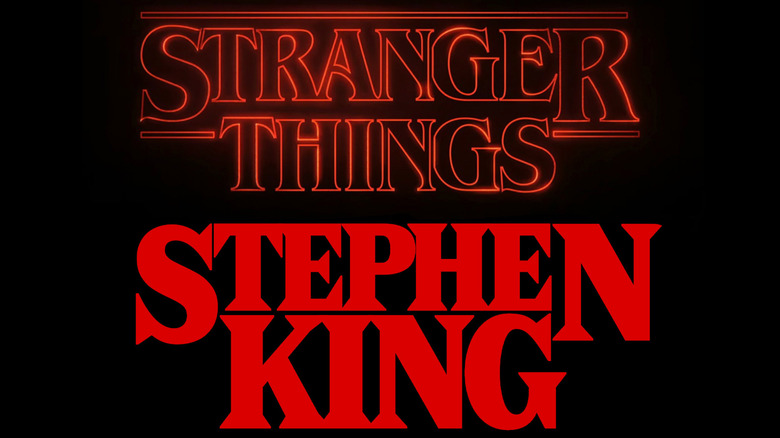
From the moment "Stranger Things" first graced viewers' screens, it was clear this was going to be a nostalgic ride. There's something inherently '80s about the "Stranger Things" logo, and that's because it's extremely reminiscent of classic Stephen King book fonts.
The font in question is a slightly modified version of ITC Benguiat. However, instead of the letters being completely filled in, they're empty, and there are lines on the top of both words to give it more of a neon aesthetic. ITC Benguiat was a popular font choice for many of King's novels, especially throughout the '80s when "Stranger Things" is set. Older publications of "Needful Things," "Night Shift," and "Pet Sematary" are just some of the titles that sport this retro font.
Of course, King doesn't have a monopoly on ITC Benguiat, and you might remember seeing this style on "Choose Your Own Adventure" books from the time period, too. You can also find it in the video game "Nier: Automata" as well as several "Star Trek" movies, including "Star Trek Generations." ITC Benguiat has a really nerdy pedigree that's only been bolstered further by "Stranger Things." It's possible the Duffer Brothers wanted to pay tribute to "Choose Your Own Adventure" stories, but Stephen King is likely more of the inspiration here.
Evil in a small town
It's no wonder that small, unassuming towns tend to make great horror settings. Folks have a certain idea that things in these areas are different — people treat one another with respect, and everyone knows your name. The contrast between small town sensibilities and untold horrors has been utilized to great effect in some of the best Stephen King books.
King likes to set many of his tales in small Maine towns, like Derry in "It" or Jerusalem's Lot in "Salem's Lot." Everything may seem fine at first, but then a supernatural alien with shape-shifting powers or vampires emerge to wreak havoc. Even when King gets out of Maine, like "Children of the Corn" being set in Nebraska, he's still saying within a rural area. The setting only enhances the horror because in small towns, you can go long stretches without another soul being around. Bodies can easily be hid in nearby woods, as opposed to large cities where it feels like you're always being observed.
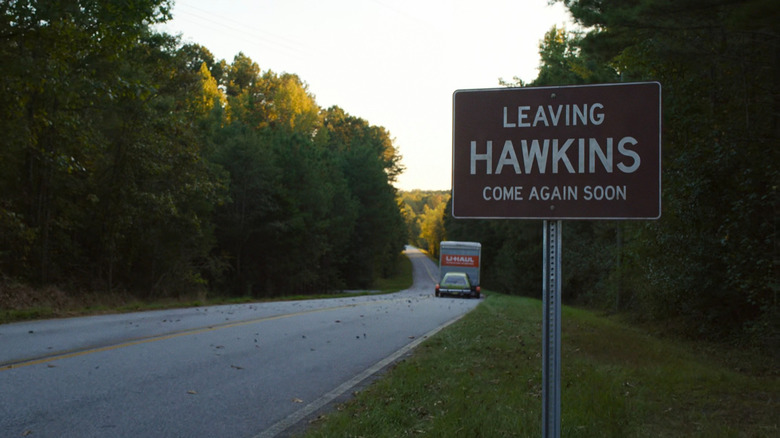
The Duffer Brothers at least got out of New England and set "Stranger Things" within the small fictional town of Hawkins, Indiana. Of course, Hawkins sometimes feels larger than it actually is, thanks to amenities like the Starcourt Mall. You'd assume a small town wouldn't have much of a need for a huge enclosed mall, but it makes for a great set piece to fight the Mind Flayer at the end of season 3.
Our heroes are outcasts
Making the hero the underdog is a trope that pretty much goes back to the birth of storytelling. These tales wouldn't be as exciting if the hero was awesome at everything and could kick anyone's butt. Just look at something like David versus Goliath to see how we've always been rooting for people at a disadvantage. But that doesn't make it any less true that Stephen King has a real knack for focusing on people, particularly kids and teenagers, who are often cast aside by society.
"It" literally has a group of protagonists called the Losers Club to take on Pennywise. The titular Carrie White from "Carrie" is an ostracized teenager who has never been adapted properly into film because they never go the extra step to portray her as overweight. And King's short story "The Body," which was adapted into "Stand By Me," is about a group of friends who consider themselves outcasts and find solace in the journey they take together to find a dead body.
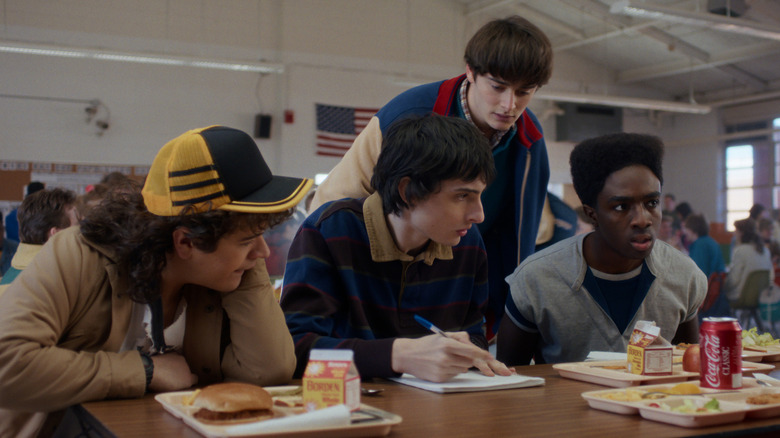
The truth of the matter is that many of us, including certain entertainment news website writers, can relate to being bullied and feeling like they don't belong in normal society. That's the case with "Stranger Things," as the show starts with four best friends — Mike (Finn Wolfhard), Dustin (Gaten Matarazzo), Lucas (Caleb McLaughlin), and Will (Noah Schnapp). They're geeks, and they play Dungeons & Dragons. And then there's Eleven (Millie Bobby Brown), who's also on the fringes of society but as someone who escaped government experimentation. Regardless of what clique you were part of in high school, everyone can relate to being on the outside looking in at some point in their lives.
There's a girl with powerful abilities
Small towns and losers as the heroes aren't exactly story tropes exclusive to Stephen King. He's obviously been influenced by horror authors that came before him, so "Stranger Things" could be seen as a natural continuation. But now we're getting into things King really appears to have popularized that are a bit more suspicious.
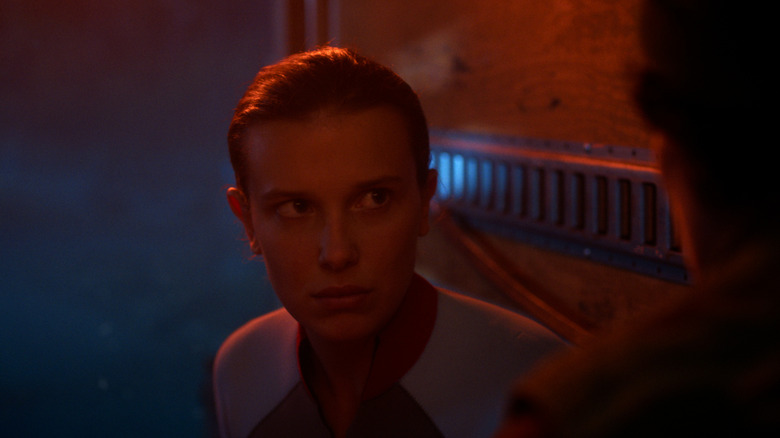
While the nerds of "Stranger Things" help ground us to the story, there's the more supernatural element with Eleven getting introduced. The tragic "Stranger Things" character has powerful psychic abilities, including telekinesis, that allow her ot manipulate objects using her mind. There's also telepathy where she can communicate with others even when they're both in different locations. Throughout the series, we learn that Eleven's powers stem from Henry Creel, aka Vecna (Jamie Campbell Bower), whose blood was transfused into her mother when she was pregnant.
King actually has several books about a young girl who discovers latent superpowers. Charlie McGee from "Firestarter" possesses pyrokinesis, allowing her to start fires with her mind. Like Eleven, she's also on the run from the government that wants to harness her powers for its own means. Famously, King also wrote "Carrie," which is about a young girl who discovers her telekinetic powers with reaching puberty and kills many of her classmates after getting humiliated at prom. Carrie's almost a cautionary tale of what could've happened to Eleven if she didn't make friends and find love.
The bullies are psychotic
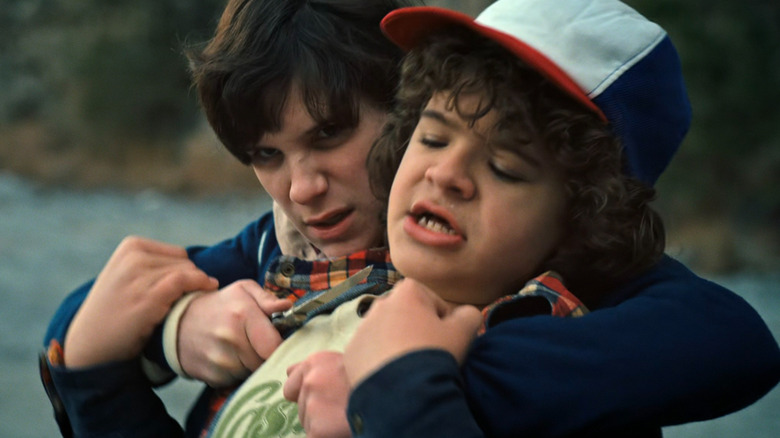
The first season of "Stranger Things" introduces Troy (Peyton Wich) and James (Cade Jones), who bully the main boys. It may start as simple schoolyard taunts, but when the two friend groups collide by the quarry, Troy holds a knife up to Dustin's throat. It's a heavy escalation, as he goes from a jerk to an attempted murderer in the span of a few episodes. He even tells Mike to jump off the quarry as payback for Eleven making him urinate in his pants earlier.
There's no doubt that many bullies take their taunts and abuse too far, and we definitely see the extreme side of bullying on "Stranger Things," just like how it's often portrayed in Stephen King books. The Losers Club face a lot of abuse from bullies, particularly Henry Bowers, in "It." To be fair, part of that could be explained by Pennywise's influence making the residents of Derry more violent than they would be otherwise.
However, there are no trans-dimensional entities in King's novella "The Body." The main boys in that story encounter some bullies upon finding a body, but Chris is able to keep them away for the time being with a gun. However, they all receive severe beatings later, with Gordie getting his nose and fingers broken. School bullies in Stephen King stories aren't just about shoving nerds into lockers. They're out for blood, and "Stranger Things" carries on that tradition.
There's a thin veil between our world and others
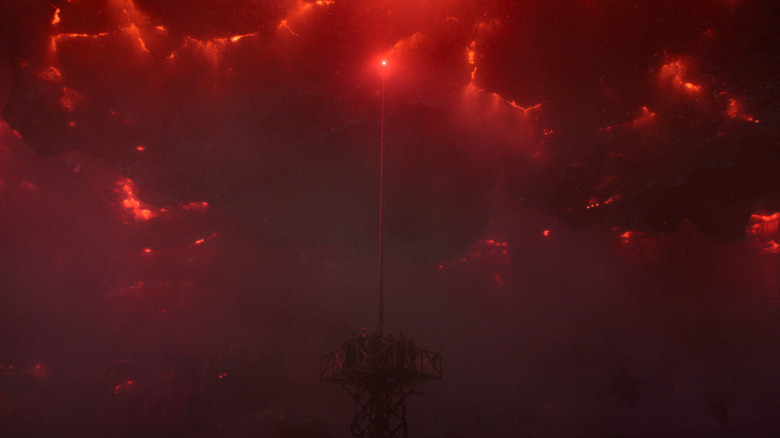
Superpowers aren't the only thing that makes "Stranger Things" supernatural. From the beginning, there's been the concept of the Upside Down, which in season 5 was revealed to be a wormhole connecting Hawkins with Dimension X. This other dimension is where Vecna was initially banished, and it's actually the home of the Demogorgons. The multiverse is definitely having a moment in the zeitgeist right now, so the concept of having alternate dimensions isn't exactly a foreign concept to many casual viewers. However, the way "Stranger Things" uses the Upside Down and Dimension X does seem to have roots in Stephen King.
In King's novella, "The Mist," there's an implication that the titular mist is another dimension entering our world as a result of government experimentation. This theory is also brought up in the 2007 film version. The way alternate dimensions are presented in "The Mist" is probably most similar to "Stranger Things," which sees Eleven creating the Upside Down upon making contact with a Demogorgon during her experiments. But this isn't the only place King makes use of other worlds.
For example, "Lisey's Story" is about an author who can travel to another world, Boo'ya Moon, for inspiration for his stories. There are many horrors and wonders to be found in the other worlds, so it's interesting to see how King and the Duffers utilize this sci-fi trope differently in their respective works.
Monsters feed off fear
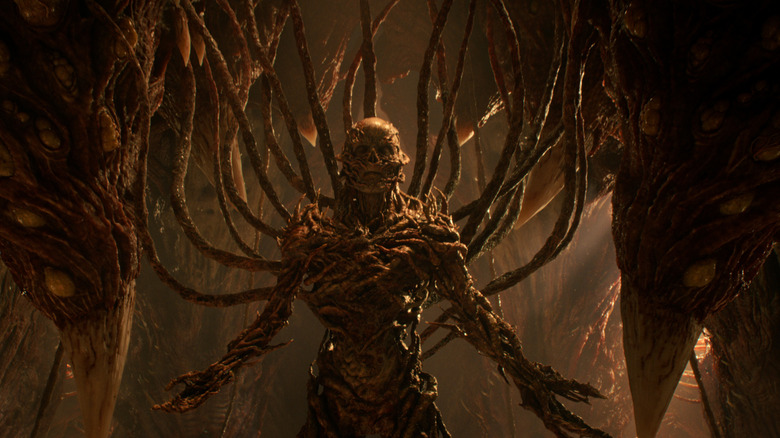
When it comes to crafting a compelling antagonist, one has to consider what their ultimate goal is. If it's a mindless monster, it can just be interested in eating, which is a simple enough motivation for anyone to understand. But other villains are after something a bit more psychological, with Stephen King and "Stranger Things" both exploring the idea of an entity who feeds off fear.
The first villain who likely comes to mind for most after hearing that is Pennywise from "It." Pennywise isn't just a clown but instead a cosmic force that preys on people's fears. It's what sustains him, but, of course, he eventually does go in for a more literal snack. Randall Flagg from "The Stand" and other stories utilizes fear in a slightly different way. He can instill and manipulate fear found in others.
Season 4 shows Vecna exploiting his victims' fears in a similar manner to Pennywise. He taps into their traumas, eventually killing them in the process, to create rifts between the Upside Down and Hawkins. Fear is a weapon Pennywise, Randall Flagg, and Vecna use against other as symbolism to show how everyone is facing their own demons, but those deep dark secrets don't have to define you.
Local cops good, military bad
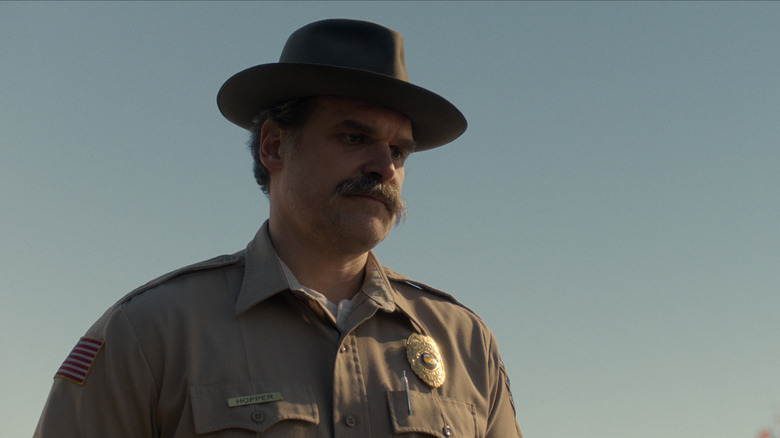
"Stranger Things" depicts various levels of law enforcement. On the one hand, you have the American military, which is behind the experiments that gave Eleven and Henry Creel their powers. This is what kickstarted the entire mess surrounding Hawkins, and the final season double-downed on that depiction, as we're introduced to Dr. Kay (Linda Hamilton) who wants to start the program all over again by capturing Eleven and using her blood to make a whole new batch of kids with special powers. But on the other hand, we have Hopper (David Harbour), who begins and ends the series as the sheriff of Hawkins. He's presented in a far more sympathetic light, as a man trying to do the best he can with the resources at his disposal, especially when it comes to locating the missing Will in the first season.
There are naturally exceptions and nuances, but this tends to be how Stephen King views local cops compared to the army. Cops, particularly those in small towns, are usually pretty noble. For instance, George Bannerman is the sheriff of Castle Rock, Maine and appears in several King stories, like "The Dead Zone" and "Cujo." He's portrayed as a good man hunting down the Castle Rock Strangler and earns a hero's death in "Cujo."
The same can't be said for the military at large in King's works. The horrors of the Vietnam War inspired "The Long Walk," and the military goes to extreme lengths, including executing many people, to suppress the virus found in "The Stand." A mentioned previously, it's implied the military is behind the terrors found in "The Mist." With so much power at its disposal, both King and the Duffers seem naturally wary of what that power can do in the wrong hands.
Stranger Things regularly references Stephen King directly
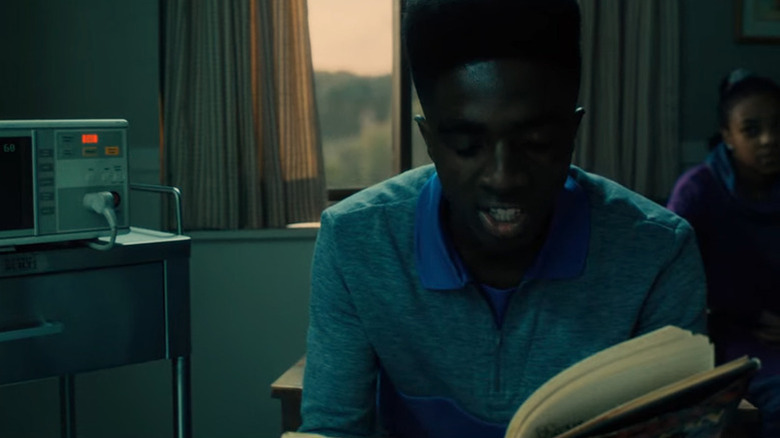
To be honest, you don't even need to dig that deep to see how much the Duffer Brothers have been influenced by Stephen King's works. The prolific author is referenced directly throughout all of "Stranger Things," starting with the first season. When Hopper and Joyce (Winona Ryder) go to speak with Eleven's mother, Terry (Aimee Mullins), they chat with her sister, Becky (Amy Seimetz). She starts describing how Terry thinks her daughter's still out there with psychic abilities, and Becky asks the pair, "You read any Stephen King?" This is probably asked because many of King's works, from "Carrie" to "The Shining," deal with psychic powers.
Various King books are also found. A state trooper reads "Cujo" during season 1, and Lucas reads "The Talisman" in season 4, while Max (Sadie Sink) is in a coma. In regards to the latter, "The Talisman" deals with parallel worlds, so the book's inclusion foreshadows how Max's psyche has actually been trapped in another plane of existence, as revealed in season 5. There's a ton of imagery that should make viewers think of King, such as when the boys and Eleven walk down a railroad track in a first season scene incredibly reminiscent of "Stand By Me."
Fortunately, King doesn't seem to mind all of the homages. After the first season dropped, King took to X (then Twitter) to praise the series: "STRANGER THINGS is pure fun. A+. Don't miss it. Winona Ryder shines."
The ending is terrible
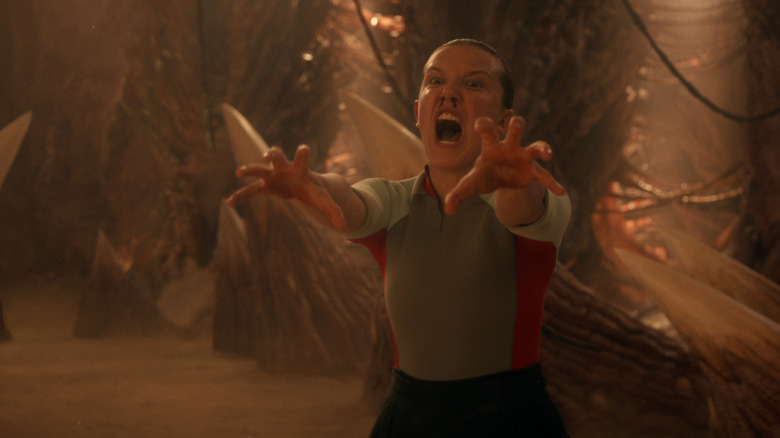
Apologies if you enjoyed the final season of "Stranger Things," but the general consensus among fans online is that it was a disappointing way to close out such an epic series. There's the unexplained absence of Demogorgons in Dimension X, as well as the lack of stakes with no main characters other than potentially Eleven dying in the finale. Fans have found much to criticize, leading to the formation of the Conformity Gate conspiracy, which states that the Duffer Brothers intentionally made a lackluster final episode on purpose. It says that this "finale" is really just Vecna's vision where everyone seemingly gets a happy ending and proposes that a secret ninth episode will depict what really occurs. Suffice it to say, Netflix wouldn't release a finale in theaters and spend the dough on two Prince songs just to fake audiences out.
But if you were disappointed by how "Stranger Things" ended, there's another way of looking at it. Perhaps whiffing the finale is just the show paying the ultimate tribute to Stephen King, who's known for having plenty of bad endings himself. Some of the worst King endings include "The Stand," where God literally fixes everything, and "Cell" having a truly terrible and anticlimactic cliffhanger. The less said about "It," the better.
Of course, the good thing about being an author is that if you ruin one ending, you can at least get it right the next time. Plenty of King books end in a satisfactory way, and who knows? With "Stranger Things" spinoffs inevitably coming down the pipeline, maybe the franchise can get it right next time or at least recontextualize some of the things in the mainline series to allow everything to make more sense.