

15 Best TV Shows Like Pluribus

It's rare that a new show comes around and makes its mark as must-watch event TV. However, leave it to Vince Gilligan to create what will undoubtedly become one of the defining shows of the 2020s. "Pluribus," on Apple TV+, is his first foray outside the "Breaking Bad" cinematic universe in decades, following a cynical romantasy writer, Carol Sturka (Rhea Seehorn), who is left with no choice but to save the world after a virus infects the entirety of the population on Earth, turning them all into one hive mind with the goal of forcing Carol and other unaffected humans into their peaceful mind meld.
While "Pluribus" is nothing like "Breaking Bad," it does take heavy inspiration from plenty of shows that Vince Gilligan and co-writers have worked on, and its concept surely will satisfy fans of modern TV science fiction. These 15 shows are ones you might want to go back and watch if you find yourself liking "Pluribus," or if you have yet to watch "Pluribus," having any familiarity with one of these shows gives you an idea of what to expect as you follow the story of Seehorn's new television heroine.
The Twilight Zone

One of the more obvious reference points for "Pluribus" is the original CBS series "The Twilight Zone," the iconic anthology series created by Rod Serling that aired from 1959 to 1964. It's a show whose vibe has rarely been captured by successors, including Jordan Peele's short-lived revival in 2019. However, "Pluribus" may be the closest thing to an extended version of some of the most mind-bending "Twilight Zone" episodes, exploring isolated stories that take place in a "middle ground" between "science and superstition," often as an allegory for deeper themes about society and the human condition.
When you dig deep past the essential "Twilight Zone" episodes everyone should watch, there's a lot that resemble the logline of "Pluribus," including season 1's "A Nice Place to Visit," in which a man enjoys the pleasures of heaven before realizing he's in hell, or "To Serve Man" in season 3, in which an alien race invades Earth with the secretive agenda to cook and eat humankind.
The X-Files

Another obvious inspiration for "Pluribus" is "The X-Files," the iconic and long-running Fox crime procedural for which Vince Gilligan wrote 30 episodes between seasons 2 and 9. "The X-Files," for the most part, follows a pair of FBI agents, paranoid Fox Mulder (David Duchovny) and skeptical Dana Scully (Gillian Anderson), who investigate paranormal occurrences involving cryptids, alien lifeforms, and other supernatural phenomena. Compared to "Pluribus," it has a lot more of the "case-of-the-week" structure largely absent from episodic television, though some episodes feel like they may have been inklings of ideas Gilligan's exploring on "Pluribus."
Aside from a few of Gilligan's own episodes for "The X-Files," like "Small Potatoes" or "Roadrunners," there are lots of episodes across all 11 seasons of the series that resemble the plot of "Pluribus." Of the essential "X-Files" episodes everyone should watch at least once, the ones that feel closest to "Pluribus" center on Anderson's Scully, whose cynicism is quite reminiscent of Carol Sturka, as is her distrust of organized religions and struggle with post-traumatic stress disorder.
The Leftovers
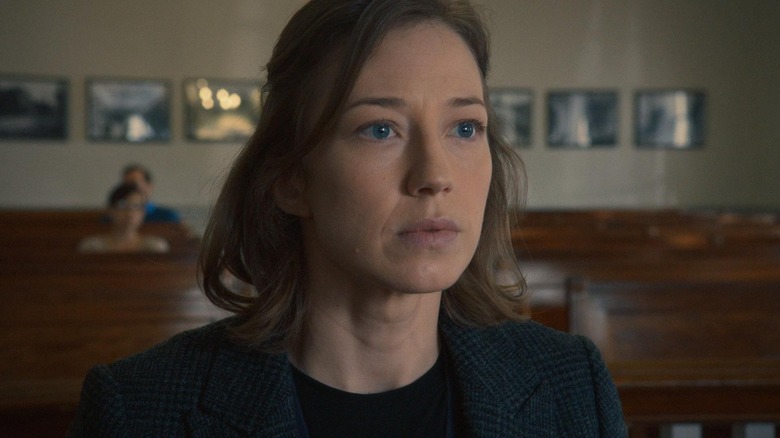
"Pluribus" isn't the type of post-apocalyptic show like "The Last of Us" or "The Walking Dead," but shares a lot in common with the more psychological examinations of a changed Earth, like HBO's "The Leftovers." Airing from 2014 to 2017, "The Leftovers" explores a global change that occurs after only 2% of the population disappears, which is significantly less than those turned into the hive mind in "Pluribus." Nevertheless, this science fiction reality becomes subject to religious zealots, looking to make sense of what becomes known as The Departure.
Among the characters followed include Justin Theroux as a police chief struggling to adjust to the new normal and Margaret Qualley as his rebellious teenage daughter, but Carrie Coon's Nora's story has the most obvious allusions to Rhea Seehorn's Carol Sturka, given that the Departure forces her to deal with the grief of losing her entire family. Whereas the first season was subject to acclaim, the two seasons that came after it are hailed as some of the best TV that HBO has ever had to offer.
Better Call Saul

An obvious entry on this list is the last television show Vince Gilligan worked on, and also the one that introduced him to his future "Pluribus" star Rhea Seehorn. "Better Call Saul" is a prequel/sequel to "Breaking Bad," following the character of Saul Goodman, back in his early days as a lawyer practicing under his real name, Jimmy McGill. Throughout six seasons, Jimmy's story plays like a morality tale, as he sheds any ambition to do good in favor of taking shortcuts and enacting petty revenge on the people who have crossed him.
Though Bob Odenkirk is very clearly the star, "Pluribus" fans will see as the show goes on that Seehorn's Kim Wexler, a more good-natured lawyer who gets caught up in Jimmy's schemes, is one of the best-written women in the history of television. The fact that Seehorn never won an Emmy for the entire run of "Better Call Saul" is all the proof you need that, with "Pluribus," Gilligan has his own petty revenge to enact against the Television Academy, and he won't stop until that actress is holding that statuette of a winged woman.
The Last Man on Earth

The way "Pluribus" depicts an apocalypse can, at times, border on dark comedy, so we definitely wanted to include some shows on this list that trend in that direction. Enter "The Last Man on Earth," an underrated sitcom starring Will Forte as Phil Miller, a man enjoying life as the last remaining person after a virus outbreak, only to discover more, including Kristen Schaal's Carol (hey, that name sounds familiar!), who pressures Phil into marrying her to repopulate the Earth. However, Phil and Carol prove to be a pretty poor match, especially as new survivors are discovered.
While the show was sadly cancelled by Fox following the end of the fourth season, "The Last Man on Earth" had strong reviews throughout its run, and its cast keeps evolving to include some of the funniest people in the world, including many of Forte's "Saturday Night Live" compatriots. If you enjoy any of the "Pluribus" episodes in which Carol must overcome her personal flaws while interacting with the other survivors, "The Last Man on Earth" is that in sitcom form.
Sense8

The second that it was conveyed to Carol Sturka in the pilot of "Pluribus" that there were only a specific number of other survivors of the Joining, this peculiar sci-fi series may have reminded fans of another sci-fi series: Netflix's "Sense8." Created and written by the Wachowski Sisters, who revolutionized the action genre with "The Matrix" franchise, "Sense8" is like a reverse of "Pluribus," in which eight strangers from across the globe discover that they're all mentally linked, allowing them to share in each other's abilities, not dissimilarly to how the hive mind in "Pluribus" operates.
Though Netflix sadly cancelled "Sense8" after its second season, the 24 episodes that have been released showcase a much different show than "Pluribus," but one that has just as much to say about human beings' capacity for empathy as well as how "special" individuals can often become enemies of the state just by being themselves. Of its central cast, the one closest in personality to Rhea Seehorn's Carol is probably Tuppence Middleton's Riley, a DJ from Iceland who battles drug addiction, a theme hinted at being part of Carol Sturka's past in "Pluribus."
Fleabag

"Fleabag" doesn't have any science fiction to compare it to "Pluribus" (unless you count breaking the fourth wall as science fiction), but it does have a hot mess of a protagonist who has redefined women in television for the foreseeable future. This 2016 BBC series began as a one-woman show from creator, writer, and star Phoebe Waller-Bridge, examining the life of a young woman dealing with the grief of her best friend dying, whilst simultaneously trying to keep her guinea pig-themed cafe from closing down. In the second season, released in 2019, she develops a romantic infatuation with an unnamed priest, played by Andrew Scott.
While there are plenty of shows like "Fleabag" you definitely need to see, "Pluribus" should rise to the top of the list just because fans of "Fleabag" will appreciate a similar, albeit much different, woman struggling with grief and lashing out at the world. The only real difference is that, in "Pluribus," the world that Carol Sturka is lashing out at is quite literally the entire world.
Maniac

Netflix's "Maniac," to some, might've been a forgettable sci-fi miniseries from the late 2010s, but it also feels like the type of sci-fi series we haven't really seen much of since, before "Pluribus." The series reunites "Superbad" co-stars Emma Stone and Jonah Hill, playing two pharmaceutical test subjects who are exposed to hallucinatory experiments that alter their perception of reality. It may sound a bit more high concept than "Pluribus," but it shares a similarity in Emma Stone, who even critics who were mixed on the Netflix series were universally crazy about.
"Maniac" also may satisfy fans of "Pluribus" so far, not just in its mind-bending science fiction, but also in its cinematography, which is often purposefully disorienting and visually stunning at the same time. Odds are, "Pluribus" probably won't go to the places that "Maniac" does, but it's a more recent example of television sci-fi that cares more about the psychology of its character than getting too lost in the woods on lore, explaining its own concepts, or trying to capture the general zeitgeist's attention.
Forever

"Forever" may seem ordinary on the outside, but it holds a lot of mind-bending twists within. The Amazon Prime dramedy series stars Maya Rudolph and Fred Armisen as June and Oscar, a married couple getting bored with their usual lives, and decide to shake things up with an unconventional ski trip. However, after some tension between the couple, Armisen's Oscar (spoiler alert!) suddenly dies, leaving June to figure out how to move through the grief without him, only for her to subsequently die and end up in the afterlife, where she unexpectedly reunites with Oscar.
It's an interesting, albeit somewhat predictable, single season of TV exploring a relationship that, whilst perfectly healthy, suffers from just going on for far too long. Rudolph is especially a revelation in the series, and her existential crisis will remind "Pluribus" fans of Rhea Seehorn's performance at times. Sadly, this Prime Video series was cancelled too soon, so we won't ever get to see where Oscar and June's relationship went after the season one finale, though hopefully we won't have to worry much about that with "Pluribus."
Miracle Workers

"Miracle Workers," another comedy series, is another strange comparison to draw with "Pluribus," but we stand by it. Based on a series of short stories by writer Simon Rich, the TBS show is an anthology where every season revolves around the same cast playing different characters in a different setting, with the first season following what happens when God (Steve Buscemi) decides to end the world out of boredom, forcing two misfits who work in heaven's prayer-answering department, played by Geraldine Viswanathan and Daniel Radcliffe to team up and prove Earth should be spared.
While it may draw more obvious comparisons to TV shows like "The Good Place," it's also a lot like "Pluribus," given how its characters are, in spite of the often-cynical worlds they live in, have a lot of heart and are ultimately heroic. Sadly, the show was cancelled after four seasons, but those four seasons are more than worthwhile to watch, especially since we have a while to wait for another season of "Pluribus."
WandaVision

"WandaVision" may be just another installment in the Marvel Cinematic Universe to some, but for those who have seen it, it's one of the best representations of grief on TV. Following the events of "Avengers: Endgame," Elizabeth Olsen's Wanda Maximoff utilizes her reality-bending powers to inadvertently create a perfect sitcom life for her and the deceased Vision (Paul Bettany), as military officials uncover the truth that she's actually holding an entire town in New Jersey hostage like toys in a doll house, forcing them to play roles in this love letter to sitcoms of different decades.
As Marvel Studios' first Disney+ series, "WandaVision is a charming and unnerving departure from formula and has a lot to say about grief, just like "Pluribus." Plus, the episode, loosely based on shows like "Modern Family," gives Wanda a storyline not dissimilar to Carol Sturka's, seeing her blowing off parenting her imagined kids, Billy and Tommy, in favor of having a mental breakdown. Whether you're dialed in to the larger MCU narrative or not, "WandaVision" is must-see TV that everyone, especially fans of "Pluribus," can enjoy.
Pantheon

As the only animated series on this list, it may seem like "Pantheon" doesn't have a whole lot of similarities to "Pluribus," besides both of their names being an SAT word that starts with the letter "P." It's a little more science fiction than "Pluribus," too, taking place in a world where humans can upload their consciousness to an artificial intelligence. The main character, Maddie (Katie Chang), is grieving the death of her father (Daniel Dae Kim) when she discovers that he's been uploaded to the technological singularity without his consent, which might remind "Pluribus" fans of what happens to Carol Sturka's partner Helen (Miriam Shor).
While the first season aired on AMC+, Vince Gilligan's original home pre-"Pluribus," the second season was aired by Amazon Prime Video, and it doesn't look like a third is on the horizon anytime soon. It's a sad fate for what's easily one of the best sci-fi TV shows in recent years, despite flying somewhat under the radar for such an intriguing concept.
Severance

At this point, if you haven't been watching "Severance," you're missing out on one of the few event television shows of the current decade, prior to the release of "Pluribus." "Severance" follows the employees of the enigmatic Lumon, a company whose employees undergo an experimental process to sever their consciousnesses between work and home selves. However, with the addition of rebellious new team member Helly R. (Britt Lower), a team consisting of Mark S. (Adam Scott), Dylan G. (Zach Cherry), and Irving B. (John Turturro) begins to uncover what the actual purpose is behind their mysterious work.
With only two seasons, now is the time to catch up on "Severance" before it comes back for season 3, whenever that may be. Like "Pluribus," it's an incredibly mind-bending sci-fi series with elements of horror and thriller genres, albeit with a lot more of a claustrophobic office setting than the sprawling deserts and empty cities of its fellow Apple TV+ drama. More than anything, the story of Mark, Helly, and the others versus Lumon is not dissimilar to the underdog story of Carol versus the hive mind.
Mrs. Davis

"Mrs. Davis" is another show on this list that's more straightforward science fiction, though with some added themes that set it apart from other sci-fi shows like it. A limited series on Peacock, Betty Gilpin stars as Simone, a mythbusting nun who rebels against the world's over-reliance on the all-knowing titular artificial intelligence, believing it to have murdered her father. The portrayal of Mrs. Davis in the show is not dissimilar to the "Pluribus" hive mind, with certain individuals being capable of speaking on behalf of the A.I., but the real story centers on Sister Simone's fight to destroy the omnipotent tech.
Though it's an ambitious, exhausting adventure series with weird humor to spare, "Mrs. Davis" also deserves a lot of credit for its dynamite lead star, just like "Pluribus." Rhea Seehorn and Betty Gilpin are both actresses with long-term work in television who should be showered with awards, but sadly aren't. Hopefully, "Pluribus" is a course correction for Seehorn where "Mrs. Davis" sadly wasn't, but maybe if we campaign hard enough, Peacock will revive it for a second season.
Silo

Our last recommendation for fans of "Pluribus" is, thankfully, another Apple TV+ series, meaning the second the first season of "Pluribus" concludes, you can get started watching "Silo." One of the best TV shows currently on the air, "Silo" takes place in a dystopian future where humanity has retreated into an underground bunker hundreds of stories high. Rebecca Ferguson stars as Juliette, an engineer in the silo's lower levels who begins to investigate the silo's origins, much like Seehorn's Carol Sturka investigates the motivations of the Joining in "Pluribus."
Whereas "Silo" boasts a much more impressive supporting cast than the largely solo adventure that is "Pluribus," its two seasons have already proven it to be one of the most psychologically impressive sci-fi series we've ever seen. Like Seehorn being the stand-out of "Pluribus," "Silo" is more than anything an incredibly playground for an actress as underrated and talented as Rebecca Ferguson, so it's best to watch it now before it returns for a third season, and eventually a final fourth season that's already been ordered by Apple TV+. That is, if you can fit a marathon of "Silo" in between rewatches of "Pluribus."