

A Venom Movie From Batman Begins' Writer Almost Beat Spider-Man To Theaters

David S. Goyer has made his mark on superhero cinema, that much is certain. Although Goyer thought his "Batman Begins" script would never make it out of development hell, the project ultimately kicked off Christopher Nolan's "Dark Knight" trilogy and, thanks in no small part to Goyer's writing on the 2005 film, helped enshrine those movies in superhero film history. But years before he tackled the Caped Crusader, Goyer nearly brought one of Marvel's most beloved anti-heroes to the big screen.
During the late 1990s, New Line Cinema, oddly enough, had the rights to make a "Venom" movie based on the beloved villain from the pages of the "Spider-Man" comic books. In 1997, Goyer submitted a draft of a screenplay for a movie centered on the character, one that New Line ultimately passed on. But if this film had moved forward, it would have changed superhero movie history. After all, Sam Raimi's "Spider-Man" — which helped save superhero movies from being a mere fad — didn't reach theaters until 2002.
Eventually, Sony Pictures got around to making a trilogy of "Venom" movies starring Tom Hardy as Eddie Brock/Venom beginning in 2018, culminating with "Venom: The Last Dance" in 2024. Though not critically beloved (indeed, all three "Venom" movies are "Rotten" on Rotten Tomatoes), they were very successful commercially.
Yes, amazingly enough, and weirdly enough, there is an alternate reality not far removed from our own that would have seen a "Venom" movie arrive years before "Spider-Man." That opens up a host of questions, quite a few of which remain unanswered years later. Still, what we do know is fascinating and strange. We're going to take a closer look at what could have been and what happened instead. Let's get into it.
Venom could have beat Spider-Man and X-Men to theaters
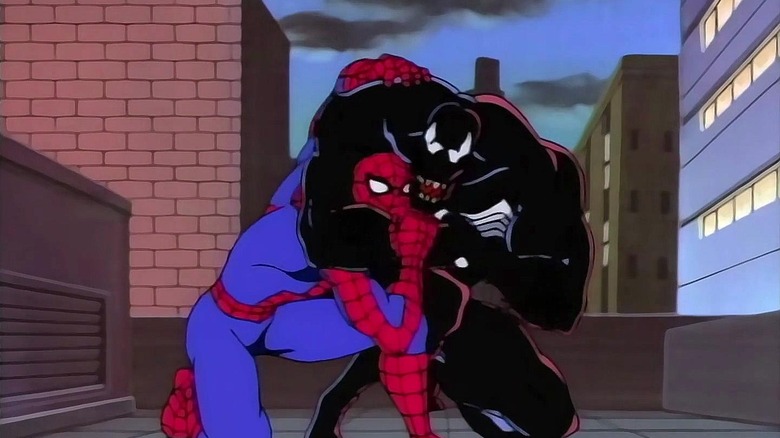
Historical context is incredibly important here. We currently live in a world where the Marvel Cinematic Universe is a cultural behemoth. "Avengers: Endgame" was once the highest-grossing movie of all time. But in the 1990s, Marvel wasn't at the peak of the pop cultural conversation. The fact of the matter is that the company didn't score a hit movie until the late '90s. Prior to that, the films that it produced tended to be less than impressive, like the 1998 TV movie "Nick Fury: Agent of Shield" (which was also written by David S. Goyer).
It wasn't until 1998 when Marvel's "Blade" became a modest box office hit that Hollywood began to see these characters as truly valuable. (Once again, that movie was written by Goyer). But it was in 2000 that "X-Men" became arguably Marvel's most important hit ever, as it demonstrated that the House of Idea's creations could truly resonate with larger, mainstream audiences. Then, when "Spider-Man" shattered box office records in 2002, the tide was irrevocably turned, paving the way for a superhero movie boom that lasted 20-plus years.
It's almost dizzying to consider a world in which a "Venom" movie hit theaters in 1998 or 1999 and what that might have done to the larger conversation surrounding Marvel as a cinematic concern. What if it had been a hit? What impact would that have had on "Spider-Man" or any of the other movies that followed? Then again, what if it wasn't a hit? Would that have derailed anything that followed?
These are questions with unknowable answers, but they're fascinating to ponder, especially since Goyer helped kick off Marvel's mainstream era with "Blade." He also wrote "Blade II" and directed the much-maligned "Blade: Trinity," for what it's worth.
What would David S. Goyer's Venom movie have looked like?
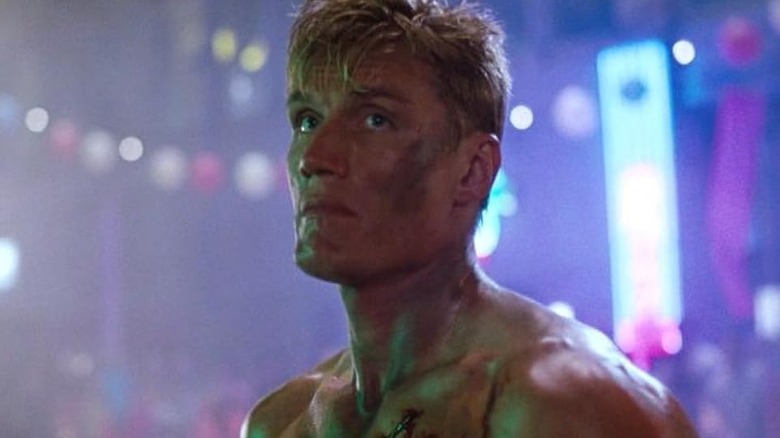
There's surprisingly little official information out there regarding David S. Goyer's "Venom" movie. It's not entirely clear why New Line Cinema passed on it or who would've directed it. What we do know is that Dolph Lundgren ("Rocky IV," "Universal Soldier") was eyed to play the title role.
Luckily, the full script, dated February 1997, leaked online at one point (per the Spider-Man Wiki), and it features some interesting choices. Chief amongst them is that Spider-Man doesn't appear in the movie at all. That probably had to do with complicated rights issues, which we'll get into more in a minute. What's more, Eddie Brock is renamed Eddy Brock (for some reason), he works for the Daily Weekly instead of the Daily Bugle, and the Symbiote that transforms Eddy into Venom originates on a planet of giant spiders (so as to explain his spider-like qualities). It's all very '90s.
In addition, Cletus Kasady, aka. Carnage, is the main villain. (Carnage, notably, eventually served as the primary antagonist in 2021's "Venom: Let There Be Carnage," played by Woody Harrelson.) It's unclear who would have been tapped to play the character, but the script positions both Eddy and Cletus as orphans who knew one another in their younger years.
A big reason why "Spider-Man" took so long to make is that the visual effects technology needed to convincingly bring the character to life in live-action didn't really exist until the late '90s/early 2000s. Could "Venom" have been convincingly made in '97? Michael Jai White came to regret making 1997's "Spawn" in no small part because it didn't realize the potential of its source comics. This is speculative, but it's possible that movie's failure led to New Line passing on Goyer's "Venom" script.
Venom almost got made because of Marvel's complicated film rights
One of the biggest questions surrounding this unmade "Venom" movie is how it could have happened in the first place. Why would Marvel potentially let this project make it to the big screen before "Spider-Man" did? Mind you, Venom didn't even fully appear in the Marvel Comics universe until 1988's "The Amazing Spider-Man" #300. Co-created by David Michelinie and Todd McFarlane, he quickly became a fan-favorite.
The answer to that question is connected to who owns which Marvel character rights. Or, more importantly, who owned them at that time. Marvel was having a tough go of it financially in the mid-'90s, so, as part of a strategy to get out of some financial trouble, it began licensing characters to various studios in Hollywood. That's how Sony wound up with the rights to "Spider-Man," which it still controls to this day.
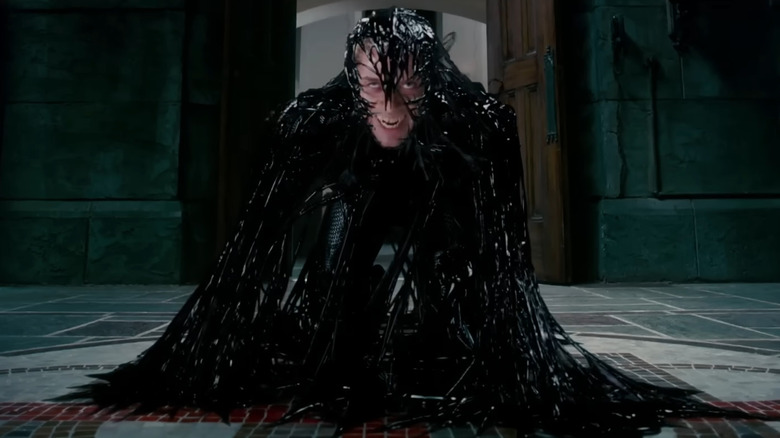
Oddly enough, Michael Jackson wanted to buy Marvel in the '90s so he could play Spider-Man, as Marvel had declared bankruptcy in 1996. As a result of Marvel selling its character rights, New Line ended up with "Venom." Eventually, those specific character rights would wind up with Sony, which is how Venom came to appear in 2007's "Spider-Man 3," as portrayed by Topher Grace ("That '70s Show").
While Marvel Studios has slowly managed to wrangle together most of its character rights over the years, certain strays remain with other studios to this day. In fact, Marvel Studios is incredibly unlikely to make a solo Hulk movie, largely because Universal Pictures still holds the rights to make solo films focused on that character. In short, due to its namesake's popularity, New Line thought "Venom" could stand on its own, and Marvel didn't have a say in the matter.
Venom could have been David S. Goyer's first big superhero movie

It was previously mentioned that David S. Goyer wrote "Nick Fury: Agent of Shield" and "Blade" in the same year. But had New Line Cinema opted to move forward with his "Venom" script, it could have been his first big superhero movie to grace the silver screen. That's far from insignificant in light of where his career went in the 2000s.
When Goyer Goyer penned Christopher Nolan's "Batman Begins," it became a modest commercial hit that, more importantly, made up for the sins of 1997's "Batman & Robin" critically. From there, Goyer returned to write 2008's "The Dark Knight," a $1 billion box office smash hit that was too good to be ignored. Goyer then received a story by credit on 2012's "The Dark Knight Rises."
But his work in the DC universe didn't end there, as Goyer also wrote Zack Snyder's 2013 film "Man of Steel," along with 2016's "Batman v Superman: Dawn of Justice" (which remains a mixed bag 10 years later). On the small screen, Goyer is likewise responsible for creating "Constantine" and "Krypton," as well as Netflix's "The Sandman" TV series.
Basically, Goyer helped define the 2000s and 2010s for DC specifically, for better or worse. Had "Venom" moved forward, who knows? Maybe he wouldn't have written "Blade" and worked on more Marvel movies instead. Or maybe he wouldn't have written any more superhero films at all. The fact that his version of "Venom" didn't happen is surprisingly consequential in the grand scheme of things.
The "What if?" alternate version of superhero movie history that would've unfolded if this film had been made is nothing if not fascinating to consider all these years later.
"Spider-Man: Brand New Day" hits theaters on July 31, 2026.