

10 Best Western Movies Of The 1960s, Ranked
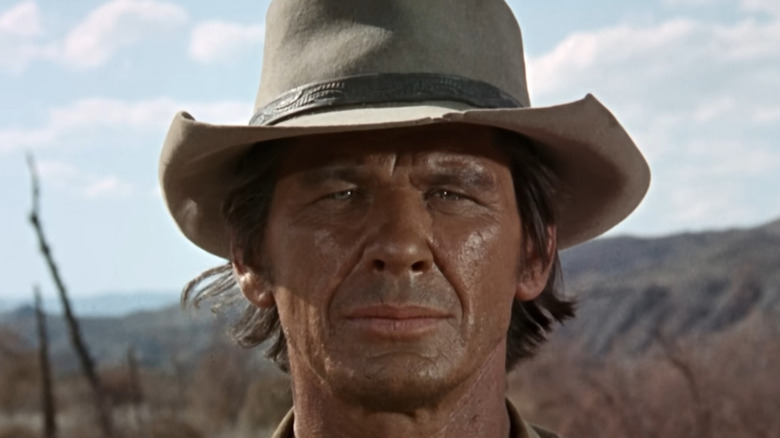
By the 1960s, cinema was very much at a crossroads in the face of social upheaval and greater access to movies from overseas studios. This definitely affected Western movies, where evolving cultural sensibilities could be seen readily in how the archetypal genre was depicted. From the advent of spaghetti Western movies from Europe to the proliferation of counter-culture antiheroes rather than more noble protagonists, the Western genre was changing rapidly. This led to more nuanced stories within Western movies, many of which still hold up today for modern audiences.
We're taking a look at the greatest Western movies to get a wide theatrical release in the '60s, with quite a range to choose from. From the last movies of the genre's old guard filmmakers and actors to the dawn of new talent and storytellers, the decade was a pivotal one for Westerns. Each of these films stand the test of time in their own way and many are among the greatest Westerns ever made.
Here are the 10 best Western movies of the 1960s ranked, epitomizing the decade's output for the genre.
10. Django (1966)
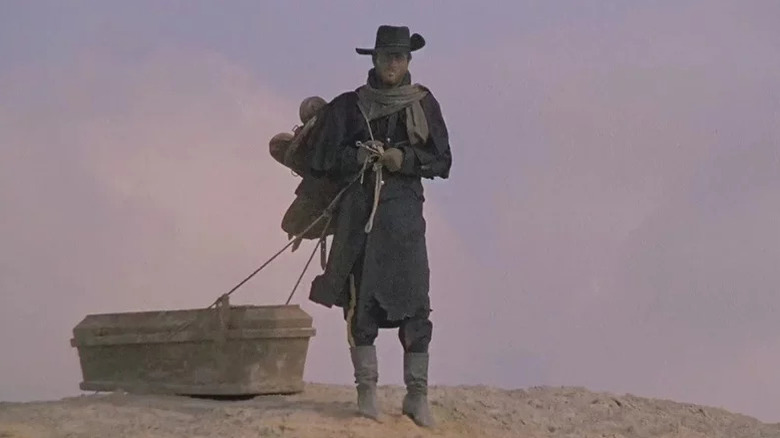
Quentin Tarantino is a filmmaker who's always worn his influences clearly on his sleeve, and the controversial spaghetti Western that inspired "Django Unchained" is 1966's "Django." Directed, produced, and co-written by Sergio Corbucci, the movie stars Franco Nero as its eponymous gunslinger (Tarantino gave Nero a cameo in his 2012 movie as an acknowledging nod). The movie has Django take on a bloodthirsty gang that routinely terrorizes a remote border town in the late 19th century. Django definitely has one of the most memorable introductions in '60s Westerns, wandering into town on foot while silently dragging a casket behind him, setting the movie's tone.
Corbucci proved to be much more grim and violent with his handling of spaghetti Westerns than fellow Italian filmmaker Sergio Leone. This provided the movie with its sense of controversy and likely held it back from finding a wider audience, particularly in North America. But the movie definitely entertains while maintaining a more mean-spirited edge than many of its contemporaries, elevated by Nero's icy leading man stare. A spaghetti Western that deserves more attention than just being regarded for its influence on Tarantino, the 1966 "Django" is a blood-soaked classic.
9. True Grit (1969)
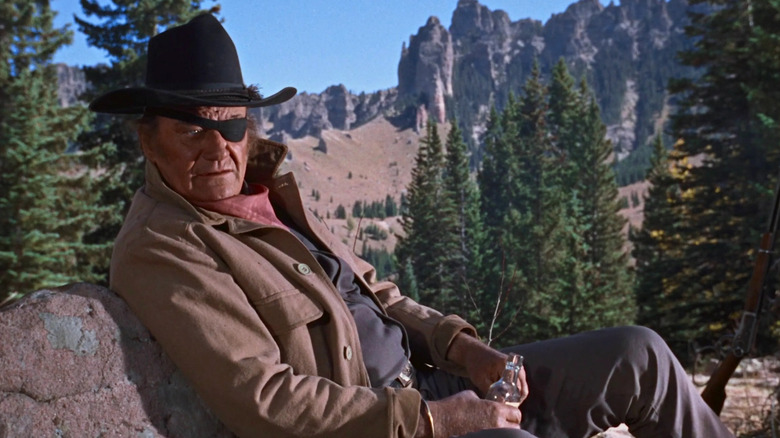
At a time when Westerns felt like they were getting more violent and serious, John Wayne subverted his usual archetypal image with his performance in "True Grit." Wayne plays lawman Rooster Cogburn, a hard-drinking and slovenly figure who agrees to help Mattie Ross (Kim Darby) track down her father's killer. This places him and accompanying Texas Ranger La Boeuf (Glen Campbell) on a collision course with an entire outlaw gang lurking in the frontier. The movie presents audiences with John Wayne as they've never seen him before, with his character a flawed mess of a man, a creative risk he was willing to take.
Wayne was very methodical with how he approached the Western genre and his on-screen image, but he broke his biggest rules in "True Grit" playing Rooster. To play a character who openly swore and was visibly drunk was a departure for him, demonstrating he still had some surprising moves left in him. Wayne was never more nuanced in his performance as he was in his first go-around as Rooster Cogburn and that sells the entire movie. The closest John Wayne ever got to making a full-on revisionist Western, "True Grit" highlighted how much range and fun the venerable actor could bring to the genre.
8. For a Few Dollars More
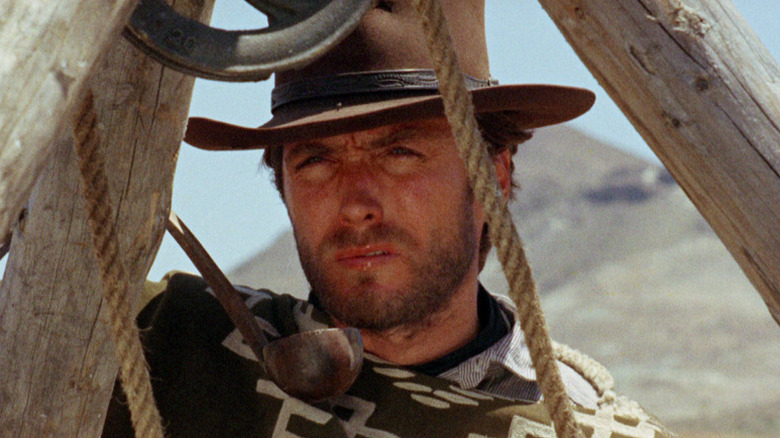
Of course, if we're talking about '60s Western filmmakers, Sergio Leone has to be a big part of that conversation. After making his first Western with "A Fistful of Dollars" in 1964, Leone reunited with actors Clint Eastwood and Gian Maria Volonté for the standalone follow-up "For a Few Dollars More." Volonté plays a new unhinged villain, El Indio, while Eastwood plays a bounty hunter known as Manco, teaming up with fellow bounty hunter Douglas Mortimer (Lee Van Cleef). While initially trying to infiltrate El Indio's gang, the trio find themselves at odds after the outlaws pull off a daring bank heist.
Whereas "A Fistful of Dollars" was an uncredited remake of "Yojimbo," "For a Few Dollars More" proved Leone had plenty to say within the Western genre. From the opening jailbreak to Manco and Mortimer picking apart El Indio's gang in an abandoned white-stone village, the movie's set pieces are more ambitious and impressively staged. A big part of that comes from Leone better synchronizing his on-screen action with composer Ennio Morricone's sweeping score and an overall sharper sense of humor. The movie where Leone, Morricone, and Eastwood cemented themselves as Western icons, "For a Few Dollars More" is a tremendous leap in quality since their last collaboration.
7. The Magnificent Seven (1960)
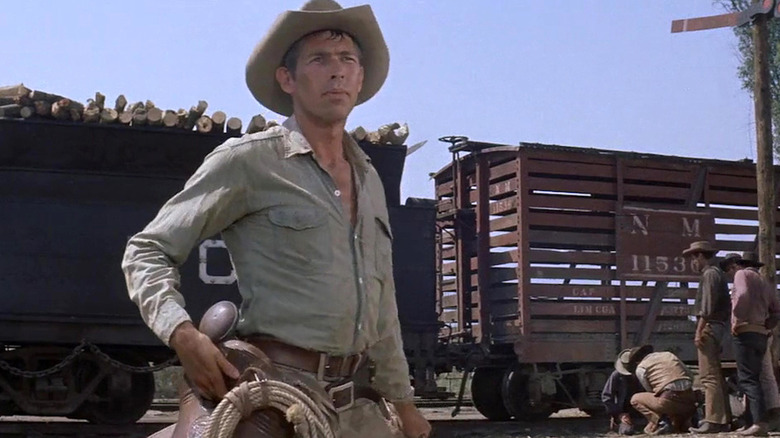
Filmmaker John Sturges believed anything could be a Western, informing his decision to direct and produce a Wild West remake of Akira Kurosawa's feudal Japan epic "Seven Samurai." 1960's "The Magnificent Seven" maintains the broad strokes of Kurosawa's story, with a motley crew of mercenaries hired to defend a remote village from an army of bandits. Leading this ensemble of gunfighters is Chris Adams (Yul Brynner), while each of the other six in the crew have their own idiosyncrasies seen as they work together. Even though the pay is meager and the villagers themselves fearful, the seven band together to make their big stand.
While Akira Kurosawa felt largely ambivalent about "The Magnificent Seven," the movie definitely holds its own as far as '60s Westerns are concerned. This comes from having a remarkable ensemble cast, with each of the titular seven given their individual time to shine at least once. Guys like Steve McQueen, James Coburn, and Charles Bronson each make the most of their screen time, because they're so unfailingly cool. Coupled with one of the most rousing genre scores ever composed by Elmer Bernstein and "The Magnificent Seven" started the '60s off right for Western cinema.
6. The Great Silence
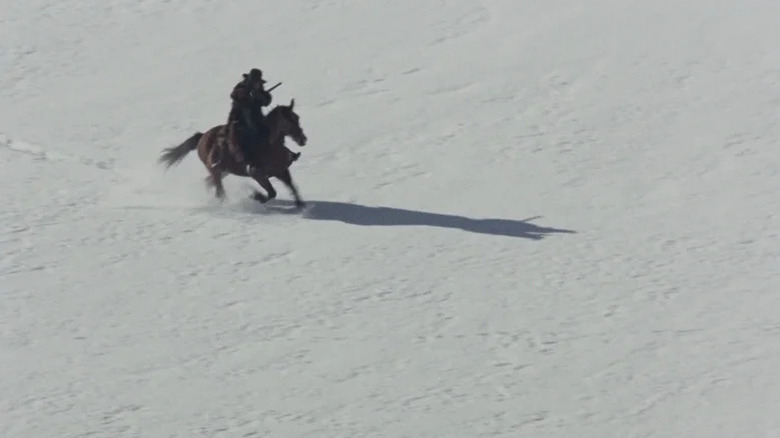
Sergio Corbucci is a spaghetti Western filmmaker who doesn't get cited enough for his strong work within the genre. Corbucci's gunslinging masterpiece is the 1968 movie "The Great Silence," starring Jean-Louis Trintignant as a mute gunslinger nicknamed, well, Silence. The silent gunfighter comes to the defense of a snowbound town driven to steal and targeted by merciless bounty hunters for it. Leading this group of bloodthirsty killers is the aptly named Loco (Klaus Kinski), working for the corrupt businessman who had Silence's parents murdered.
While "The Great Silence" flopped at the box office upon its initial release, it has gained a much greater appreciation over the subsequent decades. This positive reappraisal is driven by its atmospherically wintry setting, offering a stark contrast to its darkly clad figures and sanguine action. The movie's also easily the bleakest movie on this list with its themes and violence, right down to its shocking climactic showdown. One of the best dark Western movies, at least as far as how grim it is, "The Great Silence" brings a brutality to the genre that most of its American contemporaries lacked.
5. The Man Who Shot Liberty Valance
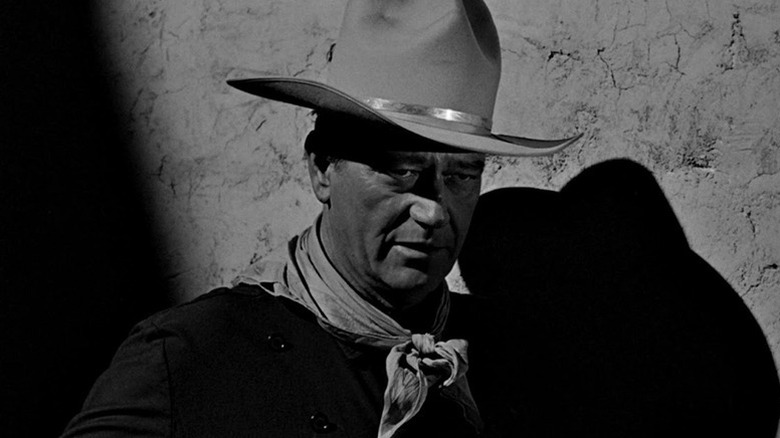
While audiences were used to seeing John Wayne save the day and get the girl, the 1962 classic "The Man Who Shot Liberty Valance" cynically subverted that expectation. Wayne stars as Tom Doniphon, a rancher who defends young lawyer Ranse Stoddard (James Stewart) from notorious outlaw Liberty Valance (Lee Marvin). This feud unfolds as the lawless West nears its end and Tom's girlfriend Hallie (Vera Miles) begins to develop feelings for Ranse. This leads to a shadowy showdown as the truth of who actually shot and killed Liberty Valance comes to light.
The melancholy behind "The Man Who Shot Liberty Valance" works precisely because of John Wayne and director John Ford's reputation within the Western genre. The movie's more murky qualities are enhanced by the black-and-white cinematography, particularly in its climactic confrontation, as it plays out from multiple perspectives. In taking on this more subversively fading figure in the West, the movie gives John Wayne one of his best roles as a gunslinger increasingly out of step with society. Modern audiences have agreed with the assessment, naming "The Man Who Shot Liberty Valance" as John Wayne's best-rated Western on IMDb.
4. Once Upon a Time in the West
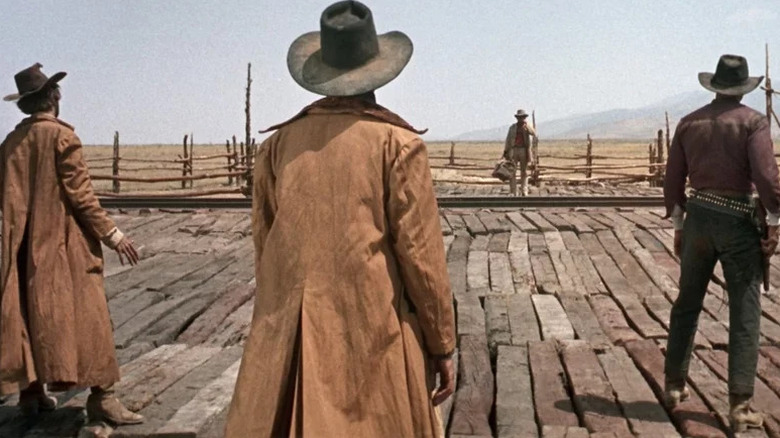
After the "Dollars" trilogy, Sergio Leone crafted a requiem to the genre that made him a renowned worldwide filmmaker with "Once Upon a Time in the West." Released in 1968, the movie is set during the twilight of the American frontier and the age of the gunslingers. Notorious outlaw Frank (Henry Fonda) is hired to wipe out a family owning land valuable to a powerful railroad company planning to develop the region. Defending Jill McBain (Claudia Cardinale), the family's sole survivor, are the surly gunfighters Harmonica (Charles Bronson) and Cheyenne (Jason Robards).
"Once Upon a Time" is a Western movie everyone should watch, with Leone still in fine form and the proceedings elevated by another memorable score composed by Ennio Morricone. Compared to his flashier "Dollars" trilogy, Leone takes his time setting up shots and sweeping vistas, often patiently setting up the violence about to punctuate a scene. This is all anchored by a solid ensemble cast, including usual cinematic nice guy Henry Fonda playing against type as a mercilessly villainous killer. Closing out Leone's work in the '60s, "Once Upon a Time in the West" proved the Italian filmmaker still had a lot to say in the Western genre.
3. The Wild Bunch
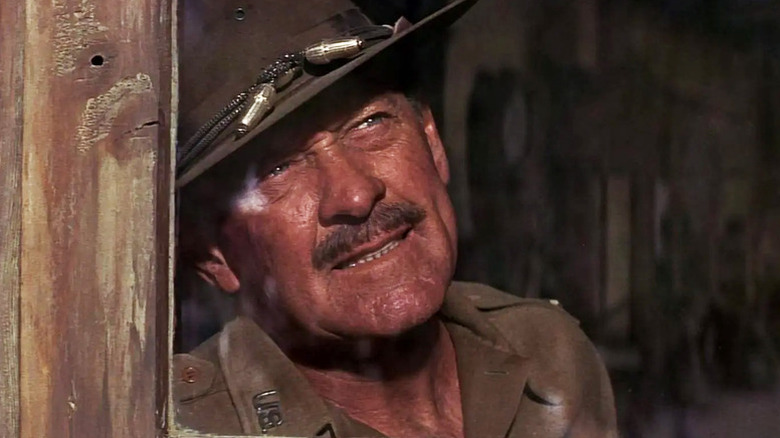
Filmmaker Sam Peckinpah often infused his movies with brutal violence to shock audiences and escalate the stakes, with "Straw Dogs" and "The Getaway" being prime examples of this. But the movie that Peckinpah will be known for the most is his 1969 Western "The Wild Bunch," another story set at the end of the Wild West. The film follows a group of aging outlaws who flee to Mexico after a botched heist, getting caught up in the revolution south of the border. The quartet decides to go out in a blaze of glory in a thunderously sanguine last stand against the Mexican army.
Decades later, "The Wild Bunch" still proves to be a divisive one, with Clint Eastwood among those who didn't like the film. That said, we're clearly among the Peckinpah project's fans and its nihilistic take on the final days of the Wild West. Yes, "The Wild Bunch" has one of the most gruesome finales to any Western movie, even nearly 60 years later, but that keeps in line with its themes. For a movie about frontier gunslingers not going down quietly, "The Wild Bunch" sticks the landing and firmly establishes Peckinpah's penchant for staging beautiful carnage moving forward.
2. Butch Cassidy and the Sundance Kid
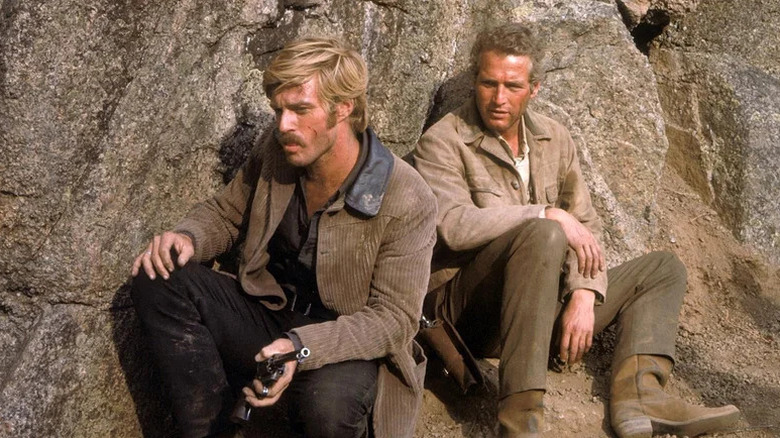
The tonal antithesis to Peckinpah's grim "The Wild Bunch," albeit coincidentally featuring a broadly similar finale, "Butch Cassidy and the Sundance Kid" is a feel-good Western. Also released in 1969, the movie's pair of titular outlaws, played by Paul Newman and Robert Redford, respectively, find themselves on the run from a relentless posse. Running off to Bolivia with Sundance's girlfriend Etta Place (Katharine Ross), the duo quickly resume their bank-robbing ways. However, even in South America, the crooks find out that they can't outrun justice the hard way and nor can they ditch their criminal lifestyle.
"Butch Cassidy and the Sundance Kid" is another Western about going out in a blaze of glory, but it takes a more light-hearted approach to reach its destination. This comes from the natural chemistry between Newman and Redford, with Newman playing his character as a mischievous scheme and Redford playing his as cooly taciturn gunfighter. These juxtaposing outlooks provide the movie with a lot of freewheeling fun while repositioning the titular characters as counter-culture figures. A cheerily subversive take on the genre while still bringing loads of spectacle, "Butch Cassidy and the Sundance Kid" is the perfect antidote to more self-serious Westerns.
1. The Good, the Bad and the Ugly
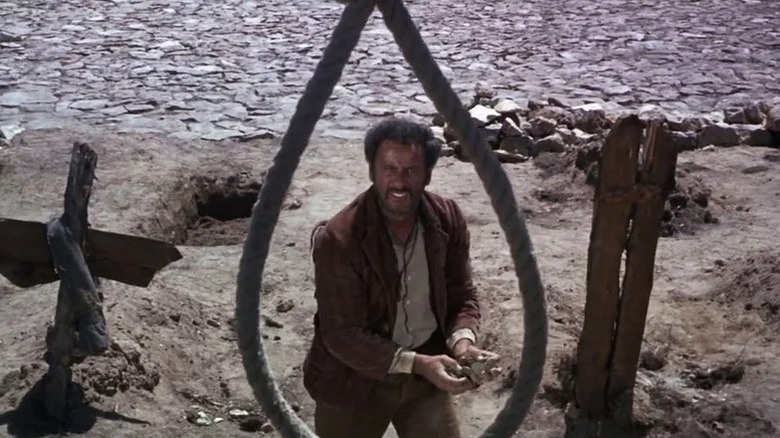
Any Western fan with a cursory familiarity with release windows knew that "The Good, the Bad and the Ugly" was going to wind up on this list and ranked highly. The 1966 movie serves as the epitome of the spaghetti Western and filmmaker Sergio Leone's magnum opus across his entire career. The story centers on three gunfighters vying for a stash of gold hidden in an unmarked grave during the chaos of the American Civil War. Complementing the feud between Blondie (Clint Eastwood) and Angel Eyes (Lee Van Cleef) is the unruly ruffian Tuco (Eli Wallach), with the trio partnering up and betraying each other regularly.
Even with a runtime of close to three hours, "The Good, the Bad and the Ugly" keeps audiences riveted with its three lead actors rarely better than they are here. Leone sharpens his knack for staging stylish action set pieces and his wickedly dark humor, with the movie standing as one of the most quotable Westerns of all time. The movie is elevated by a standout musical score from Ennio Morricone, from its title track to its climactic search and showdown in a cemetery. "The Good, the Bad and the Ugly" is the best Western movie according to IMDb, and we're certainly inclined to agree.