

5 Best Dark Western Movies, Ranked
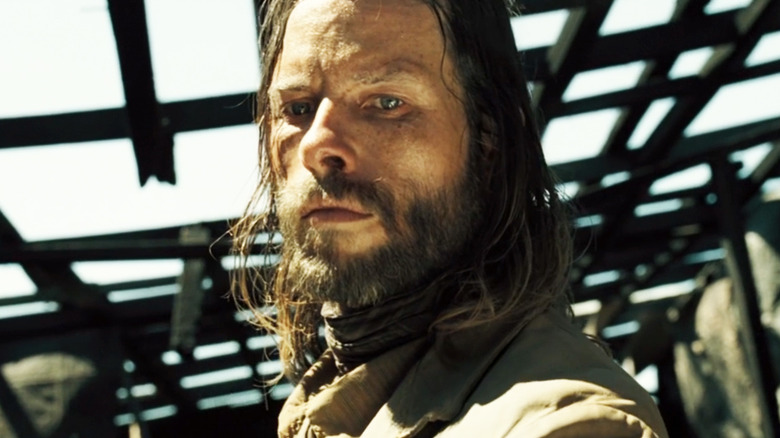
Some of the best horror movies speak to fears lingering beneath the surface of society. Dark Westerns, however, delve beneath the carapace of the genre's often simplistic retelling of history to dredge up something arguably even more unsettling, grappling with the very myths on which the United States was built to reveal fundamental flaws at the foundation of its society.
In a sense, there has always been a darkness to Westerns. The way in which early examples of the genre whitewashed the often brutal landscape of the frontier is, at the very least, slightly unsettling in hindsight. At worst, there's a great tragedy at the root of films that minimized the suffering of anyone who wasn't a clean-cut cowboy. Of course, this truth was inevitably going to come to light. The genre could only survive for so long on the white-hat-vs.-black-hat simplicity of the early to mid-20th Century. Even in the golden age of the Western, there were hints of the revisionist ethos that would come to characterize the genre's later years, with films such as 1950's "The Furies" and 1956's "The Searchers" infusing the Old West with a certain bleakness uncharacteristic of the era.
As things went on, the films continued to indulge this darker sensibility, and in the process we got some of the best Westerns ever made. Paul Newman's darkest Western is a must-watch masterpiece, and the controversial, disturbing Western "El Topo" won plaudits from the great Roger Ebert. But there are even darker examples, and we've ranked the top five while trying to include a mix of styles from the psychological to full-on Western horror.
5. The Ox-Bow Incident
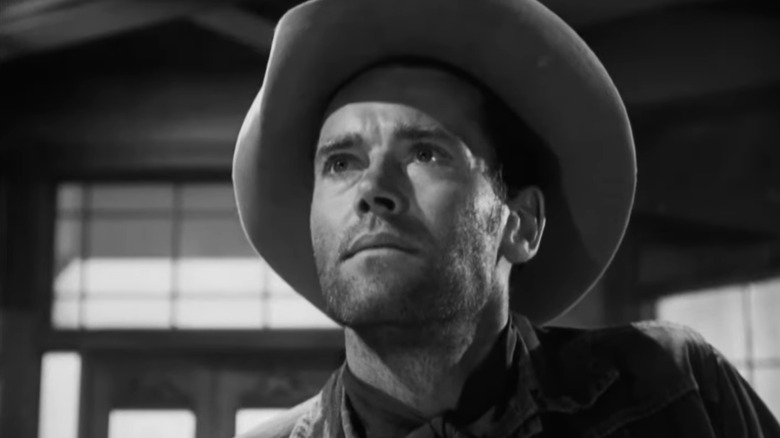
"The Ox-Bow Incident" is a rare example of a 1940s Western that exhibited many aspects of the revisionist style long before it became dominant. No wonder it was one of Clint Eastwood's three favorite Hollywood classics. The 1943 film was directed by William A. Wellman, who'd previously overseen 1937's "A Star is Born." With "The Ox-Bow Incident," however, he turned his attention to dissecting humankind's proclivity for embracing a mob mentality and exploring the devastating outcomes.
Adapted from Walter Van Tilburg Clark's 1940 novel of the same name, "The Ox-Bow Incident" stars Henry Fonda and Dana Andrews as cowboys Gil Carter and Donald Martin. The pair ride into Bridger's Wells, Nevada, where rancher Larry Kinkaid has been killed and his cattle stolen. A mob soon sets out to find the perpetrators, led by Frank Conroy's Major Tetley (Frank Conroy). When they encounter three men sleeping near a herd of cattle, they assume the worst and lynch the trio. But they soon learn they've made a terrible mistake, leading to even more devastating consequences.
Bosley Crowther of The New York Times noted how this "is not a picture which will brighten or cheer your day," even while praising the "sheer, stark drama." Indeed, "The Ox-Bow Incident" is notable for its bleak tone and a tragic denouement. Wellman had to agree to direct two other pictures for Fox just to get this film green-lit: "Thunder Birds" (1942) and "Buffalo Bill" (1944), and even then the Production Code Administration (PCA) was hesitant to approve the script due to the lynching. Ultimately, Wellman's film was a thoughtful meditation on the importance of humanity's collective conscience, and a sobering one at that. It might not have been what Fox was looking for, but it remains one of the great dark Westerns.
4. The Proposition
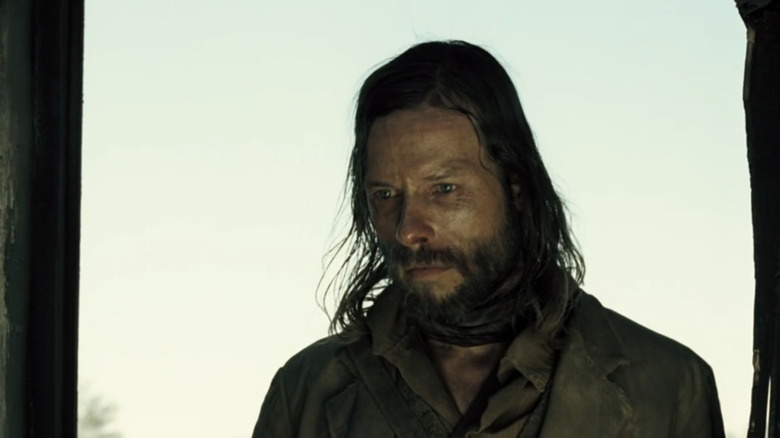
Guy Pearce has made his fair share of dark Westerns over the years, from co-starring with Robert Pattinson in the underseen Western "The Rover" to appearing alongside Dakota Fanning and Kit Harrington in 2016's "Brimstone." But there's something unrelentingly pitiless about "The Proposition," a savage Australian Western written by Nick Cave and directed by John Hillcoat. It stars Pearce as an outlaw tasked with hunting his own brother in what Roger Ebert once called "a Western moved from Colorado to Hell."
The film is set in 1880s Australia, where Pearce's bushranger Charlie Burns loses a fight with Ray Winstone's lawman Captain Morris Stanley and his officers. Stanley then delivers the eponymous offer. In order to save his younger brother, Mikey (Richard Wilson), from being executed for his crimes, Charlie must track down and murder his older brother and fellow outlaw Arthur (Danny Huston). Charlie then leaves Mikey with Stanley as he ventures out into a merciless Outback. Things aren't much better back in Stanley's hometown, where Mikey ends up being flogged for his crimes in a brutal scene that proves even the so-called civilized elements of this wretched landscape have forsaken their morality.
The uncompromisingly bleak tone of "The Proposition" puts other revisionist Westerns to shame. Things start off dark and get worse, which sounds like it might be a little too much to take. But "The Proposition" is so well made, with excellent performances and a consistently immersive world, that even with its inescapable brutality it's also undeniably great. Heck, Ebert found himself haunted by "The Proposition" and gave it a perfect score.
3. Unforgiven
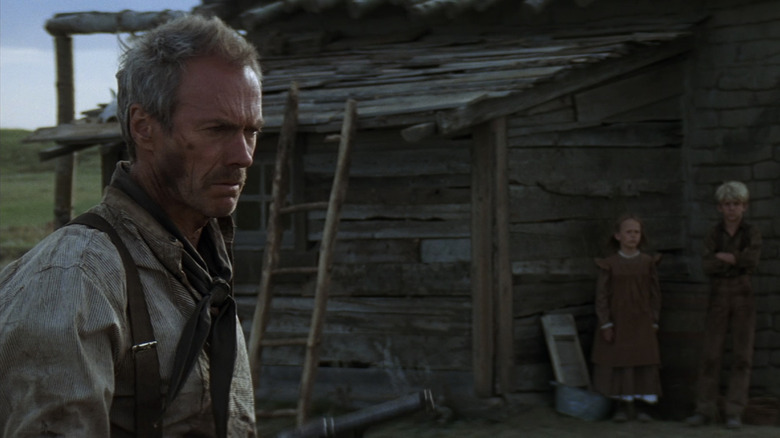
"Unforgiven" is simply a must-see. It would be an excellent film without the meta-narrative that director and star Clint Eastwood brings to it. With him, it arguably stands as the greatest revisionist Western ever made.
Eastwood plays William Munny, a former outlaw who remains infamous for his brutal crimes, which, as he reveals over the course of the film, even involved harming women and children. Here, however, we find Munny in his twilight years, tending to a small farm and raising two young children. He's haunted by his past, but when a young would-be bounty hunter arrives and propositions him, Munny can't pass up the opportunity for one more job. That job sees him tracking down a group of men responsible for disfiguring a sex worker in a nearby town, where he ends up clashing with Gene Hackman's dodgy sheriff Bill Daggett. As Munny, his young accomplice, and old friend Ned Logan (Morgan Freeman) venture out to track down the culprits, Eastwood's aging gunfighter reflects on his misdeeds, revealing how deleterious his experiences as an outlaw have been to his soul.
There are multiple levels to Munny's reckoning with his crimes. Eastwood himself interrogates his own legacy as one of the pre-eminent Western stars of the Century, while the film as a whole grapples with the legacy of Westerns that lionized the outlaw archetype. While we do get a classic sequence in which Eastwood exacts vengeance on Bill Daggett and his men, ultimately, "Unforgiven" suggests that the days when Hollywood mined the history of the Old West for adventure and thrills really just created a mirage that hid the bloody and sordid history of the frontier.
2. The Great Silence
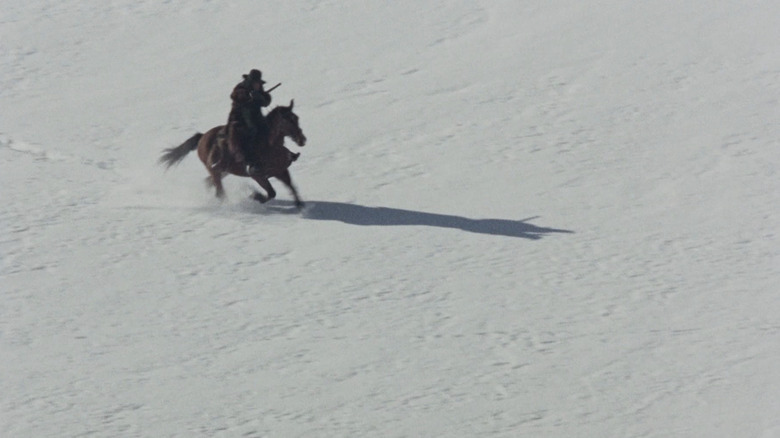
1968's "The Great Silence" is about as grim as a Western can get without verging into all-out horror territory. Directed and co-written by Sergio Corbucci, the film represents one of the great Spaghetti Westerns. But it really transcends that sub-genre entirely, representing one of the great Westerns of the mid-20th century. It's also one of the darkest.
This is a film that begins with bounty hunters killing a couple and slicing their young son's throat. Things only get worse from there. Jean Louis Trintignant plays the little boy in question all grown up. As an adult, he's become a mute gunslinger known only as Silence, and he's obsessed with exacting revenge on the man responsible for his tragedy, Henry Pollicut (Luigi Pistilli). Unlike almost all other Westerns at the time, "The Great Silence" takes place in a snow-laden Utah (represented in the film by the Italian Dolomites), where Silence finds himself defending a town against a band of bounty hunters hired by Pollicut and led by a deadly gunman named Loco (Klaus Kinski).
This great Western also flopped at the box office but has since become renowned as one of, if not Corbucci's absolute best films. The snowy landscape of "The Great Silence," which brings unrelenting deprivation to its inhabitants, is echoed in the film's tone, which offers little to no reprieve from the villains' murderous tyranny. That carries right the way through to the dreary ending, which has got to be one of the harshest and most hopeless in the history of the Western.
1. Bone Tomahawk
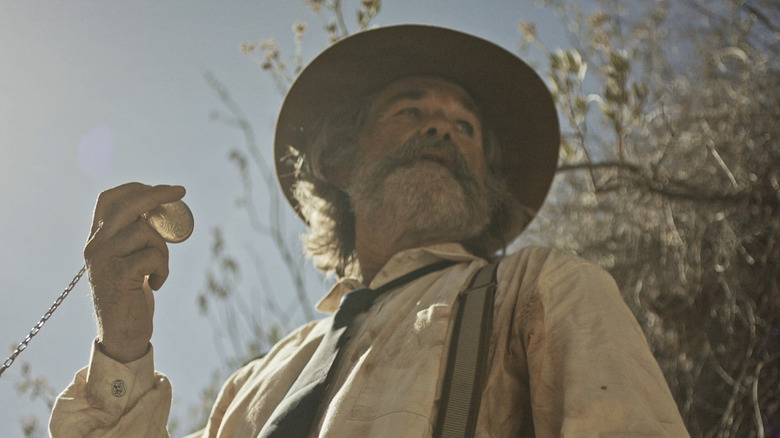
If you want dark, Western horror, "Bone Tomahawk" has you covered. This overlooked Kurt Russell Western comes with a Stephen King recommendation, which should give you some idea of how horror plays a major role in the film.
Directed by S. Craig Zahler in his directorial debut, "Bone Tomahawk" remains notorious among those who have watched for an ultra-violent scene that burns itself into the cortex upon viewing. Rarely do you see Westerns cropping up in lists of the "most disturbing scenes in film history," but this one regularly does just that. Indeed, /Film included it on the list of the 10 scariest movie scenes of the decade back in 2019, thanks to an unforgettable sequence in which a man is basically hung upside down and ripped in half while fully conscious. No other film on this list has a scene quite like this, even the unapologetically bloody "The Proposition."
But it's not just this nightmare vignette that makes "Bone Tomahawk" so chilling. Russell plays a sheriff who leads a group of four men on a mission to save three people who've been taken captive by a group of cannibals living in caves. Prior to the aforementioned gore, the story is somewhat of a slow burn, making the more visceral scenes so much more effective. Adding to the film's appeal are the performances, which are uniformly excellent. As well as a dark Western that will haunt you long after watching, then, you're also getting a top-notch example of the genre from the modern age that even somehow manages to be darkly funny at times.