

Arnold Schwarzenegger's 5 Best Sci-Fi Movies (That Aren't Terminator), Ranked
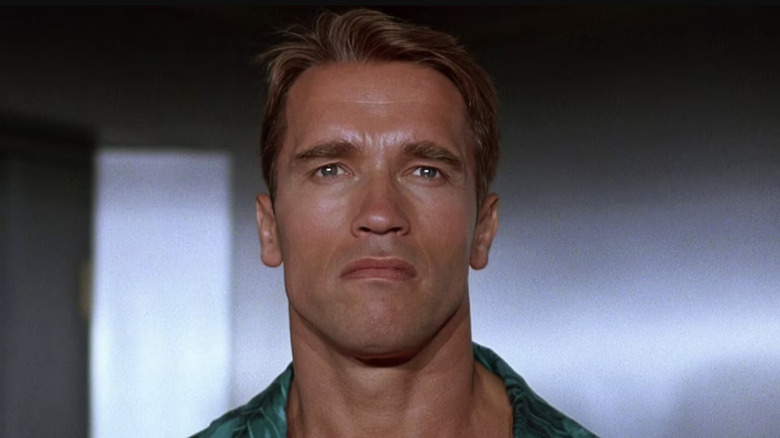
When it comes to his career as an actor, there's a number of Arnold Schwarzeneggers to choose from. You might be more into action Arnold, loving his turns in films like "Commando" and "Eraser." Or maybe you're a big fan of comedy Arnold, appreciative of the man's natural goofiness in stuff like "Twins" or "Jingle All the Way." Of course, Arnold also has a connection to the fantasy genre. After all, his first motion picture was 1970's "Hercules in New York," and he later made a splash in "Conan the Barbarian" and "Conan the Destroyer."
Despite all of that, it can be argued that Arnold Schwarzenegger's legacy is most synonymous with the science-fiction genre. While "Conan" may have been his breakout, the actor wouldn't have rocketed to star status without 1984's "The Terminator," in which he became a near-instant icon for his performance as the deadly T-800.
Throughout his career, sci-fi remained an important part of Schwarzenegger's filmography. While he went on to star in four more "Terminator" sequels (including "Terminator 2: Judgment Day," one of the best sci-fi action movies ever made), Schwarzenegger's non-"Terminator" sci-fi films are also great entries in the genre canon. As proof, here are the 5 best sci-fi Schwarzenegger movies that don't involve the actor playing a killer robot from the future.
5. Batman & Robin
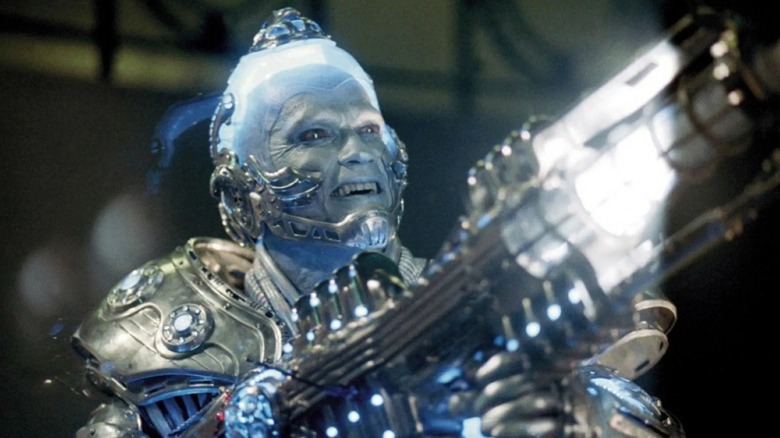
Figuring out which Arnold Schwarzenegger movie might go in this 5th slot was more challenging than you might think! For while Arnold's triumphs in sci-fi are higher than most, taking the "Terminator" series out of the equation does create a problem. So, with all due respect to "Junior" fans, I believe 1997's "Batman & Robin" to be the superior draft pick here. Yes, the film has long been maligned as a "Batman" sequel, and director Joel Schumacher famously apologized for the intentional "toyetic" quality of the movie on his commentary track from 2005. Yet time (and the swinging of the "Batman" pendulum all the way over to grim n' gritty) has been kind to "Batman & Robin." While the movie isn't ever going to be anyone's idea of a rich drama, it has its place as a eye-popping big-budget version of the 1966 "Batman" series, as its tongue is very similarly placed in its cheek. Schumacher's version of Gotham City is even more of a "Blade Runner" meets Rome dream/nightmare than "Batman Forever" was, which means the film's sci-fi coded aesthetic is never less than dazzling to look at.
That goes double for Schwarzenegger as Mr. Freeze. The actor dons some of the most impressive and bizarre costumes ever made for any comic book movie, and his commanding presence makes sure he doesn't become lost inside them. What's more, Schwarzenegger manages to bring some genuine pathos to the role. In fact, Victor Fries may be the most sympathetic live-action "Batman" villain not named Catwoman to date. Freeze's plan to blast all of Gotham with a freeze ray is gloriously kitschy, and heavily reminiscent of '50s sci-fi stuff. All this and he gets the best lines, too!
4. The 6th Day
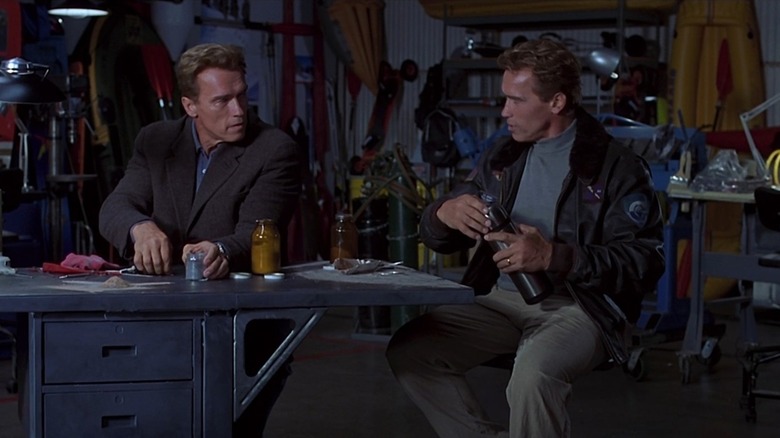
The 1996 cloning of Dolly the sheep was a boon to science-fiction authors and filmmakers for years to follow. While in hindsight we know that it didn't actually kick off a cloning crisis, for that first decade and change into the new Millennium, it seemed possible that artificial humanity could become a real thing, and thus, a real problem. Years before "The Island," "Gemini Man," or even George Lucas' second "Star Wars" prequel could capitalize on this concept, Arnold Schwarzenegger and director Roger Spottiswoode made a solid little action thriller about a cloning identity crisis in "The 6th Day."
The film was certainly not the first movie about the potential pitfalls of cloning a still-living human being, nor was it even the first to use this as the basis for an action film, as there are versions of its themes (albeit without the cloning angle) in then-recent fare like "Face/Off" and Schwarzenegger's own "Total Recall." Yet Spottiswoode takes the material seriously, and brings some of the juice that he learned while making 1997's Bond romp "Tomorrow Never Dies" to the proceedings. For Schwarzenegger's part, the actor makes his performance as Adam (both the original human and his clone) feel a little like a continuation of his work in "Total Recall" and "Last Action Hero," both of which concern Schwarzenegger playing versions of himself. "The 6th Day" is more proof that not only is Arnold a natural fit for sci-fi, but that his presence is conducive to both a fairly grounded story as well as the more fun, outrageous elements of the genre.
3. The Running Man
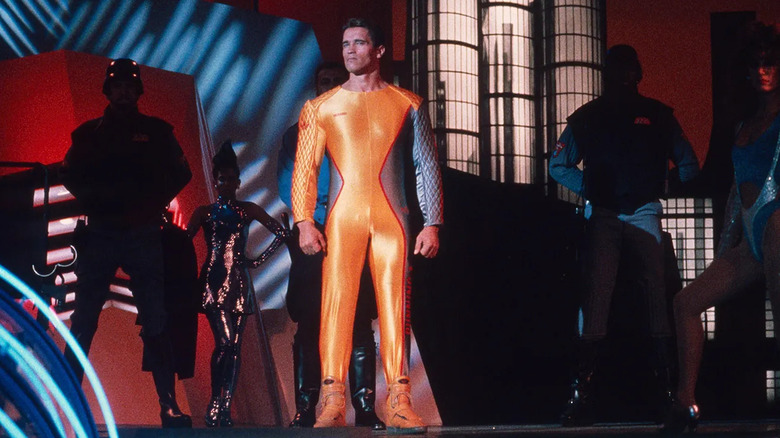
Fans of Arnold Schwarzenegger who dive into his body of work without keeping chronology in mind might be shocked to watch "The Running Man" and see that it's not directed by Paul Verhoeven. Not only that, but it can't even be accused of ripping off the Dutch auteur, as its vision of a brutal future Los Angeles (the year 2017!) arrived in cinemas in 1987. That's the same year that Verhoeven's "RoboCop" premiered, years before Schwarzenegger and Verhoeven teamed up on "Total Recall." This seems to indicate a few things: capitalistic excess and dehumanization was in the air during the 1980s, and perhaps Schwarzenegger had as much to contribute to "Total Recall" as Verhoeven did.
In any case, director Paul Michael Glaser and writer Steven E. de Souza do a pretty solid job of adapting Richard Bachman (aka Stephen King), presenting such a credible near-future of greed and fascism in the guise of mindless entertainment that it inspired a real-life series in "American Gladiators." The film also warns against the dangers of reality television and the manipulation of media by corporate and government interests, which presages things like "The Hunger Games" and, in a way, our current reality. For all the subtle (and completely unsubtle) social commentary and satire surrounding him, Schwarzenegger delivers a winning, scenery-chewing performance as reluctant contestant turned freedom fighter Ben Richards, giving other scenery-chewer Richard Dawson as Killian a run for his money. While the movie isn't nearly as bleak a sci-fi parable as King's original novel, Schwarzenegger's casting helps its finale feel more rousing than wish-fulfillment cheesy. If there's anyone who could take on a fascistic government single-handedly and win, it would make sense he'd look like Arnold.
2. Predator
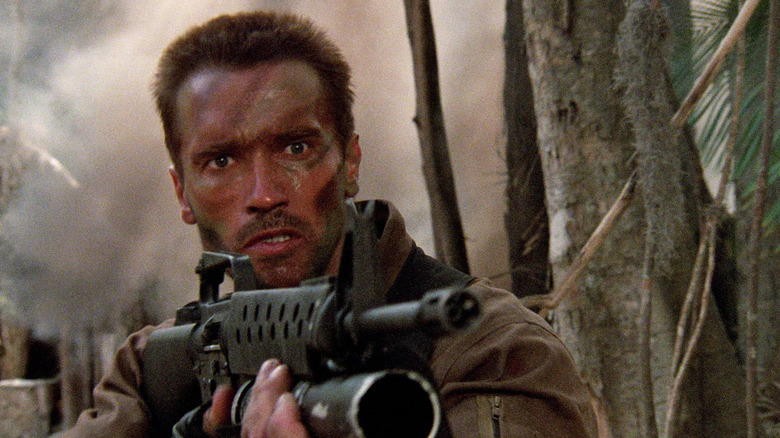
If the Terminator, an unrelenting literal killing machine from the future, is one half of the sci-fi role that Arnold Schwarzenegger was born to play, then Major Alan "Dutch" Schaefer in "Predator" is the other half. In essence, it's his "Terminator" archetype flipped on its head, as Dutch becomes the one man on planet Earth who's got half a chance going up mano e alieno against an extraterrestrial hunter loaded with high-tech alien gear. There are many layers to "Predator," not the least of which is that it's a film which changes genre like the Predator changes camouflage. It begins as what seems like a standard Schwarzenegger '80s action flick, only to morph into a horror movie as Dutch's squad get killed off one-by-one, slasher-style, before ultimately climaxing with a survival of the fittest title match in its last act. Director John McTiernan instinctively knew that Arnold could carry the movie through that entire arc and then some, allowing the film to deliver on multiple fronts.
As a matter of fact, it's Schwarzenegger's presence which keeps the movie more rooted in sci-fi than horror, even though both genres are involved. Where the film could've been akin to "Alien" had its Final Boy been a more average specimen, Arnold's bodybuilding physique and cigar-chomping prowess help McTiernan lean into more of a "The Most Dangerous Game" parable, only with an alien instead of another human. This twist on the trope allows "Predator" to introduce some compelling sci-fi concepts without dwelling on them. The subtext the film leaves audiences with is how the worst day of Dutch's life was due to a single Predator going on a simple hunting trip, meaning that for all of humanity's supposed might and dominance on Earth, we're little more than a speck in the cosmos.
1. Total Recall
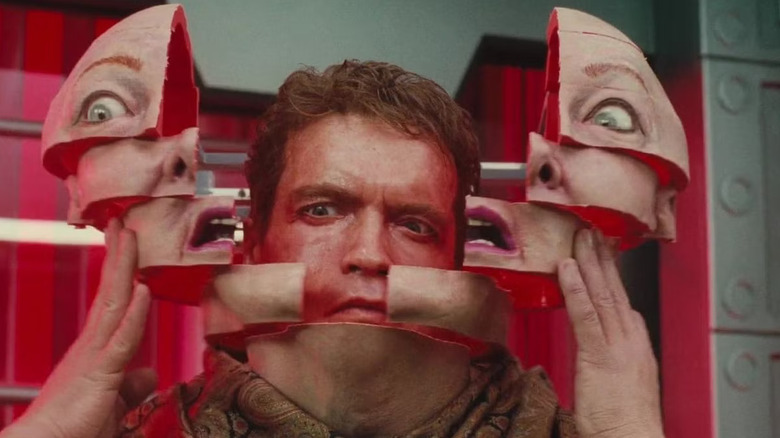
Science-fiction is a highly malleable genre, and as such can mean a variety of things. One notion that is the most consistent across every sci-fi story is that of possibility: whether it inspires progress, fear, or something in between, the sci-fi genre is the greatest playground for "what if." 1990's "Total Recall," based on the Philip K. Dick short story "We Can Remember It For You Wholesale," is one of sci-fi cinemas' greatest "what if" yarns. The film begins with the already fascinating concept of a future technology that allows you to have false memories implanted in order to live out your dream vacation, your deepest fantasy, or virtually any other experience you desire. It then adds to that interplanetary travel, secret agent intrigue, hidden identities, revolution against a tyrannical regime, prophecies, terraforming, and more, all of it wrapped up in a "is this real, or just an implanted false memory?" package.
A movie this dense and full of possibility understandably went through a wild journey to get to the screen, passing by directors like David Cronenberg and actors like Richard Dreyfuss along the way. It ultimately landed on director Paul Verhoeven and star Arnold Schwarzenegger, with both men bringing their own indelible qualities to the project. Verhoeven brought his satire of cultural excess and morality, while Schwarzenegger is crucial in making the ambiguity at the heart of the film more credible, not less. His character of Quaid could legitimately be a superspy who had his memory wiped, or an ordinary construction worker living in a delusional dream. The joy of "Total Recall" is not having to choose between all the film's possibilities, and Arnold makes that dream a reality.