

We Asked A Real-Life Astrophysicist: What Do Star Trek's Spaceships Get Right About Interstellar Travel?
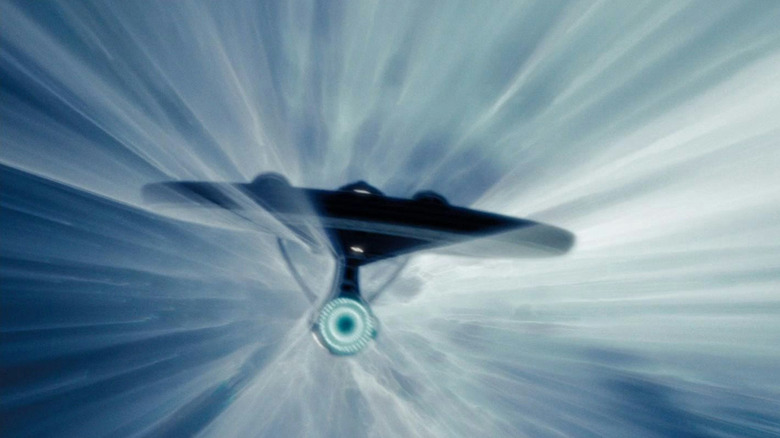
You know how it goes. You hop into the captain's chair of your fancy new starship, order your pilot to move ahead to faster-than-light speeds by warp factor 6, and then an unwelcome dose of reality hits: What about the immutable laws of physics?! For as long as science fiction has existed, writers have been fudging the boundaries of scientific accuracy to serve the purposes of their stories ... and rightfully so. Neither "2001: A Space Odyssey" nor "Star Wars" would've helped define and redefine science fiction had they insisted on documentarian approaches, rather than (mostly) throwing realism out into the cold vacuum of space.
And then there's "Star Trek," a franchise that's at least tried to maintain a sense of verisimilitude over the decades. Okay, sure, sometimes you have to slog through lows like the most hated episode of "Voyager," which turned two of its main characters into hyper-evolved lizards. But where else would you get an hour like "The Chase" from "The Next Generation," which borrows from the real-world theory known as panspermia to explain why so many aliens look suspiciously like we do? As outlandish as certain elements may seem to the casual viewer, could others — say, the logistics of how the USS Enterprise warps through space-time — stand up to scrutiny?
Well, as I always say, when in doubt, ask an astrophysicist. Better yet, ask one who's also teaching a course on the hard sci-fi genre, covering everything from H.G. Wells' "The Time Machine" all the way to Andy Weir's "The Martian." Alan Calder of Stony Brook University, a researcher in nuclear astrophysics and professor of Physics and Astronomy, fit the bill perfectly. To hear him tell it, the depiction of interstellar travel in "Trek" may have more truth to it than we'd think.
One physicist actually cracked the code on Star Trek's warp drive — but not without some complications
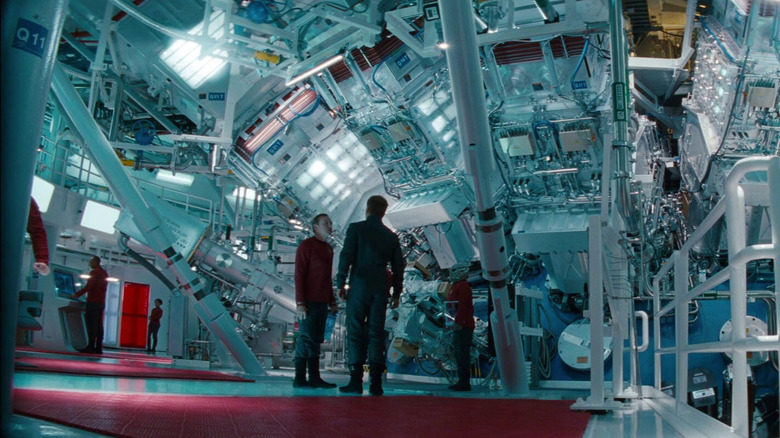
Fiction has always been meant to provoke, challenge, and inspire us. Astrophysicists like Alan Calder can speak to this directly, as he explained in a recent interview with /Film. His own career path was at least partially shaped by the works of late physicist and novelist Robert L. Forward, known for his hard sci-fi writing like "Dragon's Egg" and its sequel "Starquake" (and, to tie it all together, also for studying the same concept of antimatter propulsion frequently portrayed in "Star Trek").
One individual in particular, however, went even further in bridging the gap between "Trek" fiction and real-world fact. Mexican theoretical physicist Miguel Alcubierre is best-known for writing a seminal 1994 paper commonly considered the first serious attempt to recreate warp drive physics. In Gene Roddenberry's conception, starships like the USS Enterprise aren't accelerating beyond the unbreakable speed of light — it's the space around them which folds and expands to get around the pesky laws of general relativity. As Calder explains, the math is surprisingly sound ... but there are complications:
"I think a better question is, could you ever actually engineer it? I mean, it's plausible. So, the way to think about general relativity is that it relates the curvature of space to the mass energy. The more mass energy, the more curvature of space. And of course, the standard analogy is throwing a bowling ball on a trampoline. The gravity pulls it down and that distorts the surface.
So, in principle, you could do the Alcubierre warp drive, but the energies required are fantastic. I mean, as much energy as you could get out of a whole star [...] That's the scale of it."
Star Trek may have already provided a surprising solution to this energy problem: wormholes
As Albert Einstein's famous equation laid out, it's all about energy, folks. As big an issue as this remains for us in the real world, artists have found no shortage of workarounds in fiction. In "Project Hail Mary," author Andy Weir used his own made-up plot device of "astrophage," the microscopic space algae chowing down on our Sun, to power an interstellar spaceship up to speeds otherwise impractical with our current technology. "Star Wars," meanwhile, uses some mumbo-jumbo about hyperdrive motivators to hand-wave any logistics away about faster-than-light travel.
"Star Trek" never quite reckons with the energy problem staring scientists in the face, but perhaps it doesn't need to. It's possible the answer lies elsewhere in the "Trek" universe. When the situation calls for it, writers have never been shy about tossing wormholes in the way of various Starfleet captains in the canon. While it remains a highly speculative concept and never actually proven (and, admittedly, outside our expert's purview), Alan Calder cautiously proposes this convenient shortcut through the universe as a viable alternative to exploring the cosmos ... theoretically speaking, of course:
"Now, there are other solutions. Wormholes, for example, are real solutions. We don't know if they're physical — but the energies involved and the technology that would take is, to me, most likely unobtainable. Now, that doesn't say that we couldn't take other approaches to relativistic rocketry and things like that. But things like the warp drive [laughs], it's a long, long, long way off."
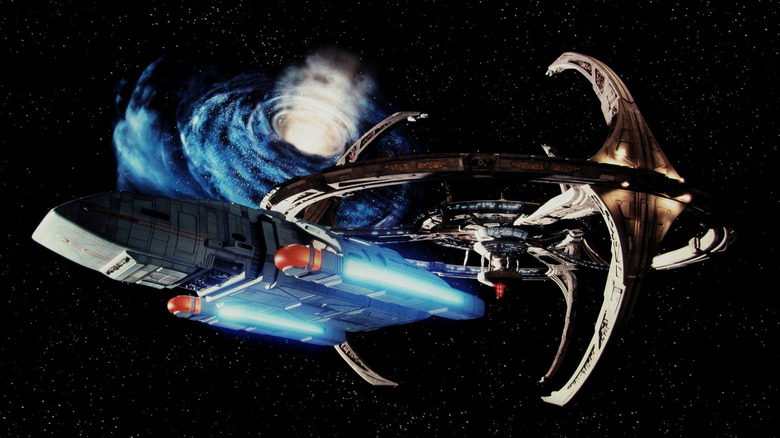
With heartfelt apologies to "Deep Space 9," we'll have to postpone any plans on visiting space stations and their nearby Bajoran wormholes. Should we give up on our dreams of interstellar travel, then? Well, not so fast.
Star Trek's various starship designs might be more viable than you think
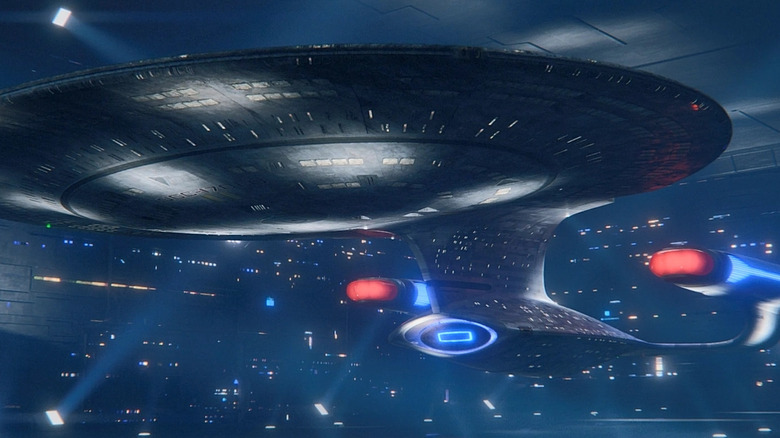
The recent launch of Artemis II not only reinvigorated the general public's interest in space, but also reminded us how cramped space travel remains. Luckily, properties like "Star Trek" envisioned a more extravagant, dynamic-looking future. The massive saucers inherent in Starfleet's ships, the avian aesthetics of the Romulan and Klingon warbirds, and even those chunky Borg cubes represent the diversity of thought on display. As we aim even further beyond our moon, could our own spacecraft eventually break free of boring ol' rockets and resemble something like the USS Enterprise? When I posed the question to Professor Calder, he painted a promising picture:
"Yes, if we start exploring deep space, then you don't need to look like a traditional rocket because you're not going to launch whatever that is immediately off of the Earth. And then if you wanted a probe that could maneuver very well, I mean, some of these things we [already] have. Like the New Horizons went around Saturn and then Galileo went around Jupiter. You would notice some patterns in the design. So, yes, I'll buy that."
That's all well and good for the artistically-minded among us, but what about the internal components of the vehicle? Our chemically-fueled rocket engines rely on brute force to escape Earth's gravity, but is there a more elegant approach? According to Calder, that's where another classic "Trek" starship concept shows potential. "There are ideas of matter and antimatter engines, where you have a store of antimatter — and how you do that is another story. But you bring that in contact with matter and they annihilate each other, and that's 100% efficiency. You go from matter to energy with no loss."
Again, we're not quite there yet, but the research is ongoing.
The Enterprise's holodeck could be the perfect workaround to a very real spaceflight concern
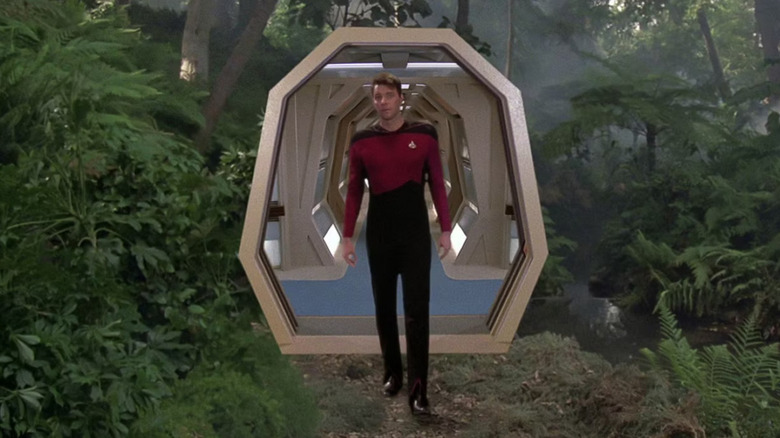
Not to burst anyone's bubbles, but there's arguably no environment that humans are less suited to survive in than space. Even within the confines of a fully-functional starship, loaded with life support systems and resources and shielding from the never-ending dangers that lurk outside, the utter lack of gravity alone is known to cause adverse side effects in the human body. That's not even getting into the nitty-gritty details of lethal radiation exposure (which, with all due respect to "For All Mankind," our expert believes is a serious impediment to any efforts to travel to Mars), interruptions to our circadian rhythm, and plenty more.
Even in the fairly routine explorations of any given "Star Trek" crew, spaceflight is a rigorous ordeal on both body and mind. Recent films like "Project Hail Mary" came up with the so-called "don't go crazy room," which allowed Ryan Gosling's astronaut Ryland Grace to enjoy the comforts of home through images depicting Earth. In "Trek," the holodeck and other cutting-edge tech help keep the mind sharp and alert. In Professor Calder's opinion, science dictates one of two different approaches:
"One is where you have a big ship that has room for people and basically, like the Enterprise, there's couples and Ten Forward and the holodeck, and it's like life. Or you put people in some sort of suspended animation until they get wherever. I do think that the reason that that always appears, it makes for good movies to have people interacting. But even to get to the outer part of the solar system, you would have to do something like that."
And just like that, the goofy joys of the holodeck were vindicated, once and for all.
Scientists are experimenting on tech that could end up resembling Star Trek's transporter
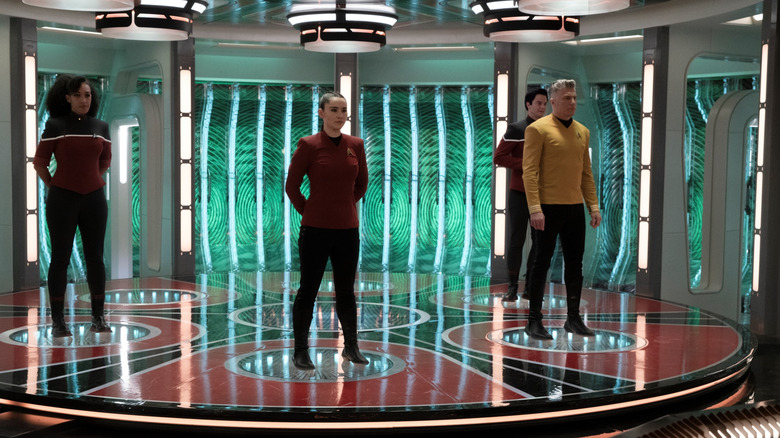
With all this said, one simply can't talk about futuristic travel options in "Star Trek" without addressing the granddaddy of them all: the transporter. From its inception in "The Original Series" back in the 1960s, this quasi-scientific spin on teleportation has remained a sci-fi staple of any "Trek" adventure over the decades (though also a practical one, for budgetary reasons). Well, what was once firmly in the realm of fiction may be closer to fact than most would've ever thought possible.
"People are doing true quantum mechanical teleportation experiments now," Alan Calder explains. Although quick to add the disclaimer that this is not his specific area of research, this is backed up by a wealth of sources (as most recently seen in this National Geographic report). While tantamount to magic to laypeople like us, matters are very different once you shrink down to the quantum level. He goes on to add:
"When you get down to the quantum scale, things are indistinguishable. If you've got an electron in this state, you can't tell that that's any different than an electron in the same state at the same place, even if they can't necessarily be there. So, the quantum teleportation is taking the state of an electron that's in one place and teleporting that to another, but it means assembling the same state in another electron there. Although again, in the quantum, they're indistinguishable.
I think that in principle, you could, through that sort of teleportation, actually move an extended body if you had a lot of energy and a lot of knowledge."
Dare to dream, folks. If "Star Trek" teaches us anything, it's that empathy, creativity, and a little optimism will take us far.