

How Does Star Trek's Holodeck Actually Work? The Wild Sci-Fi Concept Explained
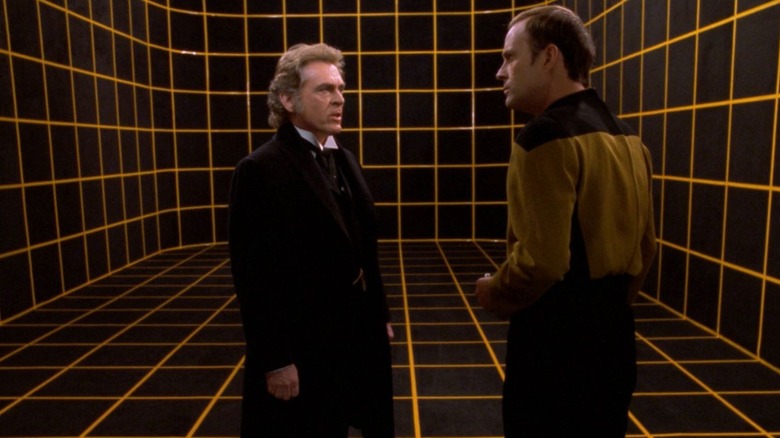
Welcome to Trekspertise, a series where we break down the technology, history, details, and decisions that make the Star Trek universe so complex — and so fun.
Trekkies love to note that the earliest version of the holodeck first appeared on the "Star Trek: The Animated Series" episode "The Practical Joker." It was called a "recreation room," but it could create immersive, holographic environments. That episode also introduced the idea of the "holodeck malfunction," and several crewmates were trapped in the rec room as a holographic blizzard broke out. They had to feel along the non-holographic walls to find their way through the snow.
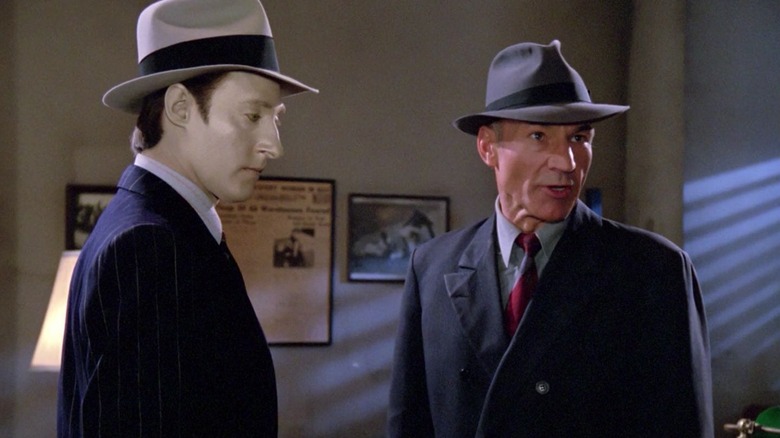
The technology was reintroduced in the pilot episode of "Star Trek: The Next Generation," explicitly called a "holodeck," and shown to create a fully immersive environment even more elaborate than before. Crew members could go on hikes through simulated nature preserves, lounge about in a glade, or violently grapple with holographic martial arts opponents. The late "Next Generation" writer Tracy Tormé expanded what the holodeck could do, and with the episode "The Big Goodbye," introduced the idea that Starfleet crewmembers could walk around inside interactive detective novels, play-acting as their favorite characters and conversing with holographic video game characters. Fans of "Vampire: The Masquerade" have something to look forward to, as it seems LARPing is going to supplant cinema in the 24th century.
The holodeck offered visual variety to "Next Generation," providing an organic reason for starship-bound officers to "get off the ship." In technological terms, one will have to crack open Rick Sternbach and Michael Okuda's invaluable sourcebook, "Star Trek: The Next Generation Technical Manual," to get the skinny on how holodecks work. In brief, anything you see on a holodeck is a 3D light projection, and anything you touch is a carefully calibrated force field.
Everything in a holodeck is made of light and force fields
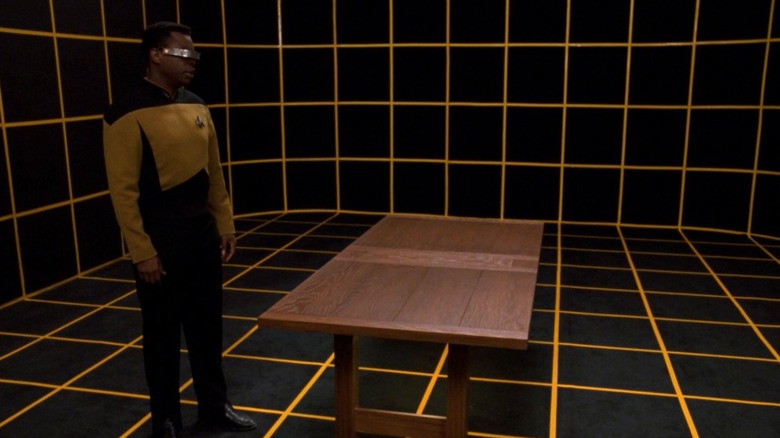
A holodeck is about the size of a small storage warehouse. When a holodeck is inactive, one can see plain walls covered with a yellow grid containing all the necessary projectors and holo-emitters to create a fully immersive environment. There are also climate controls inside a holodeck, so the temperature can change; you can feel the cold of a snowy day, for instance. One can pick up objects that feel real, having been made by a projected series of force fields.
The holodeck is also equipped with the same energy-replicating technology used in the Enterprise's food replicators, so certain smaller objects can actually be manifested for real. If one gets hit with a snowball on the holodeck, one can walk out with a wet shirt. In the episode "Ship in a Bottle," Picard (Patrick Stewart) throws a holographic book out of the holodeck door, and it instantly vanishes. This is a little inconsistent with "The Big Goodbye," in which two holographic characters walk out of the holodeck, only to slowly vanish. It seems that the holodeck's emitters can briefly project out of its own door.
The holodeck doesn't provide crew members with clothing, and "players" are frequently seen entering and exiting holodecks in full costume. Picard, when he wants to act as his favorite detective Dixon Hill, has to wear his own suit and hat. If someone wants to go scuba diving (or kayaking like Chief O'Brien), they have to wear their own wetsuit. This is wise; if you wore holographic clothing on the holodeck and it malfunctioned, as it tends to do, you could be stranded in your underwear.
Holodecks are maybe about 20 feet square, but people walk around on force field "treadmills" or magnetic bubbles. A person can seemingly run in a straight line for miles or walk around a whole building when, really, they are in one place, and the environment is shifting around them.
Can you eat on the holodeck? Can you poop? Can you...you know?
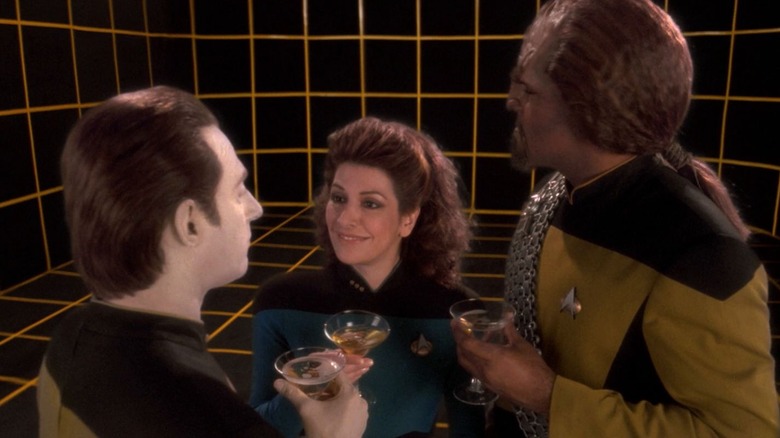
One can indeed eat on the holodeck thanks to food replicator technology, though it's a little unclear how a holodeck decides what to physically replicate and what to simulate as a hologram. I can only imagine that a holodeck user has to make a special request for a replicated physical object.
Thanks to "Star Trek: Lower Decks," we know that one can also poop on the holodeck. Ensigns on a starship are tasked with cleaning out the holodeck's "filters," presumably put in place to remove any, uh, fluids a user might have left behind.
And before you ask, yes, you can also have sex with holographic partners on a holodeck. On "Star Trek: Deep Space Nine," the all-time great "Trek" character Quark (played by all-time great character actor Armin Shimerman) owns a raft of "holo-suites," which are smaller-sized holodecks designed specifically for sexual purposes.
But beyond playtime, the holodeck can create a simulation that actually works alongside, and impacts, a ship's main operations. Specifically, it can transfer energy and information back into the computer systems. In the "Next Generation" episode "The Nth Degree," Lieutenant Barclay (Dwight Schultz) was able to use the holodeck to create a high-tech neural interface that allowed him to plug his own brain directly into the Enterprise's main computers, even though the connectors were only holograms.
So it's not all screwing and pooping.
Just how real is the holodeck and its NPCs?
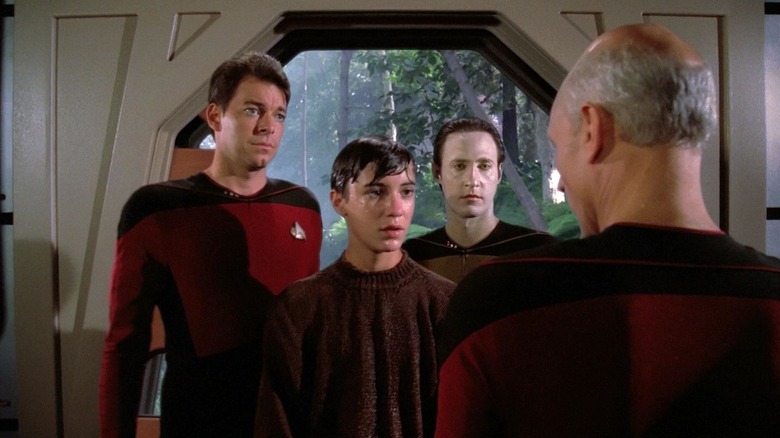
The NPC characters on holodecks can be extrapolated from real people, or they can be wholly fictional. There is certainly an ethical dilemma involved with creating a simulation of a real person on the holodeck and then killing them or having sex with them.
The computers that control the NPCs are so complex that they can actually create conscious beings, even by accident. There have been many sentient holograms throughout "Star Trek," so one must be very careful if they don't want to summon a living creature. The Doctor from "Voyager" is the most famous of the self-aware holographic people in the "Trek" universe, you may also recall the villainous Moriarty from "The Next Generation" and jovial nightclub singer Vic Fontaine from "Deep Space Nine," all of whom were allowed to grow beyond their original programming.
But can you, a non-holographic visitor, get hurt on the holodeck? Not usually. Throughout all "Star Trek" shows, there is constant dialogue devoted to the holodeck's "safety protocols." There seem to be fail-safes in place to make sure that nothing is too dangerous. One can't fall off a building and die while using a holodeck. However, in the episode "Descent," it's explained that two senior officers can disable the safety protocols, making holograms potentially lethal. In the movie "Star Trek: First Contact," Captain Picard disables the safeties on his own, creating a Tommy gun that can fire lethal holographic bullets.
Thanks to various writing contrivances, the safeties are accidentally flipped off repeatedly throughout the franchise, giving a sense of real danger, even if it's just holograms. "Holodeck malfunction" was a very, very common story trope on "Star Trek."
The ethics of holodeck use are an ongoing concern
The main characters on "Star Trek: The Next Generation" are all Starfleet officers and are expected to behave in an ethical fashion. That said, they still sometimes use the holodeck for unsavory reasons. Barclay was famously addicted — afflicted with "holodiction" — and used the technology to recreate his Enterprise crewmates in fantasy scenarios. He would beat up his commanding officers and program Counselor Troi (Marina Sirtis) to be sexually attracted to him. There is no mention of the legality of such creations, but doing so is considered a personal violation. Troi gets outraged when she sees Barclay's recreation of her. So, yes, you technically can create a duplicate of a living person on a holodeck, but it's not cool.
The "Deep Space Nine" episode "Meridian" treads into similar territory, but reveals this is a problem that goes far beyond Starfleet personnel.
These ethical limits were taken to an extreme in the "Star Trek: Lower Decks" episode "Crisis Point," when Ensign Mariner (Tawny Newsome) turns a holodeck program into a means of taking out her anger on her mother, eventually facing her own mom in combat and almost "killing" her. Luckily, Mariner's friends note that these dark holographic fantasies are a good sign that Mariner needs therapy. Yeah, I'll say. We deemed "Crisis Point" to be one of the best episodes of the series. And this is before we even talk about "Lower Decks" characters like Lt. Shaxs and Dr. T'Ana using the holodeck to simulate violent (and often erotic) murder scenarios. You know, just for fun.
It's a miracle technology, but it must be used responsibly.