

5 Best Movies Like 2026's Resident Evil
This article contains spoilers for "Resident Evil."
This month's "Resident Evil" is a movie born of its own complex lineage. Technically, it's the eighth live-action feature film in the "Resident Evil" franchise. It also follows an eight-episode live-action TV series that premiered on Netflix in 2022. With that series and the 2021 film "Resident Evil: Welcome to Raccoon City," 2026's "Resident Evil" is the third live-action adaptation of the successful Capcom video game series to reboot continuity. Even though the movies written and/or directed by Paul W.S. Anderson from 2002-2016 ostensibly take place in the same fictional universe, those films became notorious for constantly leaving cliffhangers unresolved and having main characters go missing. Meanwhile, the main video game series itself has undergone its own string of changes, ranging from several remakes to a revolving door of main characters and a variety of settings.
All this is to say that "Resident Evil," when taken as a whole, contains a wide variety of influences beyond the usual suspects. While a small (albeit vocal) section of fans would demand more consistency in live-action adaptations of the series, the variety and malleability of "Resident Evil" is what makes it so consistently exciting. That's certainly the case with the latest movie, directed by Zach Cregger, who also co-wrote the script with Shay Hatten.
"Resident Evil" is Cregger's follow-up to his award winning film "Weapons" from last year, and this movie carries the DNA of that film as well as that of Cregger's other horror feature, "Barbarian," too. It's also frequently hilarious, the clear product of Cregger's work with the sketch troupe "The Whitest Kids U'Know." In addition, "Resident Evil" exhibits some influences beyond Cregger's own filmography and the varied history of the "Resident Evil" franchise.
Here are the 5 best movies most like "Resident Evil," in no particular order.
Evil Dead II (1987)
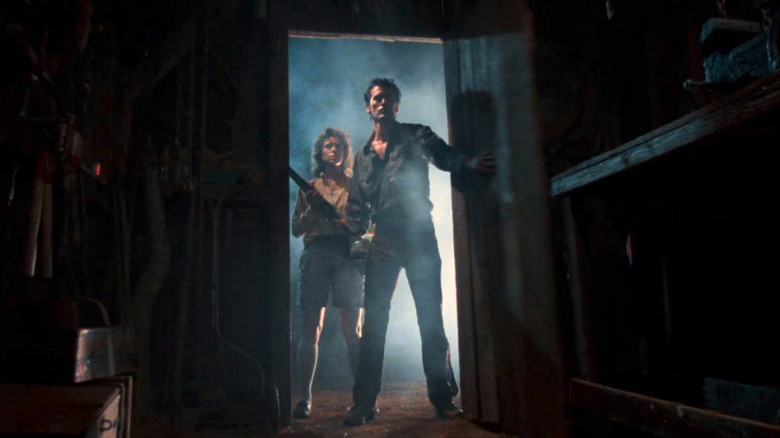
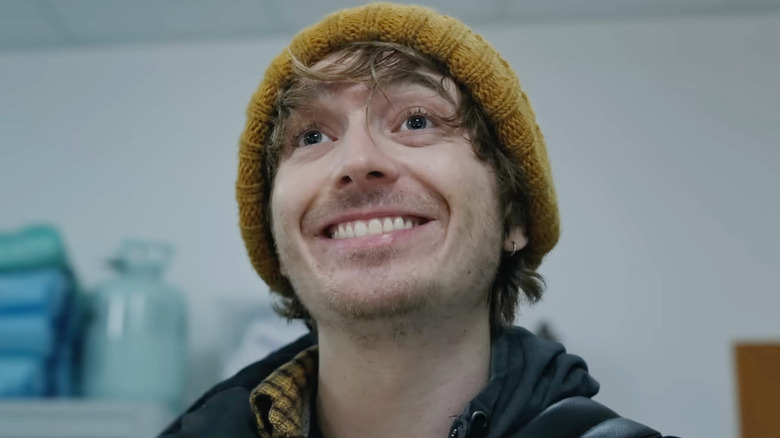
During its tight 90-minute runtime, "Resident Evil" exclusively follows the exploits of an average putz, Bryan (Austin Abrams), during one long, doomed night. A freelance medical courier, Bryan accepts a last-minute job to take a mysterious parcel to Raccoon City based on little more than the fact that it pays double the rate, not to mention that he's having relationship issues with his girlfriend. From there, we follow Bryan through Raccoon City as it rapidly succumbs to a T-Virus outbreak, courtesy of the buffoons at the Umbrella Corporation. Bryan means well and has a strong resilience, yet he's also painfully average, goofing up as often as he manages to have success.
That element of his character makes him highly reminiscent of the protagonists in most films by Sam Raimi, especially Ash from the "Evil Dead" saga, played with a similar mix of bravado and lunkheadedness by Bruce Campbell. The 1987 horror-comedy classic "Evil Dead II" feels like the closest analogue to the way "Resident Evil" pits Bryan against an increasingly upsetting and bizarre horde of creatures. "Resident Evil" even features a similar ramp-up of beasties as the Raimi film, moving from zombie-esque humans to phantasmagorical Lovecraftian creatures. Though the T-Virus victims in Cregger's movie are reminiscent of other films (most especially John Carpenter's "The Thing"), the film's treatment of them with humor feels far closer to "Evil Dead II."
In fact, the way Raimi blends horror and humor without sacrificing either element is a quality that Zach Cregger has also mastered, and "Resident Evil" is a shining example of this. In addition, Raimi has become famous for having a mean streak toward his protagonists, especially Campbell's Ash, and between "Weapons" and "Resident Evil," it feels like Cregger and Abrams have developed a similar double act.
After Hours (1985)
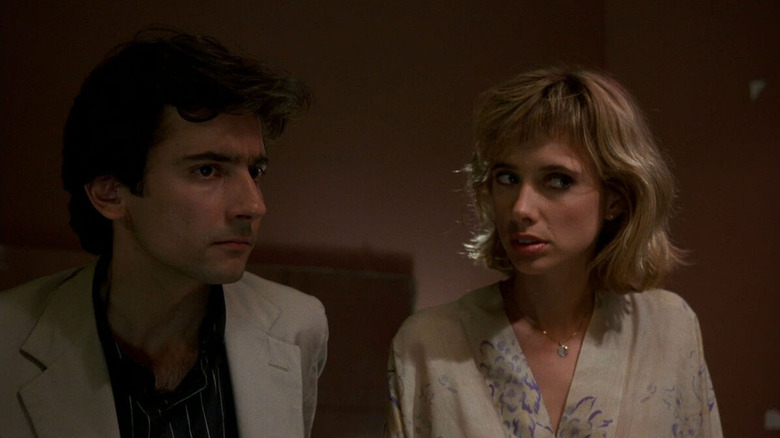
Not every major influence on "Resident Evil" is a horror film. Martin Scorsese's "After Hours" is pointedly not a horror movie per se. However, it shares with Zach Cregger's movie a sense of liminal unease surrounding its average dude protagonist as he descends into a city where strange, unfriendly, and oddly malicious characters lurk at every turn. Scorsese's movie follows Paul Hackett (Griffin Dunne), an upper middle class NYC computer clerk. He meets an alluring stranger, Marcy (Rosanna Arquette), and, like "Alice in Wonderland" before him, follows her into an after hours underworld downtown that he wasn't prepared for. Scorsese and screenwriter Joseph Minion aren't as cruel to Paul as Sam Raimi (or Zach Cregger, for that matter) might've been, yet their neo-noir black comedy doesn't exactly let him off the hook, either.
As a result, "After Hours" is the consummate example of a perennial cinematic trope, what I tend to call the "one long night" movie. The trope is admittedly a loose one, as it applies more to a cinematic structure than it does a tone or genre. Yet most "one long night" movies tend to be an odyssey of some sort, and often indulge in circumstances and stakes increasing to bizarre levels. "Resident Evil" absolutely belongs to this trope, as it's not just victims of the T-Virus that Bryan encounters. He also meets various employees of the Umbrella Corporation, all of whom are either remarkably self-involved, or, as with Paul (Paul Walter Hauser), sociopathic in a way befitting of a big tech company. That's one of Cregger's biggest and best jokes in "Resident Evil," which is that essentially the entire Umbrella Corp. is made up of Paul Hackett types.
Creepshow (1982)
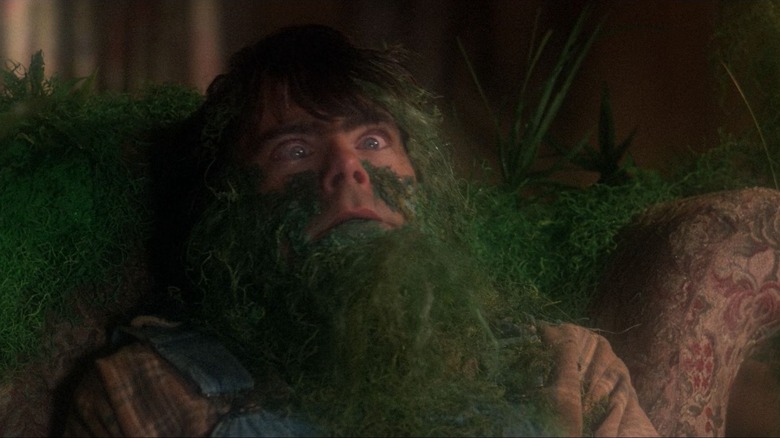
It would feel like a minor sin to leave George A. Romero off this list, not only because he's the creator of the modern zombie mythos with 1968's "Night of the Living Dead," but because he famously very nearly made his own "Resident Evil" movie (and did, in fact, direct a live-action commercial for the "Resident Evil 2" game). Yet it's not one of his zombie films that Zach Cregger's "Resident Evil" most closely resembles, even though the film's mid-apocalypse settings and trappings certainly apply. Instead, "Resident Evil" 2026 recalls Romero's collaboration with Stephen King, 1982's "Creepshow.
Yes, "Creepshow" is an anthology movie, and thus not every segment can be seen reflected in Cregger's film. But a good chunk of it resides in the movie's DNA. Thus, there are echoes and connections to be found: in one segment of "Creepshow," a character is menaced by seemingly endless killer cockroaches. In "Resident Evil," Bryan has to contend with dozens of possessed rats.
The biggest resonance between the two films involves Bryan's character, as reflected by Stephen King himself in the "Creepshow" segment "The Lonesome Death of Jordy Verrill." King plays the titular Jordy, a not-too-swift farmer who foolishly touches a mysterious meteor that falls on his property one night. Soon enough, poor Jordy has been overcome by a persistent alien weed that won't stop growing over everything, including himself. Bryan, just like Jordy, is doomed as soon as he's bitten by a T-Virus creature, and all his efforts to stave off the inevitable only result in his total transformation into a monster and the deaths of several others. Bryan, like Jordy, is a dope who unwittingly dooms not only himself, but perhaps the world, too.
Maze Runner: The Death Cure (2018)
I was very tempted to put Paul W.S. Anderson's 2002 "Resident Evil" on this list in order to cheekily point out how versatile the franchise has been and continues to be. I also legitimately believe the film to be an innovative step in video game adaptations, as Anderson makes the character of Alice (Milla Jovovich), who was never in the games, a sort of "player character" analogue by way of her amnesia. It makes "Resident Evil" not just a movie adapted from a video game but a film that adapts structural and narrative tropes of video games themselves, similar to how Zach Cregger's "Resident Evil" brilliantly adapts the mechanics of survival horror gaming.
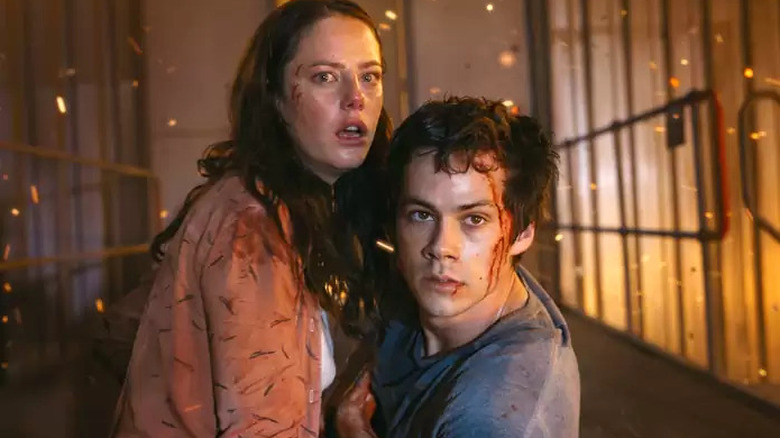
Yet there exists another, underseen movie franchise whose filmmaker, Wes Ball, also has an innate understanding of video game grammar. That franchise is "The Maze Runner," adapted from a series of young adult novels. The third in the film trilogy, 2018's "Maze Runner: The Death Cure," feels very close to Cregger's film. Both movies' third acts feel especially similar, as "The Death Cure" and "Resident Evil" eventually end up inside the skyscraper headquarters/labs where a cure to their respective apocalyptic viruses (the Flare in "Maze Runner," the T-Virus in "Resident Evil") might be found.
Though Ball's movie is set in the future, both films have sci-fi elements in addition to horror, and the blend of those genres is so often found in video games. The skyscraper setting for the finales of both movies presents a very video game-like structure as well. Once Bryan in "Resident Evil" or Thomas (Dylan O'Brien) in "The Death Cure" reach the top floor, the ending is literally and figuratively nigh.
Eraserhead (1977)
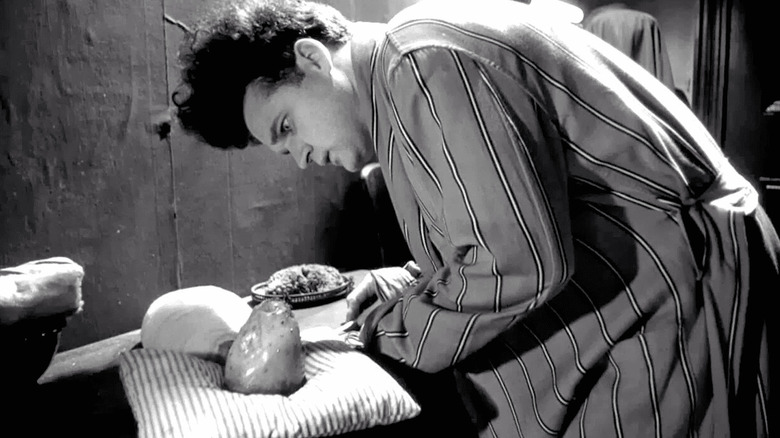
"Eraserhead," David Lynch's student film-turned-feature debut, is pure American surrealism suffused with horror movie imagery. Where the film and Zach Cregger's "Resident Evil" fascinatingly overlap is in their thematic subtext. In "Eraserhead," Henry Spencer (Jack Nance) is awkwardly informed that he's going to become a father. What follows is either a surreal representation of Henry's experience having to deal with his unwelcome child, a dream (or nightmare) version of these events, or some conflation of the two. While Lynch was famously tight-lipped on the ultimate meaning of his film, a popular theory is that Lynch was incredibly anxious in real life about the birth of his daughter, Jennifer.
Although it's not known if Zach Cregger harbors similar anxieties in his personal life about fatherhood, there is a very similar subtext running through "Resident Evil." My colleague Chris Evangelista called this an "undercooked storyline" in his review, which is fair, yet I find Cregger to be a filmmaker who's more interested in implication and ambiguity rather than strict narrative set-ups and pay-offs.
The very first moment of the film sees Bryan trying to dodge responsibility for what he's helped create, tying his selfish abdication to that of the Umbrella Corporation's T-Virus mistake. A harrowing setpiece inside a maternity ward taken over by the virus is essentially Bryan's worst fears made manifest, akin to Henry's vision of his mutant, sickly baby. The finales of both films involve the two men rejecting fatherhood in favor of something far more destructive: Henry kills his child and is birthed into a new realm where he can indulge in his love for another woman, while Bryan is reborn as a T-Virus monster who consumes everyone he sees. As the title implies, some evil was already living with him.
"Resident Evil" is in theaters now.