

5 Star Trek: The Next Generation Episodes With Great Space Battles
To put it on the record right away: "Star Trek: The Next Generation" isn't really a "space battle" kind of show. Creator Gene Roddenberry launched "Next Generation" in 1987 with the hopes of making it even more peaceful, egalitarian, and diplomatic than the original "Star Trek." He even instilled a strict policy of no interpersonal conflicts between the main characters, which, as you can imagine, frustrated the show's writers to no end.
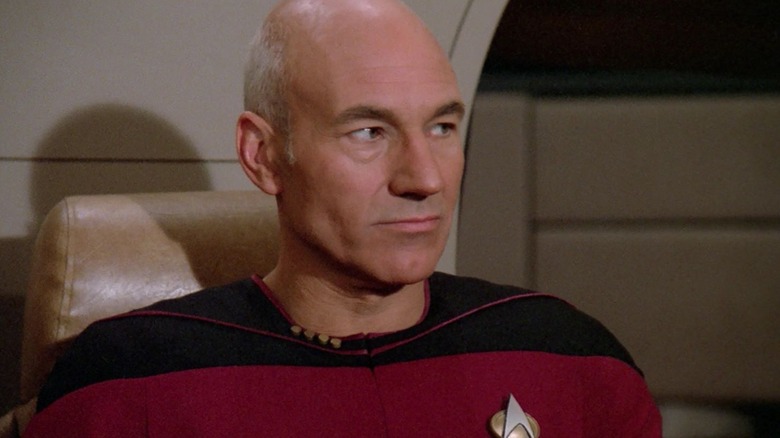
The USS Enterprise-D may be equipped with powerful phaser banks and a full complement of photon torpedoes, but the ship rarely enters into any situation with weapons hot. Even when an enemy vessel appears directly in their path, the ship will merely go to yellow alert, and Captain Picard (Patrick Stewart) will calmly ask what it is they might want before taking any kind of tactical action. Yes, the Enterprise can fight off attackers, and Starfleet vessels are sometimes used to form blockades or provide weapons backup to tense situations, but it's rare that you'll see any of them firing the first shot.
As such, space battles are actually somewhat rare on "Star Trek: The Next Generation," and conflicts aren't always solved when an enemy vessel is blown up. That kind of story resolution is more feted in the "Star Trek" movies, which tend to skew away from diplomacy and toward traditional Hollywood action schlock.
But that doesn't mean that the Enterprise doesn't have a whole dictionary of evasive maneuvers, attack patterns, and other tactical techniques that it's fully ready to employ in an emergency. Indeed, even Captain Picard invented an attack pattern — the Picard Maneuver — which involves using a split second of warp speed in the middle of a battle. Other such exciting battle maneuvers can be seen in the episodes below.
5. Descent, Part II
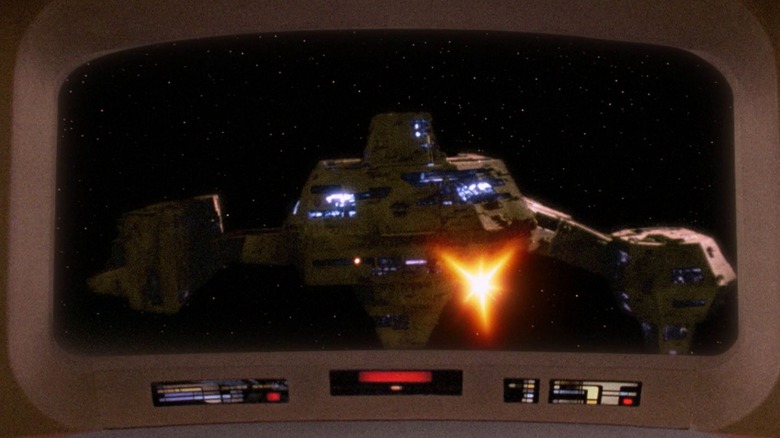
In the second part of "Descent," the two-part episode that bridged Seasons 6 and 7, the Enterprise finds itself battling an outside Borg vessel helmed by a cult of passion Borgs ripped from their original hive-mind collective. Like the Borg cube before it, the new vessel seems indestructible, and the Enterprise's weapons can land several direct hits without inflicting any damage. The new Borg vessel also has access to some kind of ineffable portal technology that allows it to essentially "slipstream" across vast distances. It is formidable.
In the episode, Picard and most of the Enterprise's senior staff are being held captive on a distant world by Lore (Brent Spiner), Data's evil twin. Lore has arranged himself as the Messiah in a newly formed cult of freed Borg drones and aims to build a better future for them, whatever that means. Back on the Enterprise, Dr. Crusher (Gates McFadden) is left in charge, and she has the unenviable task of fighting the Borg vessel without much of a head for tactics.
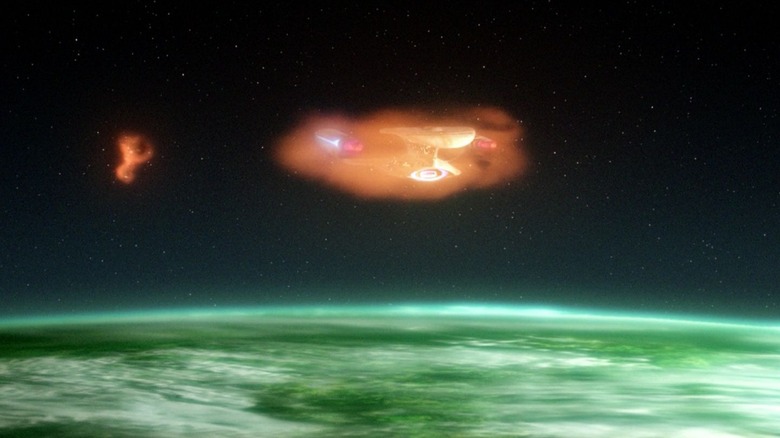
Dr. Crusher, however, remembered the events of the episode "Suspicions," and that the Enterprise could be equipped with a special metaphasic shield that allowed it to hide out in the corona of a star. It was one of the rare instances on "Next Generation" when tech from a previous episode became a plot point later on. Dr. Crusher took the Enterprise to a nearby sun and hid out, able to stay out of range of the Borg's weapons. Then, using the ship's phasers, she was able to instigate an enormous solar flare, which overwhelmed and destroyed the Borg ship. It was a clever solution to a desperate situation.
4. Booby Trap
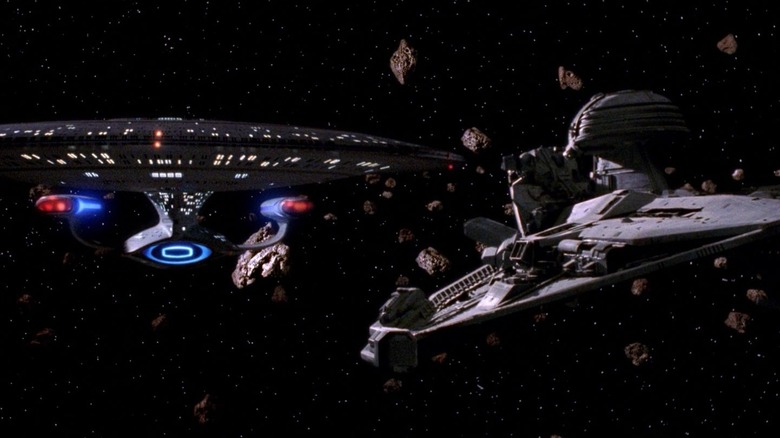
There isn't much of a weapons-hot battle in "Booby Trap," but the plot of the episode is about the USS Enterprise becoming snarled in a conflict. In a distant asteroid field, the Enterprise has located a Promellian battlecruiser, fully intact, left over from a war that had been fought between the Promellians and the Menthars 1,000 years earlier. Picard, being an archaeology enthusiast, is eager to fly up close and take a look, but his interest proves reckless. It seems that the battlecruiser was snared in an energy-draining minefield, laid by the Menthars a millennium ago, and now the Enterprise is caught in it as well.
Every time Geordi (LeVar Burton) tries to muster up the engine power that the Enterprise would need to escape the booby trap, everything on the ship spontaneously begins to power down. Eventually, the Enterprise will lose life support power, and everyone on board will suffocate. Geordi has to consult with a holographic version of the ship's designer, Dr. Leah Brahms (Susan Gibney), to get some better insight as to how the Enterprise functions.
Because there is no power for weapons — or anything else, really — the crew of the Enterprise has to use their wits to escape. Geordi eventually finds that shutting everything down, and piloting with simple thrusters and relying on physics can haul the Enterprise out. The Enterprise was victorious, unwittingly drawn into battle from a war that had been forgotten about centuries ago. There is one weapon fired at the end of the episode, when Picard orders that the snared Promellian cruiser be finally destroyed. It's been 1,000 years, but the war is only, just then, ended.
3. The Arsenal of Freedom
In the first-season episode "The Arsenal of Freedom," the USS Enterprise is on a search mission to locate the USS Drake, which went missing many years ago. They don't find the Drake, but they find the planet Minos, which seems to be populated by only one enthused salesman, played by legendary character actor Vincent Schiavelli. The salesman says that he would love to sell them the best weapons system ever developed, and instigates a demonstration that, naturally, proves life-threatening. On the planet below, several members of the Enterprise's senior staff have to contend with small flying drones, equipped with phasers, that seem able to adapt to any attack. It can also project holograms, temporarily creating humans that the Enterprise crew might have known.
The reveal at the end of the episode is that this adaptive automated weapons system was what wiped out the Minosian people many years ago. The salesman, meanwhile, is just hoping to make a sale.
Up in orbit, Geordi has been left in charge of the Enterprise, and he too has to face off against an unmanned battle craft that can cloak itself. Geordi didn't have too much command experience at this point in the series, and had to develop interesting tactics to take care of the invisible threat. He eventually resolves to separate the Enterprise, and send the saucer section — the part with all the civilians living on it — away to safety. Using only half the ship, Geordi dips into the ionosphere of the planet, causing it to heat up. Luckily, the drone follows it, making itself visible for a few moments. Geordi is able to fire at an opportune moment, proving that he has some command skills after all. It's a fun episode.
2. Peak Performance
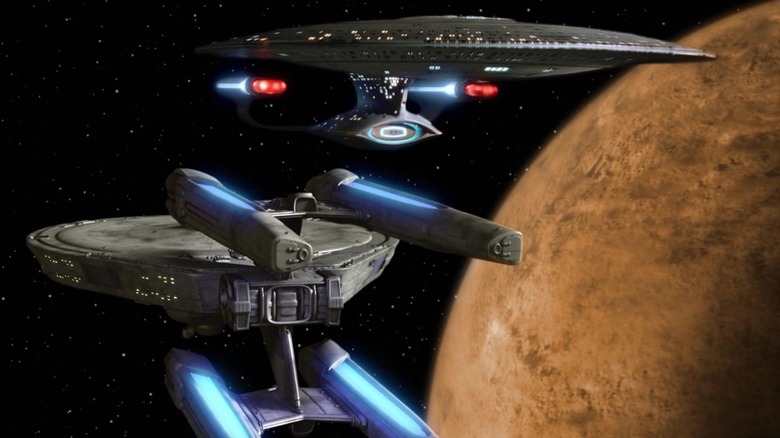
The episode "Peak Performance" is all about battle tactics, and introduces a master starship tactician named Kolrami (Roy Brocksmith) who has been called to the Enterprise to test its battle-readiness. The Enterprise is to be placed in a battle situation with a real-life ship, and the two ships will fire fake weapons at one another, scoring points for hits, and be graded on their cleverness. Commander Riker (Jonathan Frakes) is put in charge of an 80-year-old vessel called the USS Hathaway, and he and his crew have to engage in subterfuge to score any hits. The ship is so old, it's underpowered and can't go to warp. But Riker is clever.
The ensuing subterfuge is golden. Riker selects the teenage Wesley Crusher (Wil Wheaton, whose career was almost sabotaged by "Star Trek" producers) to be on his staff on the Hathaway, and Wes insists on bringing a school project with him, something Kolrami reluctantly agrees to. The project, however, contains a tiny amount of antimatter, which Riker can use to bring the Hathaway to warp for a moment. From the Hathaway, Worf (Michael Dorn) is able to manipulate the Enterprise's sensors and project fake vessels on their viewscreen. It's a thrill to watch Starfleet's best and brightest playfully attack one another in simulated war games.
Naturally, a Ferengi vessel arrives in the middle of the war games and complicates matters quite a bit. Luckily, the warp burst and the sensor ghosts come in handy against the Ferengi vessel as well. On "Star Trek," battle strategy may be vital in a serious combat scenario, but it's also a chance to express one's intelligence and resourcefulness. And what is "Star Trek" but a series about smart people using their brains to solve complex problems? "Peak Performance" is a smart episode.
1. The Best of Both Worlds, Part II
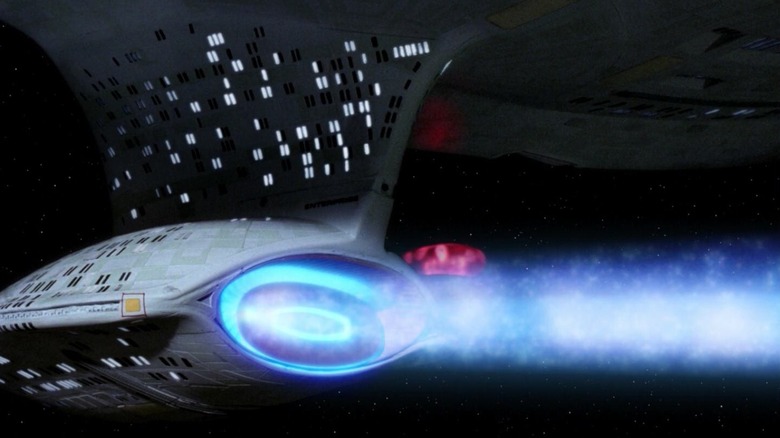
The most famous episode of "Star Trek: The Next Generation" is also often considered its best. "The Best of Both Worlds" is the one where Captain Picard is kidnapped and assimilated by the Borg. As the super-drone Locutus, Picard leads a strike against Earth, and destroys many Starfleet vessels, and ends about 11,000 lives. It's one of the most violent moments in the entire series.
Of course, at the beginning of the episode, the USS Enterprise has to try out a few tactics first. The crew tries channeling a huge amount of power through their main deflector dish, but the super-blast does no damage to the Borg vessel. The Borg can adapt to any attack and their vessels can rebuild themselves when damaged, and they become more dangerous when they scan Picard's brain and incorporate all his knowledge into their hive mind. The Enterprise, however, keeps on trying. The ship separates to confuse the Borg cube, and hits the ship with an antimatter spread. All kinds of new tactics are needed, and rarely are they effective.
The ultimate strategy is to re-kidnap Picard, now a Borg, and see if his machine-implanted brain can offer them any kind of link to the Borg, hence providing them tactical advantage. In true "Star Trek" fashion, the Enterprise crew finds a way to defeat the Borg without weapons. Using Data's android brain, they can snake into the Borg's systems and reprogram them from the inside. The Borg may be an unstoppable combat force, able to overwhelm any ship in battle, but they are also machines that don't recognize that someone else has told them to shut down for maintenance. This is "Star Trek" at its finest.