

Star Trek: Deep Space Nine's Best Episode Was The Result Of A Night Of Drinking
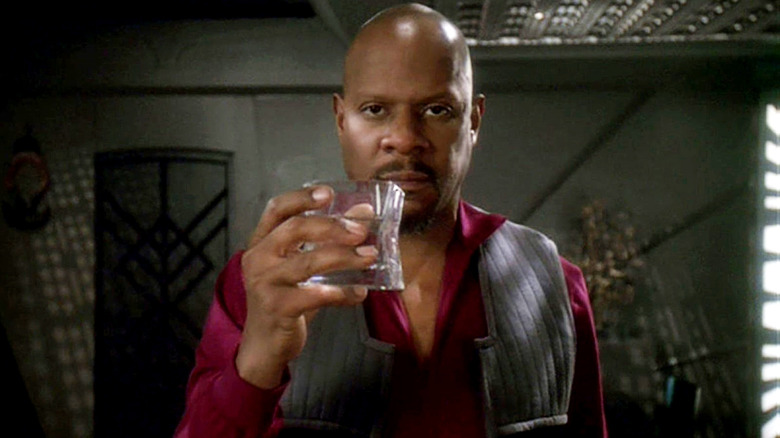
One of the most controversial episodes of "Star Trek: Deep Space Nine" is also arguably its very best. The season 6 episode "In the Pale Moonlight" highlights all that is great about "Deep Space Nine" and its captain, Benjamin Sisko (Avery Brooks). The story examines what a Starfleet officer must do when faced with a true ethical dilemma: Captain Sisko must try to figure out how to bring the Romulans into the war with the invading Dominion or risk losing the entire quadrant to Dominion rule, essentially ending the Federation. According to the episode's original screenwriter, Michael Taylor, inspiration for Sisko's decision to use deception to engage the Romulans was inspired by a piece of U.S. history. But producer and writer Ronald D. Moore, who made heavy edits to the screenplay, also found unique inspiration for the episode.
In a retrospective for The Hollywood Reporter, Moore shared that he was having a hard time figuring out the structure of the episode in his rewrites. But after a night of drinking, he was inspired to create a framing device of Sisko drinking and recounting the whole episode directly to camera as a supplemental computer log. By having the captain himself deliver all of the difficult exposition, the more dramatic elements could be depicted without needing to be bogged down with explanatory dialogue or scenes. The frame narrative with Sisko explaining it all works perfectly, and having him drinking as he strips off his uniform for the day makes it much more interesting.
The framing of In the Pale Moonlight gives it added depth
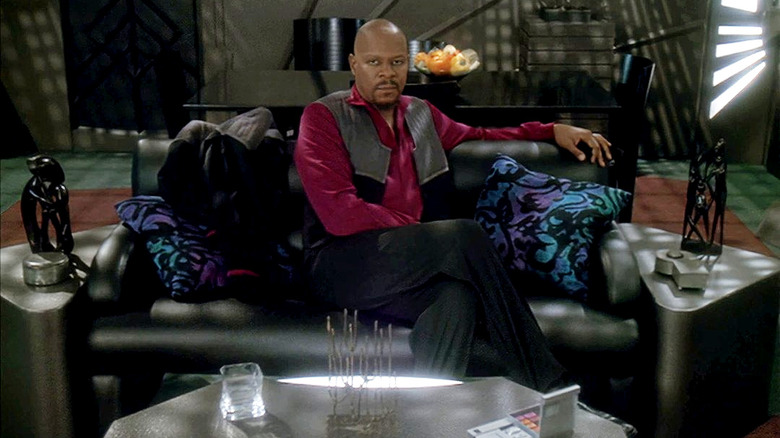
Over the course of "In the Pale Moonlight," Captain Sisko strips away elements of his Starfleet uniform while he explains his story. As he strips away the details and reveals that he was willing to do some very un-Starfleet behavior in order to save billions of lives, he also removes the parts of his outfit that make him so clearly Starfleet. It's a genius detail, and screenwriter Ronald D. Moore explained that it came to him during a night of drinking:
"It came in the same kind of epiphany of 'let's do it all in flashback.' Because once I had that frame, it kind of then defines everything within the [episode's] structure. So the whole business about him taking off the clothes, I don't remember where that came up, but it was a great metaphor for the whole thing. And as I set through the script in that framework, I knew that each scene was a step to hell for Benjamin Sisko in the past, because he was already in hell at the beginning."
By the episode's end, the audience knows that Sisko has traded his self-respect as a Starfleet Officer (and the lives of a Romulan emissary and a criminal) for the Romulans to join the war on the side of the Federation. This made it not only one of the most controversial "Star Trek" episodes of all time, because a captain did something so ethically complex, but also one of its most philosophical.
The Dominion War pushed incredible character growth
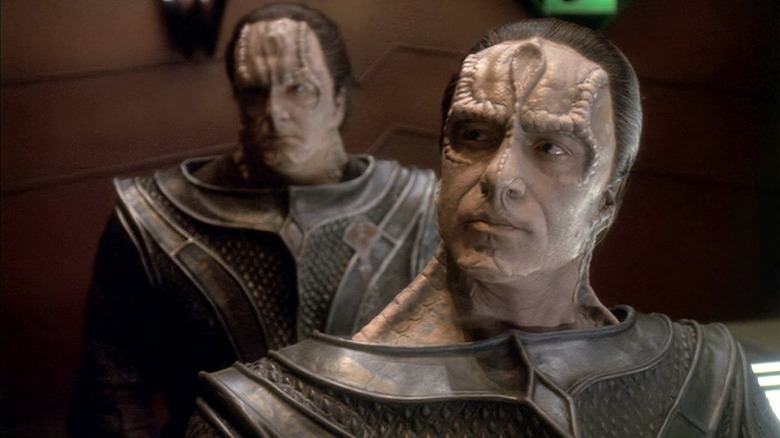
The effects of "In the Pale Moonlight" echo throughout the rest of "Star Trek: Deep Space Nine." Captain Sisko isn't the only one who goes through a total philosophical shift on account of the Dominion War. He's not even the only one who does it while drinking, as the Cardassian Gul Damar (Casey Biggs) ends up chugging down a lot of kanar (a kind of strong Cardassian booze) over the course of the war. When the war begins, he represents all that's wrong about the Cardassian empire, as he's bigoted towards Bajorans and is far too militaristic. But after he becomes Legate and must rule his people while under Dominion occupation, he realizes the error of his ways.
Damar is stunningly complex character performed to perfection by Biggs, which is kind of amazing considering Biggs had to learn major background information about Damar after already playing him for years. By the end of "Star Trek: Deep Space Nine," Damar has not only realized his folly, but has changed his behavior and treats Bajorans with respect. The camaraderie forged between Damar and Bajoran Major Kira (Nana Visitor) is one of the most interesting arcs in season 7, as Kira teaches the Cardassian rebellion how to fight dirty using the tactics she once used on the Cardassians themselves during their occupation of Bajor.
"Deep Space Nine" was never afraid to get a little messy with the ethical questions it posed, but Ben Sisko's stripped down, alcohol-soaked supplemental log was the moment that really kicked off the best the series had to offer.