

12 Movies That Reinvented Genres
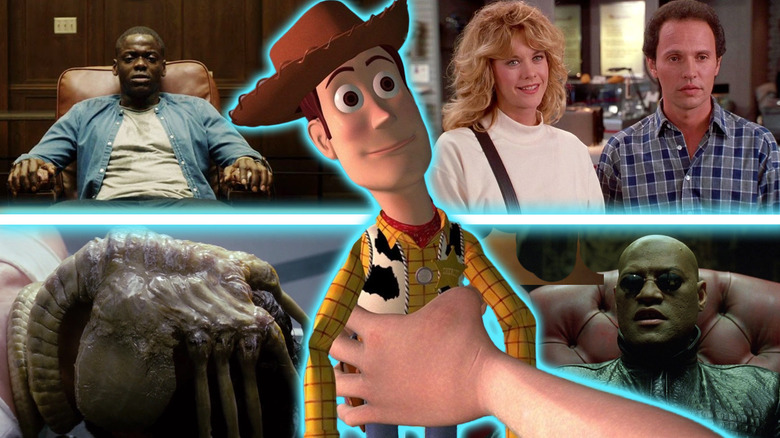
These days, movie genres are more nebulous than ever. Just look at "Everything Everywhere All at Once," which combines science-fiction, action, and family drama, or "Poor Things," simultaneously a raunchy sex comedy and steampunk fantasy. Even Christopher Nolan described "Oppenheimer" as a merging of multiple genres: a hero's journey origin story, a heist, a courtroom drama, a Western, and a horror movie.
However, while these films may break the rules of what constitutes a "genre," there are others that not only firmly fit in a genre, but re-shape it for generations to come. From classics of the '70s and '80s to more recent box office phenomena, these films changed more than just the lives of the performers and filmmakers involved, they affected the future of the movie industry as a whole.
Let's take a look at 12 of these films that we can credit with reinventing their genres, which previously may have suffered from being tired and predictable, or even dominated by one franchise entirely. We'll point out the specific qualities of this film that not only resonated with audiences, but have etched them into cinematic history as timeless movies that, no matter how old or recent, have forever changed their genres.
Sci-Fi: Alien (1979)
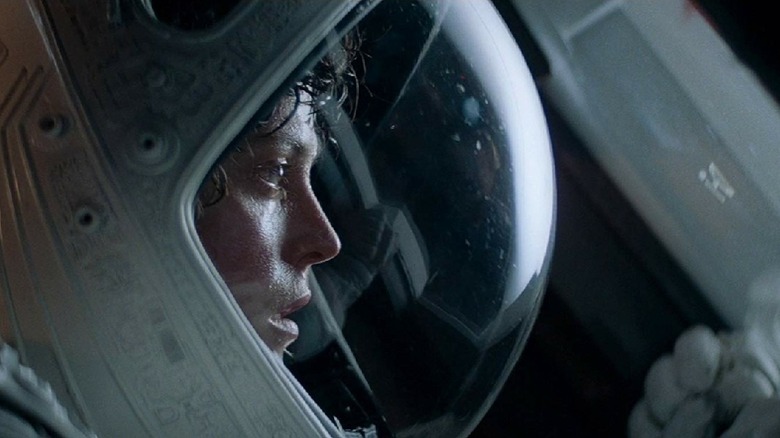
If you've just watched "Alien" for the first time, you might be surprised to find just how different it is to the science fiction movies of today. Truthfully, it's not that different to the reaction when "Alien" first came out in 1979. At the time, science-fiction wasn't taken very seriously, with the exception of Stanley Kubrick's "2001: A Space Odyssey," which came out a decade earlier. Sci-fi was more synonymous with "Star Wars" or "Westworld" in the late '70s than the dark, realistic atmosphere of Ridley Scott's seminal space thriller.
Rather than center on chosen ones, utopian societies, or exploration of galaxies, "Alien" centers on the crew of the spaceship Nostromo, awoken from stasis to investigate potential life on other planets. Sigourney Weaver's Ellen Ripley, not the ship's heroic captain but a pragmatic officer, becomes the sole survivor after a "facehugger" imbeds itself in her colleague, giving birth to a 7-foot-tall violent xenomorph.
Before "Alien," there hadn't existed a film that so successfully blended sci-fi with horror. Ripley's status as a powerful female protagonist was also quite uncommon in the late '70s, especially in a male-dominated genre like sci-fi. Though "Alien" influenced a lot of future films in terms of its world-building and stylistic choices, few have been able to achieve the genuine inventiveness you still experience while watching it today.
Adventure: Raiders of the Lost Ark (1981)
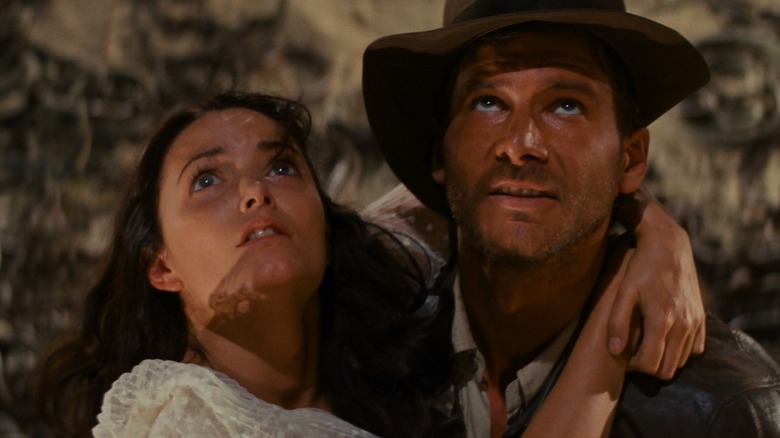
By now, the complete "Indiana Jones" franchise is such a staple of pop culture that it can be hard to imagine a time when it was a pastiche adventure film in a time when the film industry was waning in popularity. Nevertheless, with Steven Spielberg behind the camera, Lawrence Kasden writing the screenplay, George Lucas producing, and Harrison Ford in the lead role, it's also hard to imagine a world in which "Raiders of the Lost Ark" didn't become one of the greatest films ever made, let alone in the adventure genre.
Adventure films are often synonymous with "action-adventure," though where "action" promises cinematic fights or impressive stunts (see: "Die Hard"), "adventure" promises unseen worlds (see: "The Fellowship of the Ring"). "Raiders of the Lost Ark" isn't exactly original; Ford's Dr. Henry "Indiana" Jones is an archaeology professor who moonlights as a fedora-wearing, whip-wielding adventurer recovering artifacts for the sake of preserving history, a clear ode to the serial films of Lucas's youth.
However, "Raiders" was hardly style without substance. Indy is a fully fleshed-out characters with many flaws, from his fear of snakes to his mistreatment of former lover Marion Ravenwood (Karen Allen), herself a more spunky, independent sidekick than could be said for many of Indy's inspirations. There are few adventure films that can't name "Raiders" as a direct influence, with Ford's performance being a benchmark for leading men like Tom Cruise or Glen Powell.
Rom-Com: When Harry Met Sally (1989)
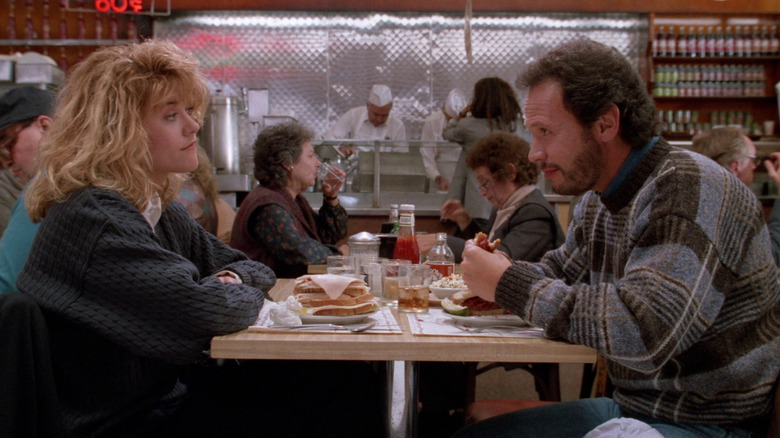
Each of the late, great Rob Reiner's movies feels genre-defining in its own way, whether it's the coming-of-age drama "Stand By Me" or the romantic fantasy "The Princess Bride." However, it's hard to not talk about Reiner without crediting his greatest contribution to cinema: reinventing the romantic comedy with 1989's "When Harry Met Sally...," starring Billy Crystal and Meg Ryan as the titular enemies-turned-friends-turned-lovers-turned-enemies-turned-couple.
Prior to "When Harry Met Sally...," the romantic comedy had more in common with the slapstick genre, as evidenced by screwball comedies like "Some Like It Hot." However, thanks to screenwriter Nora Ephron and with invaluable contributions from Crystal and Ryan, Reiner perfected the genre in this story of two people whose lives keep crossing paths, despite their obvious personal differences making them seem like an impossible pairing. And yet, by the time they share that final kiss on New Year's, it's hard to imagine these characters' lives not ending with them together.
The "enemies-to-lovers" trope has been around since at least Shakespeare's time, but there's something about "When Harry Met Sally..." that gives it a much more modern edge. (Maybe it's the fact that male or female stereotypes have never been so perfectly nailed as they are in this movie.) For many modern rom-coms, like "Sleeping With Other People," "Knocked Up," or "Crazy Rich Asians," you're really just watching a variation of Harry and Sally's love story. Thankfully, it never gets old.
Western: Unforgiven (1992)
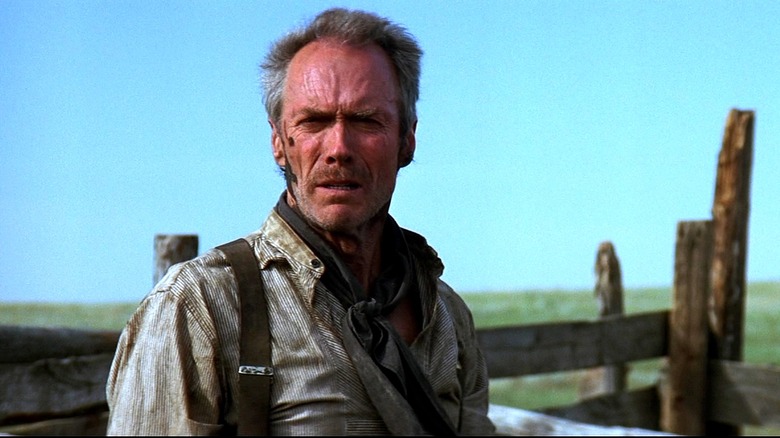
Westerns had a long and storied history by the early '90s, particularly for Clint Eastwood, famously the star of many of Sergio Leone's spaghetti Westerns. Surprisingly, Eastwood hadn't won an Oscar until 1992's "Unforgiven," which he directed and starred in alongside Morgan Freeman and Gene Hackman. Notably, "Unforgiven" marked the end of an era for Eastwood's career as his last traditional Western.
"Unforgiven" follows Will Munny, an outlaw who emerges from retirement to chase a $1,000 bounty for two cowboys who assaulted a sex worker. Though it has many attributes of the classic Westerns that Eastwood cut his teeth on, the film broke new ground for the genre by including far deeper themes, including allusions to Biblical violence and Greek tragedy. Whereas Eastwood's Man with No Name in the Leone films had some sense of justice even as an anti-hero, Will Munny's story isn't so black and white in its depiction of good and evil.
Ultimately, "Unforgiven" didn't just introduce a fresh gravitas to the Western, but practically revived it as a genre. The next few decades have seen plenty of modern classics, from "No Country for Old Men" to "The Power of the Dog." Not only that, it did so by turning many Western tropes on their head, while also serving as a love letter to Eastwood's past.
Animation: Toy Story (1995)
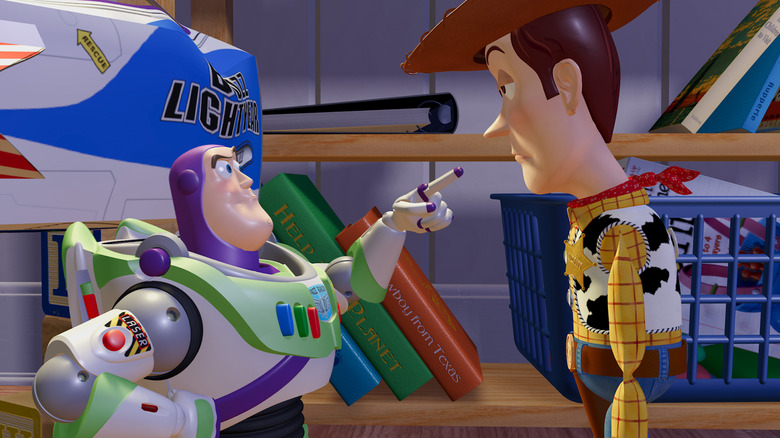
We're being kind of sneaky with this one, because animation is technically a medium, not a genre. But "Toy Story" did change the genre of family friendly animated movies, so hopefully you'll go with us on this.
In 1995, Pixar, backed with funding by Apple CEO Steve Jobs, revolutionized the animation industry with "Toy Story," the first feature to be fully animated with computer-generated imagery. Even with the knowledge of what they were doing, no one who worked on "Toy Story" could've predicted the massive success it'd become, either at the box office or among award pundits.
Tom Hanks voices Woody, a toy cowboy who's the de-facto leader of toys belonging to a young boy named Andy, and Woody's authority is threatened by the latest addition to Andy's toy chest: Buzz Lightyear, an astronaut voiced by Tim Allen who is unaware of his own toy-hood. "Toy Story" appealed to both children and adults, yet again proving that animation wasn't limited to being just for children.
The legacy of "Toy Story" influenced the future of Pixar's success as a studio, leading to box office hits like "Cars," "Wall-E," and "Coco," as well as four sequels in this franchise (including the upcoming "Toy Story 5," which pits toys against tablets) and one spin-off (the critically-panned "Lightyear"). What's most impressive, though, about the legacy of "Toy Story" is that even by 2026's standards, its animation still looks pretty great, even in 3D animation's most primitive state.
Action: The Matrix (1999)
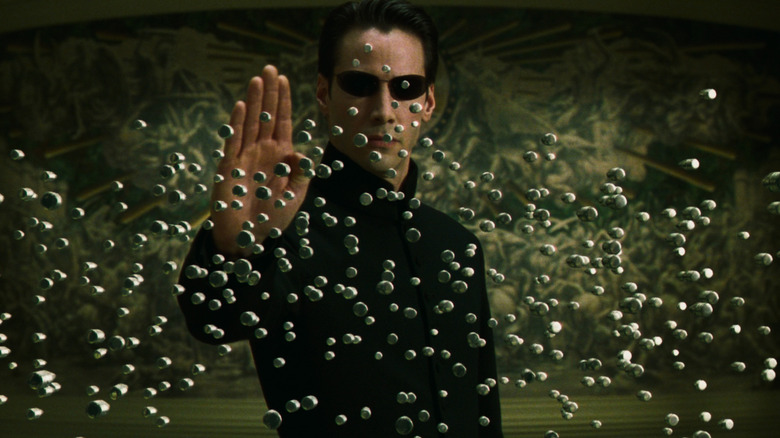
There hadn't ever been a film like "The Matrix" before 1999, and even with all its sequels, there still hasn't. Lana and Lilly Wachowski wrote and directed the film, in which a hacker known as Neo (Keanu Reeves) uncovers the truth that humanity is living in a simulated reality under the control of artificial intelligence. (Yes, this film came out over 20 years ago, even though it's incredibly prescient about current events.)
"The Matrix" broke the box office, and cinema was never the same — particularly action cinema. Prior to 1999, action films consisted of testosterone-fueled franchises like "Dirty Harry" and James Bond. Even sci-fi action franchises like "Terminator" felt more akin to Westerns than the Wachowskis' influences, which included Hong Kong action cinema's highly-choreographed fight scenes and comic books for its visual style.
Not only did "The Matrix" popularize new action movie tropes like "bullet time," but it's essentially the forefather of films like "Inception," Marvel's "X-Men" franchise, and even Reeves' "John Wick" series. It revolutionized how action films were shot and choreographed, while also featuring much deeper themes about humanity's relationship to A.I. as well as allusions to transgender themes and ideas.
Fantasy: Pan's Labyrinth (2006)
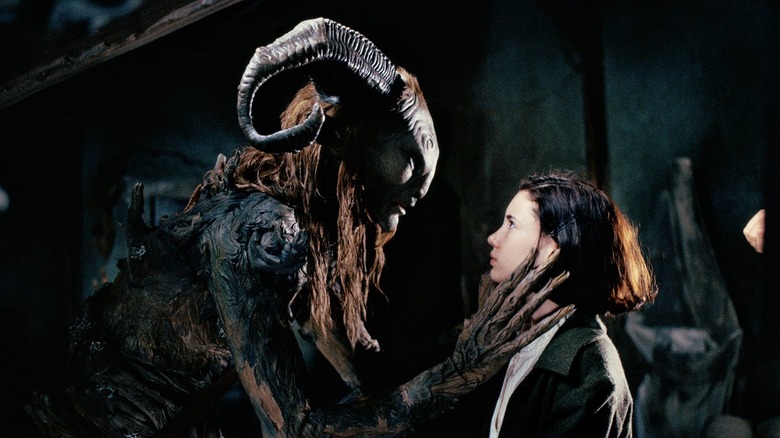
Fairy tales had been a rife subject for filmmaking ever since the early work of Disney, but never had they been interpreted cinematically the way Guillermo del Toro did with "Pan's Labyrinth." Prior to that movie, fantasy films were more family friendly, with some of darkest examples including Jim Henson's Muppet-filled "The Dark Crystal" or Tim Burton's "Edward Scissorhands." "Pan's Labyrinth" makes those films look like Disney's "Snow White and the Seven Dwarves."
In 2006, fantasy was fresh territory for del Toro, who'd directed mostly horror and superhero films. "Pan's Labyrinth" follows a young girl named Ofelia (Ivana Baquero), who, after discovering her connection to a fairy tale princess from the Underworld, navigates a massive labyrinth in order to cure her pregnant mother of a mysterious illness. Despite del Toro's unparalleled vision being on full display with "Pan's Labyrinth," the film doesn't lose sight of its broader commentary on colonialism.
While many believe "Pan's Labyrinth" is still Guillermo del Toro's masterpiece, it's clear that its fairy tale influences have guided the director's career in making films like "The Shape of Water" and "Pinocchio." Furthermore, you may find a lot of fantasy films that strive for the dark depths and visual uniqueness of "Pan's Labyrinth," but saying they're all successful would be an insult to del Toro's singularity as a director.
Coming of Age: Juno (2007)
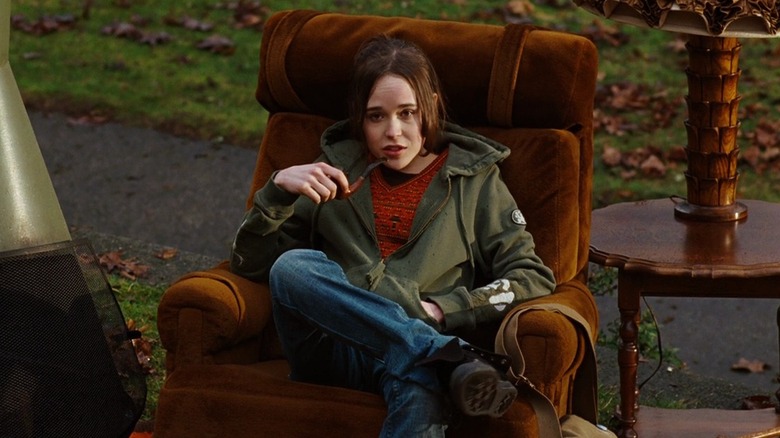
Sabrina Carpenter's album "Short n' Sweet" isn't the only thing the 2007 film "Juno" has inspired. Directed by Jason Reitman and written by Diablo Cody, "Juno" stars Elliot Page as the titular teenager, whose sudden unwanted pregnancy forces her to consider her future far before she's ready, altering her relationships with her parents (played by J.K. Simmons and Allison Janney), the baby's oblivious father (played by Michael Cera), and the pair of optimistic parents she agrees to give her baby to (played by Jennifer Garner and Jason Bateman).
Not only is "Juno" one of the best coming of age movies of the modern era, but for 2007, it was a lot more modern than coming of age films tended to get. Whereas the genre at the time included period pieces like "Little Women" or animated films like "Spirited Away," "Juno" felt grounded in the realities of 2007, from its dialogue reminiscent of authentic teen speak to its taboo subject matter.
You'd be hard-pressed to find more recent coming of age films that weren't influenced by "Juno," especially ones with female leads. Films like Greta Gerwig's "Lady Bird," Bo Burnham's "Eighth Grade," and Olivia Wilde's "Booksmart" all feel indebted to this incredibly poignant and bold coming of age story that treated a pregnant teenager not as a punchline or a fool, but as a smart and good-hearted woman facing the harsh realities of adulthood.
Superhero: Iron Man (2008)
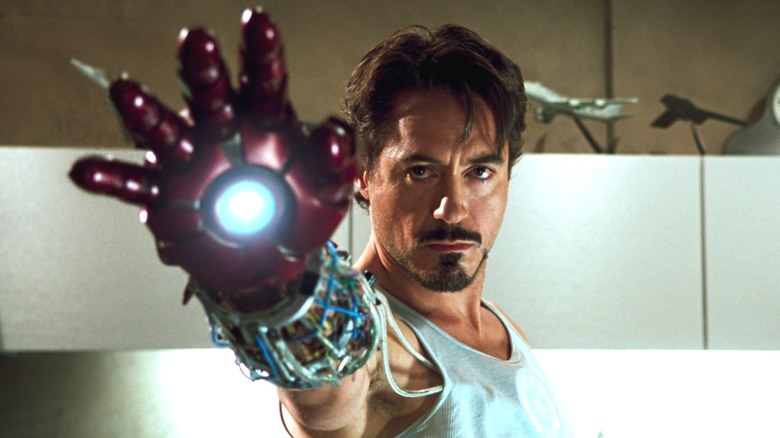
Calling the Marvel Cinematic Universe influential is blindingly obvious, but worth repeating for the purposes of this list. Prior to 2008's "Iron Man," superhero films were prevalent but largely independent of each other. The most notable examples, like "The Dark Knight" or Sam Raimi's "Spider-Man" trilogy, found success as blockbusters mainly thanks to the popularity of their respective heroes.
Before 2008, Iron Man was hardly a household name outside of hardcore Marvel Comics fans. And yet, under the direction of Jon Favreau and with a charismatic performance by Robert Downey Jr., the name "Tony Stark" is as recognized today as real-life tech billionaires like Elon Musk or Mark Zuckerberg. Aside from Downey's charm, "Iron Man" created a superhero narrative grounded in modernity. Stark's status as a weapons manufacturer for the American government gave the character's origins a realistic edge often absent from comic book continuities.
Against all odds, Iron Man became the unlikely superhero that changed Hollywood forever, serving as the face of Marvel's cinematic universe as it grew and grew over the next 10 years, leading up to 2019's "Avengers: Endgame." Over that span of time, superhero movies transformed from a career risk for actors to a complete dominating force in theatrical releases, while other franchises struggled to compete.
War: The Hurt Locker (2008)
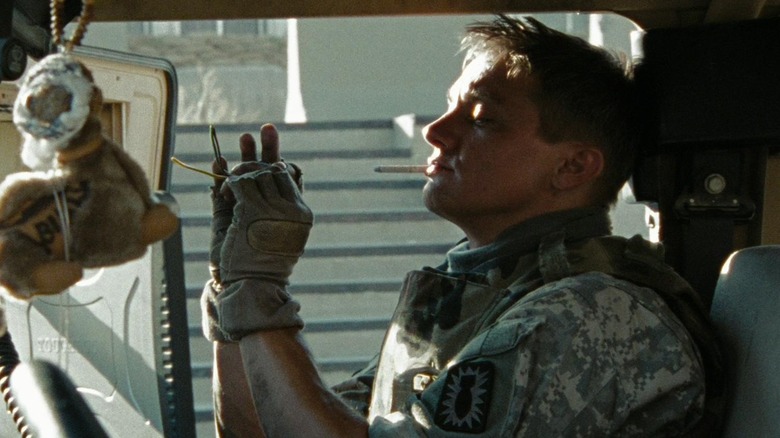
When you think of influential war films, the first that pop into your mind are probably "Apocalypse Now" and "Saving Private Ryan." However, it's unlikely you'll find one as ground-breaking as "The Hurt Locker." Kathryn Bigelow's drama starring Jeremy Renner was released during the Iraq War in 2008, making it as hauntingly relevant as Charlie Chaplin's "The Great Dictator" in 1940.
In "The Hurt Locker," Renner plays William James, a sergeant of the U.S. military's bomb-defusing squad, covering a deeply traumatic aspect of modern warfare that was often eschewed in films before in favor of epic battle sequences and action-packed violence. In this film, war is a metaphor for addiction. In one scene, James returns home from war and goes grocery shopping, his empty scanning of aisles for cereal a stark contrast to the earlier chaos. Frustrated by the lack of action in civilian life, he re-enlists for another year of active duty, leaving his wife and newborn baby.
Though the film garnered criticism for its portrayal of war conditions in the Middle East, it's far from a critically-panned war movie you need to give a second chance. It's an important document in the history of American war cinema that, rather than focus on the action you could get out of a "Call of Duty" video game, focused on the intensity of silence.
Horror: Get Out (2017)
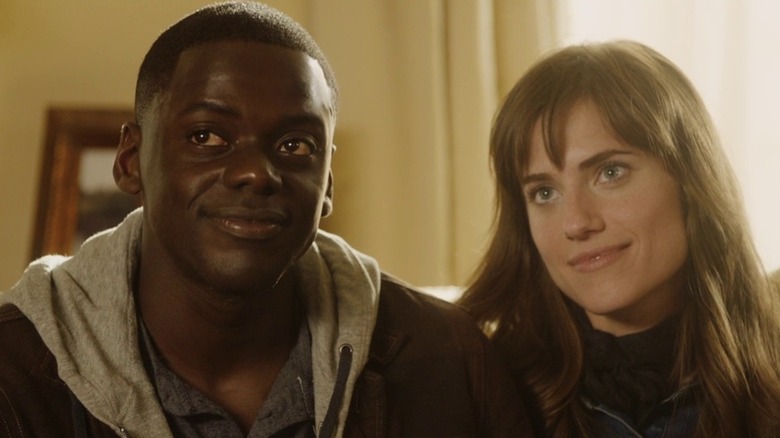
When sketch comedian Jordan Peele announced his filmmaking debut would be a horror film, few could've anticipated it'd be one of the most influential horror films of the past decade. "Get Out," released in 2017, follows Chris (Daniel Kaluuya), whose getaway to his girlfriend Rose's (Allison Williams) family estate doesn't just expose him to subtle racist micro-aggressions, but a secretive society devoted to abducting Black men and women and using their "superior" physical bodies as vessels into which rich white people can surgically force their consciousnesses.
Obviously, anyone who's seen "Get Out" knows how truly thrilling and gripping it is, with Chris making an excellent horror movie protagonist as he navigates these complex social situations. It's also truly harrowing to see Allison Williams go fully dead behind her eyes in portraying one of the most evil beings in all of horror. As excellent at it is being scary, "Get Out" helped usher in a new era of "elevated horror," often foregoing jump-scares for psychological and socially relevant themes.
Among the films reminiscent of "Get Out" released since 2017 include Ari Aster's "Midsommar" and Jane Schoenbrun's "I Saw the TV Glow," though it remains impressive how much of a benchmark "Get Out" is in any type of film discourse. If anything, the overabundance of "elevated horror" may have made audiences hungry for more popcorn horror like "Five Night's at Freddy's" or "The Conjuring: Last Rites."
Comedy: Barbie (2023)
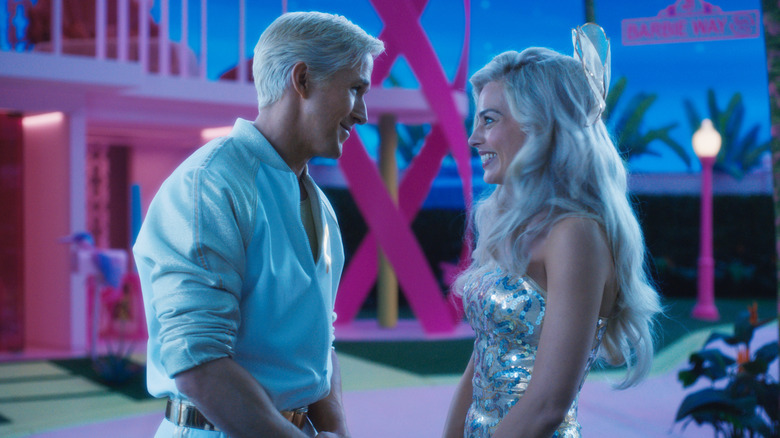
There are two types of people in this world: Those who were in on the "Barbenheimer" trend, and those who weren't. While Nolan's "Oppenheimer" may have racked up the Oscars, "Barbie" topped it at the box office and definitely surprised audiences with an inventive take on adapting a familiar intellectual property. With direction from Greta Gerwig and a screenplay she co-wrote with Noah Baumbach, "Barbie" subverts expectations by finding Margot Robbie's titular doll exposed to the realities of womanhood, while Ryan Gosling's dim-witted Ken discovers the power of patriarchy and enacts it in Barbieland.
However, "Barbie" is more than an uproarious, existential adventure that made for one of 2023's best summer movies. In this day and age, studio comedies (particularly, theatrical studio comedies) aren't as dominant as they used to be. Despite being based on existing IP, its exploration of deeper themes about masculinity, femininity, and the meaning of life is already spawning copycats in A24's upcoming "Barney the Dinosaur" movie produced by Daniel Kaluuya and Amazon's upcoming "Masters of the Universe" movie starring Nicholas Galitzine.
All in all, it's just rare for an IP-driven comedy to be so lampooning of its own brand, with an unsparing amount of meta criticism towards Mattel's exploitative capitalistic tendencies in the movie. Don't be surprised if in the next few years, corporations become more and more comfortable allowing filmmakers to poke fun at them like Gerwig did with "Barbie," because the result was box office gold.