

House Of The Dragon Season 3's Big Death Proves George R.R. Martin Right
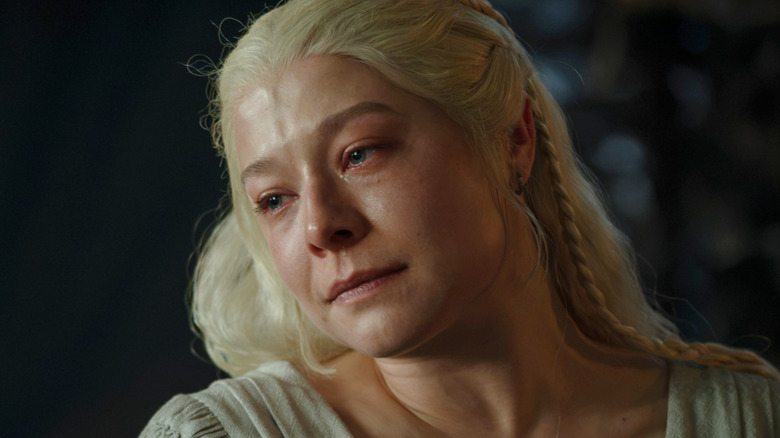
Warning: Dragon-sized spoilers follow for the "House of the Dragon" Season 3 finale.
There may be no such thing as happy endings in the world of Westeros, but some fates are worse than others in "House of the Dragon." Season 3 alone has racked up quite the body count and emphasized the cost of needless war, from Prince Jacaerys (Harry Collett) in the season-opening Battle of the Gullet to the unceremonious death of Fabien Frankel's Criston Cole just a few weeks ago. For others, however, we knew the writing was on the wall — and Episode 8 saves its most heartbreaking death for last.
The finale says one last goodbye to the doomed dreamer Queen Helaena (Phia Saban), who tragically throws herself out a window and ends her life impaled on the spiked moat surrounding the castle keep of Maegor's Holdfast. It's a horrific turn of events that's transposed almost directly from the pages of "Fire & Blood," though the circumstances surrounding it have been completely altered. Of course, we knew this was coming because author George R.R. Martin spoiled it himself almost two full years ago, criticizing co-creator Ryan Condal's Season 3 outline for changing Helaena's motivations and essentially having her kill herself for no reason at all.
While the finale does go out of its way to provide a fair amount of reasoning behind this drastic act, Helaena's death unfortunately proves Martin's point nonetheless. Try as it might, Episode 8 can't fully give this sequence the weight it truly deserves. What we're left with is an unbelievable downer of an ending and the nagging sense that we're left with yet another missed opportunity in "House of the Dragon."
House of the Dragon's Helaena death scene feels abrupt and pointless
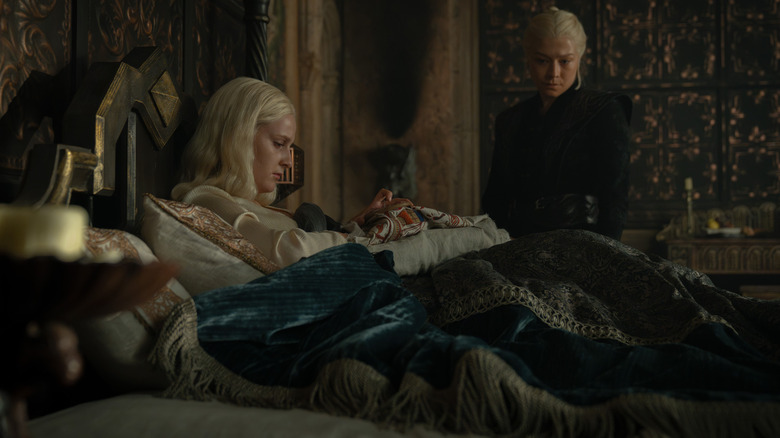
Rest in peace to Helaena Targaryen, the queen who only wanted to quit the ceaseless drama of King's Landing and retire to the countryside with her kids to raise some chickens. The fate the gods had for her instead in "House of the Dragon" feels unimaginably cruel, even if book readers knew her mysterious death was coming sooner or later. The finale doesn't shy away from this, either, beginning the hour by showing her in the midst of a hunger strike and steadily giving her more reasons to be irate about her captivity.
But the way this ultimately plays out can't help but feel somewhat questionable. Helaena has already suffered through the traumatic murder of her young son at the hands of Blood and Cheese in Season 2, yet she continued to carry out her duties as Queen regardless of her own grief. Sure, part of this emotional distance can likely be chalked up to her eccentricities, as she's seemingly more preoccupied with her prophetic dreams and her obsession with bugs than with matters of the realm. But for someone who has been given far more personality and import than her book counterpart, shouldn't her death have felt more ... meaningful? Instead, one parting word by the spurned Mysaria (Sonoya Mizuno) is seemingly all it takes for Helaena to give up all hope entirely, forget about her mother Alicent (Olivia Cooke), who's currently fulfilling her end of the deal so that she may go free, and die by suicide.
It can't help but make viewers what the heck all this was for in the first place. Helaena's death is abrupt and upsetting to the extreme, yes. But worst of all? It almost feels entirely pointless, too.
How Helaena's death in House of the Dragon compares to her death in Fire & Blood
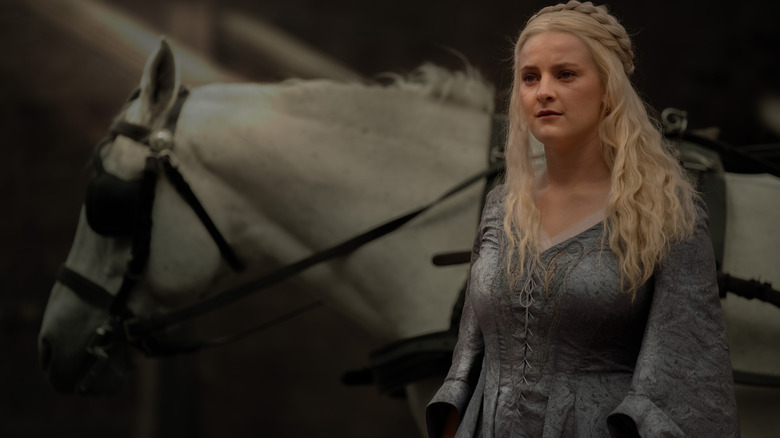
Compare Helaena's bitter ending in "House of the Dragon" to the one in "Fire & Blood." In the book, her captivity at the hands of Rhaenyra (Emma D'Arcy) is far bleaker from the start. She and Alicent aren't given any freedom whatsoever, cooped up in King's Landing and forced to sit by helplessly as the war rages on without them. This is how Helaena receives the news that seemingly bends her to her breaking point — the horrific death of her youngest son Maelor. In the book, he's sent away with a knight of the Kingsguard after the fall of King's Landing to Rhaenyra. They're both discovered by smallfolk and killed gruesomely in a violent riot. It's speculated that this is the reason why she then jumps to her death some time later, but this is largely kept ambiguous in the text.
It's easy to understand why George R.R. Martin was so concerned about the trajectory of "House of the Dragon," after all. Like much of the show to this point, Season 3 has had mixed results in its attempt to tell the darkest chapter of the Dance of the Dragons yet. Part of that has to do with the various changes made to the story, which started with minor reshufflings and soon grew into larger detours over time. But it's a given that adaptations will have to make narrative changes in order to serve a live-action medium. What's frustrating about Helaena's arc is that the changes made don't make for a better or more insightful conclusion — it simply raises more questions.
With only one more season to go, it's worth wondering how satisfyingly "House of the Dragon" can wrap this story up.