

Why Do The Backrooms Look Like That? The Movie Gives Us A Creepy Answer
This article contains major spoilers for "Backrooms."
Kane Parsons' "Backrooms," the feature film spin-off from his popular YouTube series, is well on its way to making history at the box office this weekend. Setting aside the usual popularity of original horror films, "Backrooms" seems to be striking a chord with audiences in a unique manner. Part of this is due to the film's inclusion in the new liminal horror trend, which Parsons' original series helped kick off over the last several years. Liminal horror is a subgenre which emphasizes the uncanny within the ordinary, turning mundane objects and settings into portentous and threatening elements. There's an additional element of the existential injected into the concept of the Backrooms, too, in the way that large, empty, and abandoned spaces conjure up feelings of isolation, loneliness, abandonment, and feeling (literally and figuratively) lost.
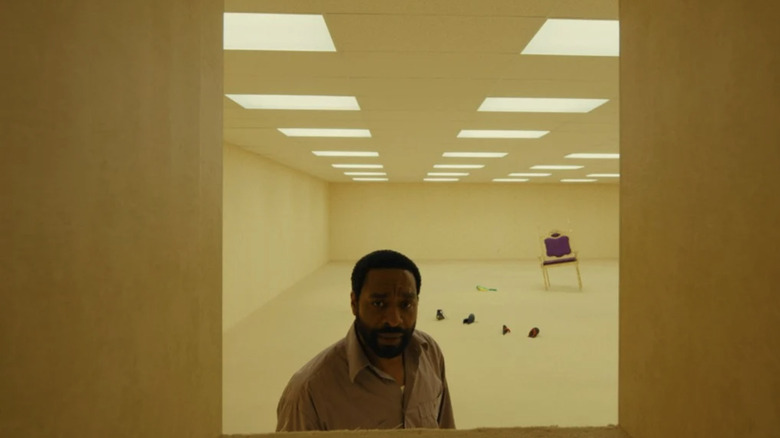
Yet when it comes to the question of what makes the Backrooms look the way they do, the film itself gives us a creepy, haunting answer. The Backrooms appear to replicate every place on Earth, with a primary focus on man-made structures (mostly interiors, with some exteriors as well). It also appears to replicate people, though it's seemingly selective about which people it copies. Clark (Chiwetel Ejiofor), a furniture store owner who happens upon an entrance into the Backrooms, describes the realm's aesthetic as if you told someone who has never seen a dog before what a dog looks like, and then asked them to draw it. As he explains, this person would undoubtedly get most things right, but some key details would be decidedly off.
The Backrooms, aka "The Complex," then, look that way because of some paranormal fault that causes this mistranslation, resulting in a place which is the very definition of uncanny.
Backrooms' look evokes the impermanence of memory
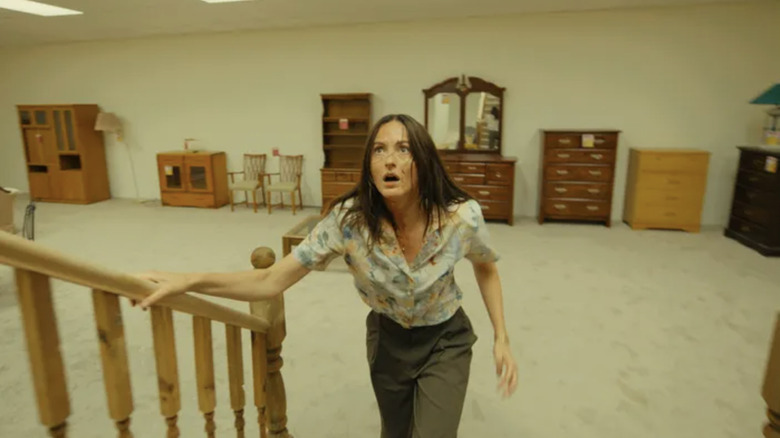
At the core of the horror genre lies every primal, ingrained fear that human beings have ever or will ever have. As much as a modern-day horror story might prey upon timely fears, such as new technology or social and political changes, there's always a primal fear lurking beneath the surface. Every horror story ever told involves the fear of death, whether it be an untimely end or a portal to a new plane of existence. "Backrooms" is no exception, as seen in at least one copy of a human (which is called a Still Life) being violent and murderous.
In addition, "Backrooms" adds a bigger picture, more existential dread to that basic fear of dying, which is that of decay. Time is impermanent, as we all know, but so is memory, which is something most people don't like to think about or acknowledge. Memory is half recall, half story which we tell ourselves, a combination of objective observation and personal editorializing. As Akira Kurosawa's "Rashomon" brilliantly points out, no two recollections are exactly the same.
The entire existence of the Backrooms is the concept of the impermanence of memory made manifest. It's close enough to evoke feelings of familiarity, even nostalgia, but vague and off-kilter enough to cause a sense of dread or even alarm. In other words, Kane Parsons is trying to strike at the sweet spot between knowing and unknowing. It's this quality that is most notably evoked by the Still Life clones. Each one is recognizably humanoid, yet their features are all distorted and wrong. It's where Parsons and "Backrooms" dabble in surrealism of a vintage sort, seen in the paintings of Salvador Dalí or the films of Alejandro Jodorowsky.
Backrooms' aesthetic conjures up a lost past
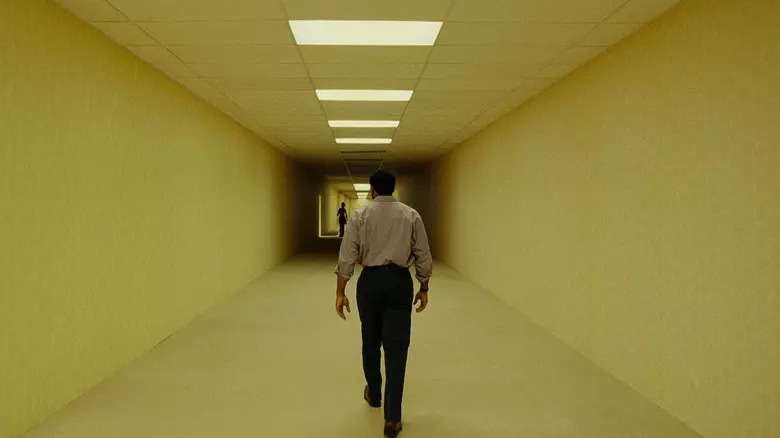
The other key ingredient to the aesthetic lies in its real-world origins. The original photograph that started it all went viral after being posted anonymously on the website 4chan in 2019. As interest in the photo and its mysterious ancestry grew, internet detectives eventually discovered that it was part of a series of photos taken in 2003 at a HobbyTown retail store in Oshkosh, Wisconsin, that was undergoing renovation. Upon further research, it turned out that the place (now an RC racing track) was once a furniture store in the 1970s.
As most students of history know, there's a stark difference between the verifiability of a pre-internet versus a post-internet age. That essential mysterious quality is what Kane Parsons is conjuring in "Backrooms," which is deliberately set in 1990. To a young Millennial or Gen Z, the pre-internet years feel almost like a new Dark Ages, where some information has been verified, preserved, and passed down, while swathes of it have been lost or distorted. This existential mystery is exemplified by the Backrooms, an amorphous place where everything and yet nothing exists.
It's a concept that goes hand in hand with the notion of "no-clipping," a term used to describe what happens when people enter the Backrooms. It's derived from the uncanny oddity of a glitching video game, when a player character accidentally goes through a wall and finds themselves in a space that was never intentionally designed or built. It's pure, unadulterated cultural id; reality, but interpreted differently.
You could say that all of us, with our myriad perceptions, already live in a Backrooms of our own making. That's what "Backrooms" says in the end, and it's why it lingers with you long after the credits roll.