

12 Most Quotable Westerns, Ranked
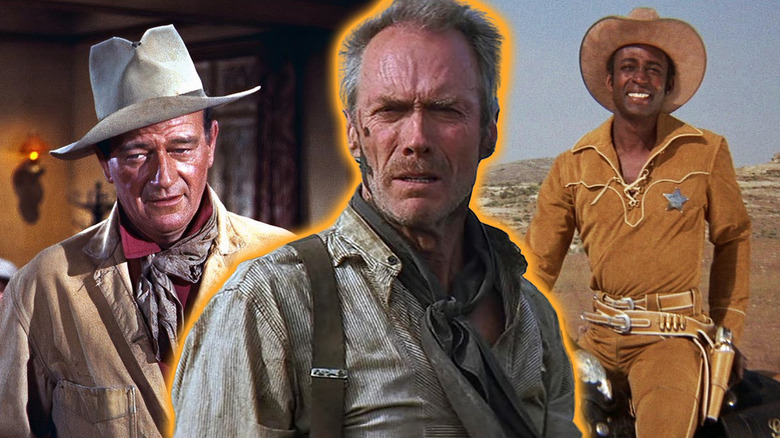
Westerns are one of the most iconically archetypal film genres around, often revolving around gunslingers, shootouts, and other sun-baked tropes. Though many protagonists in these movies are strong, silent types, the films still have their fair share of memorable dialogue. Whether it's classic Westerns, revisionist takes on the tropes, or neo-Westerns, the best movies in the genre all have standout lines. A lot of this dialogue can be quoted readily, including outside of the context of the movie itself.
While a movie being quotable isn't the biggest determinant of its quality, it does help a film stay in the public consciousness. Moreover, a highly quotable movie can stand the test of time and rise above its genre counterparts to become a beloved film. And when it comes to Westerns, standout quotes capture the appeal of the entire genre in just a handful of lines. To highlight memorable dialogue that lives on beyond the viewing experience, here are the 12 most quotable Westerns, ranked.
12. Rio Bravo
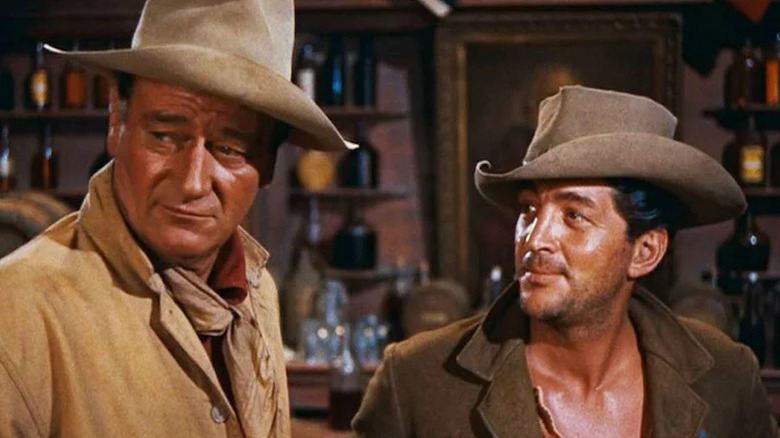
As far as John Wayne movies go, there are few Westerns that top the buddy-gunslinger rapport of 1959's "Rio Bravo." Wayne plays John T. Chance, the sheriff of a Texas frontier town who arrests local malcontent Joe Burdette (Claude Akins) for murder. This attracts the ire of Joe's land baron older brother Nathan (John Russell), who hires a small army of mercenaries to free Joe before a marshal can arrive for him. Joining Chance are his deputies Dude (Dean Martin) and Stumpy (Walter Brennan), along with young gunslinger Colorado Ryan (Ricky Nelson), to ward off the Burdette's gunfighters.
So much of the enjoyment of "Rio Bravo," apart from the requisite gunfights, is the camaraderie between Chance and his allies. In addition to the other gunfighters helping him watch over Joe, there's Chance's love interest Feathers (Angie Dickinson), helping elevate the dialogue-driven scenes. The film's success led "Rio Bravo" to spawn an unofficial trilogy, all starring Wayne and directed by Howard Hawks, offering loose retellings of its broad premise. But none of the sequels match the breezy rapport Wayne shares with his co-stars in "Rio Bravo," exemplified by its fun banter.
11. The Hateful Eight
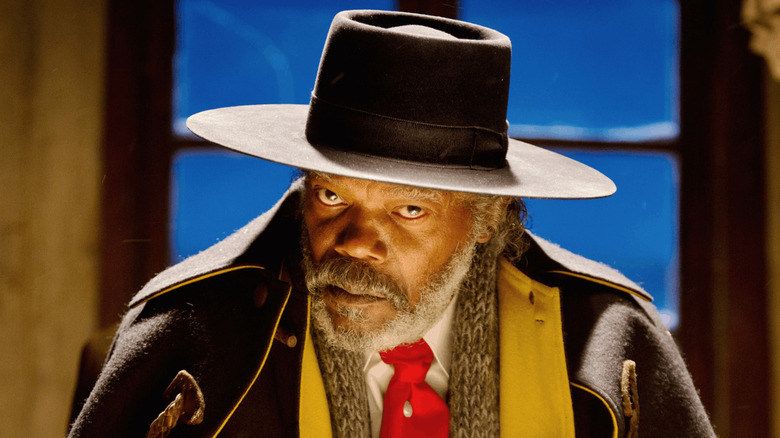
When it comes to writing sharp dialogue, no matter what genre, few modern filmmakers do it better than Quentin Tarantino. Venturing back into the Western genre with 2015's "The Hateful Eight," Tarantino crafted a claustrophobic tale of a handful of hardened figures stranded in a snowy stagecoach stopover in Wyoming. Among these are two bounty hunters, Marquis Warren (Samuel L. Jackson) and John Ruth (Kurt Russell), the latter of whom is escorting captured outlaw Daisy Domergue (Jennifer Jason Leigh). As the group shelters during a raging blizzard, paranoia and mounting tensions over whether the strangers are actually in league with Domergue build to bloody violence.
With its locked cabin premise, so much of "The Hateful Eight" relies on its dialogue to carry the story and set the mood. Given her character's importance to the story, Tarantino wisely centers "The Hateful Eight" around Jennifer Jason Leigh, with so much dialogue involving interplay with her character. And, of course, if you have a Western with actors as charismatic as Jackson, Russell, and Walton Goggins, they're each going to get their own memorable lines. A movie that Tarantino himself almost cancelled, "The Hateful Eight" is among the filmmaker's most underrated projects.
10. The Searchers
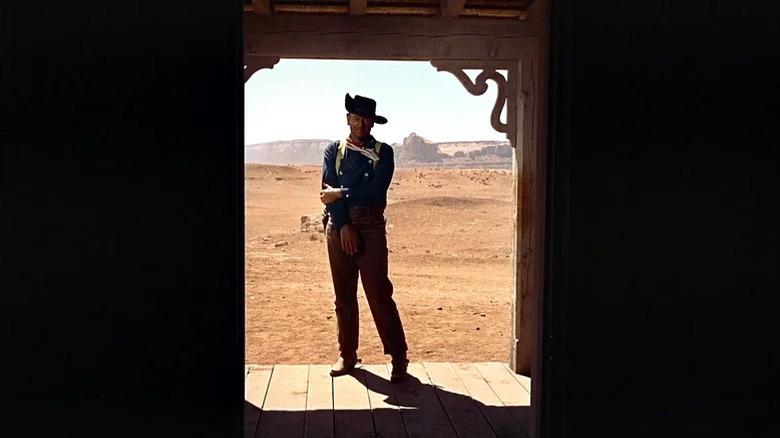
Steven Spielberg's favorite John Wayne Western is 1956's "The Searchers," directed by Wayne's frequent collaborator John Ford. The movie adapts Alan Le May's 1954 novel of the same name, with Wayne playing embittered Civil War veteran Ethan Edwards. After his brother's homestead is raided by the Comanche, Ethan leads an obsessive quest to rescue his niece Debbie (Natalie Wood), joined by Debbie's adopted brother Martin Pawley (Jeffrey Hunter). This search spans several years and reveals Ethan's deep-seated hatred towards the Comanche, showing he's more interested in achieving vengeance than a successful rescue.
For being such a sullen protagonist, Ethan provides "The Searchers" with a lot of its most memorable quotes. This includes his usual unimpressed refrain "that'll be the day," which reportedly inspired the Buddy Holly song of the same name and repeated lyric. Ethan and Martin share a lot of notable dialogue throughout the film, underscoring the movie's themes and stakes. One of the greatest Westerns ever made, "The Searchers" is Wayne and Ford's joint masterpiece.
9. The Outlaw Josey Wales
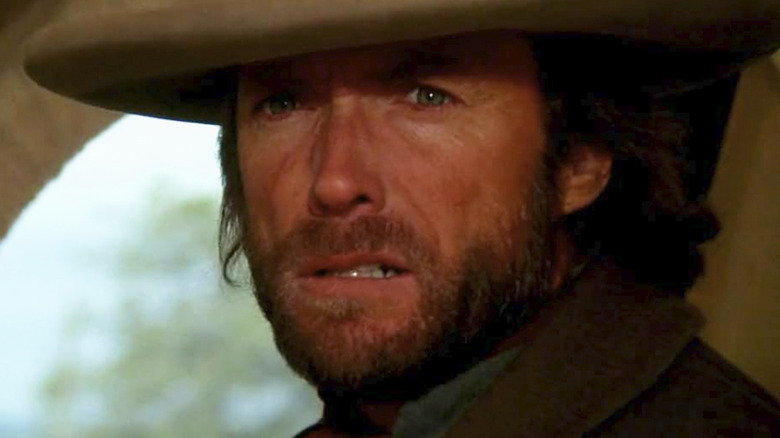
Another taciturn Western protagonist that happens to be a former Confederate soldier is Josey Wales, the titular character behind 1976's "The Outlaw Josey Wales." Played by Clint Eastwood, who also directed the film, Wales joined the Confederacy after pro-Union Jayhawkers murdered his family during the Civil War. After the war, Wales becomes a wanted man and flees to Texas, hunted by bounty hunters and his former nemesis, Captain Terrill (Bill McKinney). Wales forms a found family, each character enduring their own traumatic past as they commiserate together while contending with Terrill and his killers.
Looking back, Clint Eastwood felt "The Outlaw Josey Wales" was a career high point, and it's certainly one of his best projects as either director or actor. More than just through his actions, Wales shines as an anti-authority figure and vengeance-driven character through his fiery dialogue. Here, Eastwood delivers what is arguably his best '70s performance in any movie genre. A sharply crafted revenge Western, "The Outlaw Josey Wales" is one of the best revisionist takes on the genre ever made.
8. True Grit (1969)
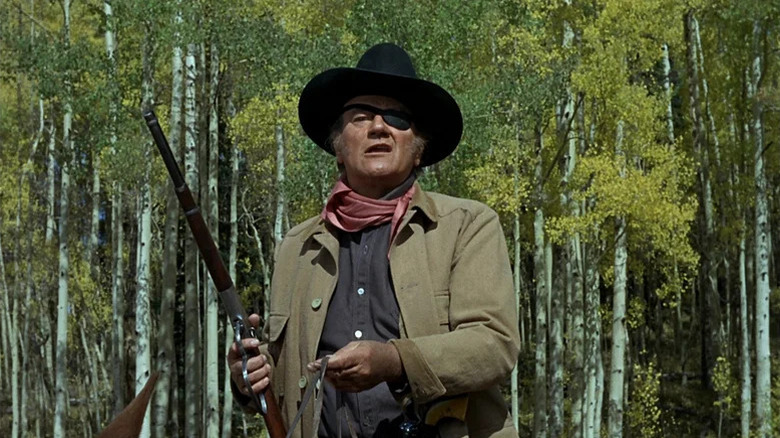
One last John Wayne movie to cement his legacy in the Western genre, at least in terms of quotability, is 1969's "True Grit." The first adaptation of Charles Portis' 1968 novel, Wayne stars as U.S. Marshal Rooster Cogburn, a grizzled and hard-drinking lawman. Teenager Mattie Ross (Kim Darby) hires Cogburn and Texas Ranger La Boeuf (Glen Campbell) to track down the outlaw who murdered her father. This places the trio in conflict with the outlaw's larger gang, led by the notorious crook Ned Pepper (Robert Duvall).
Rooster Cogburn is one of John Wayne's best roles, earning him his sole Academy Award throughout his extensive career. Clearly relishing his character's uncouth nature, Wayne broke one of his biggest rules for the movie, with Cogburn openly using the on-screen profanity that Wayne often distanced himself from. This makes Cogburn even more endearing, quotable, and lovably salty as he takes Mattie under his wing. While the Coen Brothers' 2010 remake of "True Grit" is a fantastic retelling of the story, the 1969 version still remains the most enduring version.
7. Unforgiven
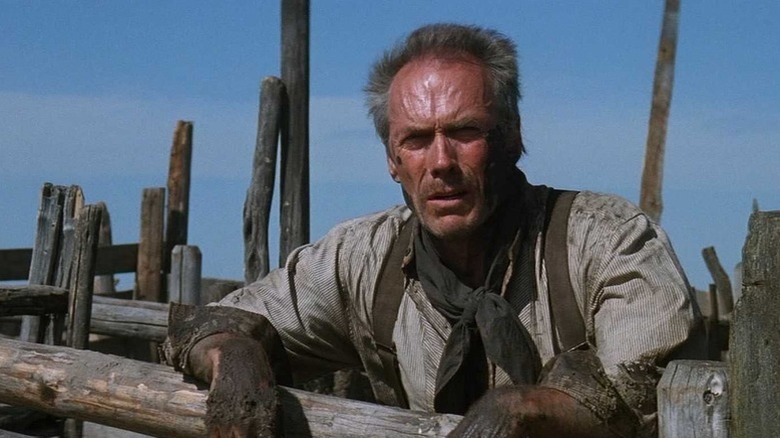
It was Westerns that made a star out of Clint Eastwood, both in television and film, and he crafted a requiem to the genre with "Unforgiven." In addition to directing and producing the 1992 movie, Eastwood stars as retired gunslinger Will Munny, who struggles raising his children as a single father and farmer. Munny reluctantly emerges from his self-imposed retirement to accept a job tracking down two cowboys who viciously assaulted a sex worker. This places him in direct conflict with sheriff Bill Daggett (Gene Hackman), a skilled gunfighter who had been protecting the cowboys.
Clint Eastwood's career had hit rock bottom before "Unforgiven" rescued it thanks to the movie's impressive critical and commercial reception. Eastwood and Hackman each get the chance to deliver resonant monologues regarding their characters' perspectives on the Wild West. These moments not only add to the movie's appeal, but serve as clear eulogies to an era coming to an end. "Unforgiven" is Eastwood at his most meditative, and Munny and Daggett articulate those qualities with some of the best dialogue in the genre. (Little Bill: "I don't deserve this...to die like this. I was building a house." Munny: "Deserve's got nothin' to do with it.")
6. No Country for Old Men
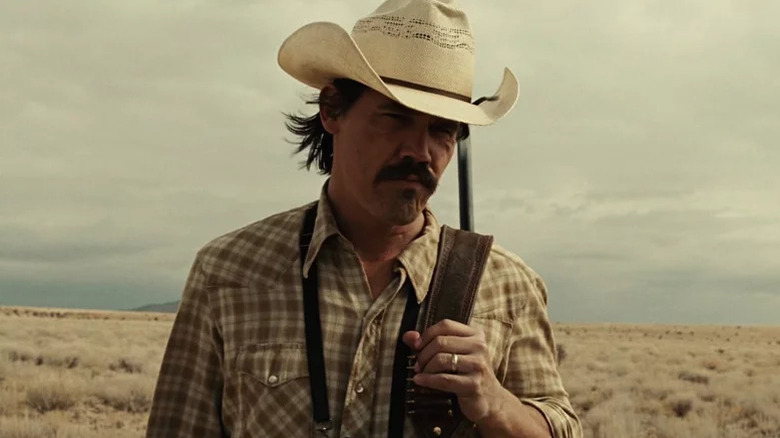
The Coen Brothers have always had a penchant for writing strong dialogue, and that includes their 2007 adaptation of the Cormac McCarthy novel "No Country for Old Men." The story has Llewelyn Moss (Josh Brolin) stumble on a drug deal gone wrong, making off with the intended cash payoff from the dead participants. While trying to bring one of the dying men water, Moss is spotted, leading to him being pursued by the relentless hitman Anton Chigurh (Javier Bardem). As the hunt for the money escalates and the body count grows, Sheriff Ed Tom Bell (Tommy Lee Jones) becomes involved with the investigation.
From its tense conversations before moments of lethal violence to its powerful, dreamy ending, "No Country for Old Men" is a neo-Western tour-de-force. Much of the acclaim was centered around Bardem's laser-focused performance as Chigurh, and rightfully so, but the rest of the impressive cast does fantastic work. Hearing Chigurh's self-assured taunts to his prospective victims informs a lot of the movie's mounting suspense, juxtaposed with the other characters' reaction to imminent death. (No coin toss will ever be complete without someone uttering "call it" in a monotone voice.) A solid change of pace for the Coens, "No Country for Old Men" is arguably one of the best neo-Westerns ever made.
5. Django Unchained
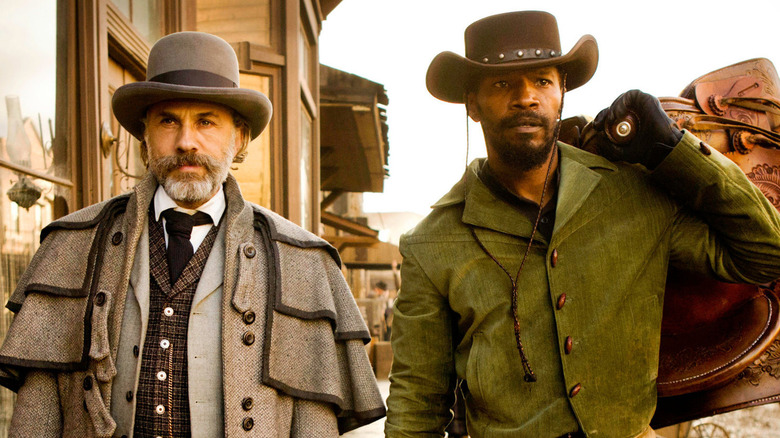
Of course, when it comes to Quentin Tarantino and Westerns, there is still no topping 2012's "Django Unchained." Set in an antebellum United States, the movie centers on former slave Django (Jamie Foxx), who trains to become a bounty hunter by the man who freed him (Christoph Waltz). After becoming an experienced gunfighter, Django and his mentor, Hannibal Schultz, discover that Django's wife (Kerry Washington) is being held at a plantation in the deep South. This pits the duo against the especially cruel plantation owner Calvin Candie (Leonardo DiCaprio) and sinister figures in his inner circle.
A sweeping saga, "Django Unchained" subverts the white savior trope while giving its titular protagonist a cathartic journey through an unfriendly land. The movie features some memorable scenes between its heroic central pair but really rises to another level when they venture into Candie's grim Southern domain. Tarantino's trademark crackling dialogue is present throughout these sequences, adding to the movie's energy, even in its quieter moments. ("You had my curiosity, but now you have my attention.") Over a decade later, "Django Unchained" is still Quentin Tarantino's biggest movie, and the dialogue plays a major role in that success and enduring quality.
4. Butch Cassidy and the Sundance Kid
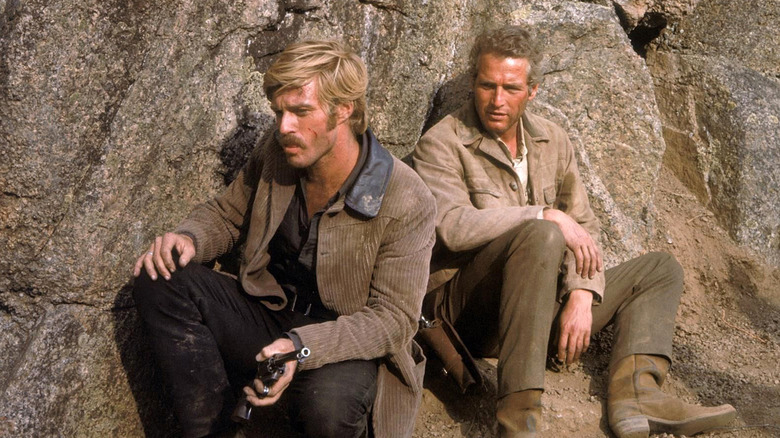
This is the story of Butch Cassidy and the Sundance Kid and their real-life exploits as outlaws. In the twilight of the Old West in 1899, robber Butch Cassidy (Paul Newman) and the Sundance Kid (Robert Redford) find themselves relentlessly hunted by a posse. This leads both men to flee together to Bolivia where they resume their criminal activities with Sundance's girlfriend, Etta Place (Katharine Ross). However, the two outlaws' luck begins to run out as they are confronted by the military in South America.
"Butch Cassidy and the Sundance Kid" is a proto-buddy movie, with so much of the film revolving around its title characters' friendship. Their rapport is informed by plenty of lively interplay that Newman and Redford warmly bring to life with spectacular dialogue. The duo's dynamic is strongly highlighted whenever they're both under pressure, either pinned down by the posse over a raging river ("the fall will probably kill ya!") or preparing to make their final stand. A fantastic collaboration between the two stars, director George Roy Hill, and screenwriter William Goldman, "Butch Cassidy and the Sundance Kid" is pitch-perfect.
3. The Good, the Bad and the Ugly
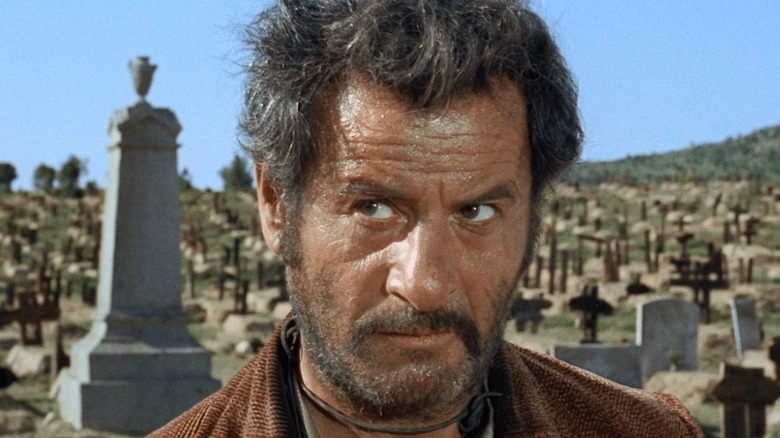
The apex of Sergio Leone's unofficial "Dollars" trilogy is its final installment, 1966's "The Good, the Bad and the Ugly." The spaghetti Western is set in the midst of the American Civil War, following a trio of outlaws searching for a hidden stash of gold. This includes Blondie (Clint Eastwood) and Tuco Ramírez (Eli Wallach), two bandits who formerly worked together but had a murderous falling out. The three men violently collide multiple times over the course of their treasure hunt, culminating in a tense showdown in a large graveyard.
"The Good, the Bad and the Ugly" features plenty of Leone's usual dark humor, often delivered by the raucous Tuco. This includes several memorable lines throughout the movie, like Tuco's last curse at Blondie ("You know what you are? Just a dirty son of a b—!"). But beyond Tuco, the movie is Leone's most well-articulated spaghetti Western, exemplified by Blondie's observations of the Civil War raging around him. The best Western movie of all time according to IMDb, "The Good, the Bad and the Ugly" is an enduring classic.
2. Tombstone
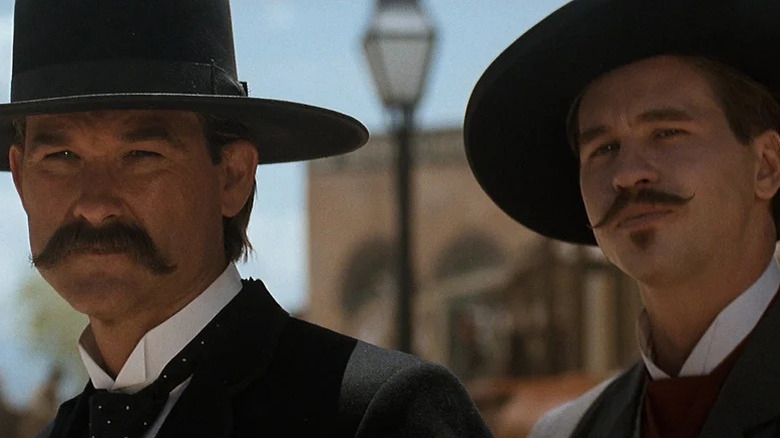
A retelling of the Earp brothers and Doc Holliday's fateful feud with the Cowboys gang, 1993's "Tombstone" is an eminently quotable Western. With Kurt Russell playing Wyatt Earp and Val Kilmer playing Doc Holliday, the movie chronicles the Earp family's quest to establish law and order in the titular Arizona town. Setting up a gambling emporium and saloon in Tombstone, the group quickly forms a violent feud with the marauding Cowboys. After a gunfight at the O.K. Corral and the death of one of his brothers, Wyatt launches an ambitious vendetta against the gang.
Whether it's Val Kilmer's scene-stealing performance or the undeniable swagger from the rest of the cast, "Tombstone" stands as the coolest '90s Western. The movie's repartee is almost as entertaining as its numerous action set pieces, with every major conversation absolutely electric. ("You called down the thunder, well now you've got it!") Kurt Russell himself claimed "Tombstone" was the most quotable Western ever made, and the film has a very strong case. But with all due respect, there is one Western that has the 1993 fan-favorite beat on that score.
1. Blazing Saddles
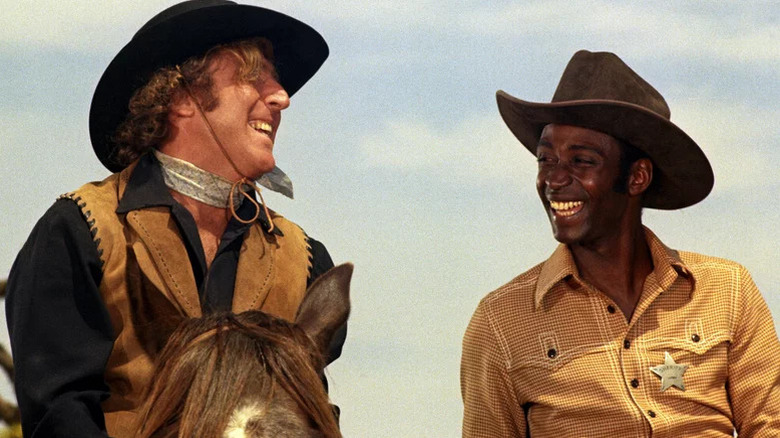
1974's "Blazing Saddles" is one of the most quotable movies of all time, regardless of genre. The movie follows Bart (Cleavon Little), a Black man deliberately appointed as the new sheriff of the frontier town of Rock Ridge to upset the locals. This is all part of a scheme by corrupt government official Hedley Lamarr (Harvey Korman) to seize the land as part of his railroad expansion efforts. Teaming up with the famous gunslinger The Waco Kid (Gene Wilder), Bart wins the town's support and confronts Hedley and his conspirators.
The satire of "Blazing Saddles" still has bite — this is maybe not the kind of movie you should watch with more sensitive audiences. But those jokes are still among the best filmmaker Mel Brooks and his cast have delivered on-screen, with the rapport between Little and Wilder evident in every shared scene. ("These are people of the land. The common clay of the new west. You know ... morons.") Obviously, not every line from the movie should be quoted, but in terms of sheer volume, no other Western comes close. A sharp send-up of the genre, "Blazing Saddles" certainly has the funniest lines of any Western.