

Reed Richards And Doctor Doom's Longtime Feud, Explained
We may receive a commission on purchases made from links.
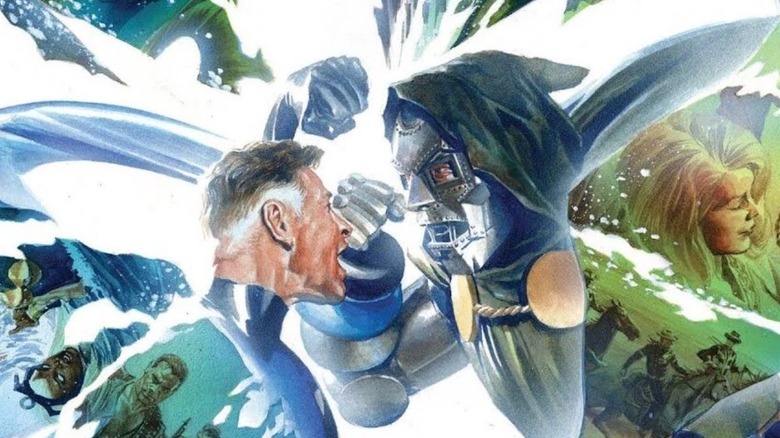
American superhero comics are filled with unending rivalries between do-gooders and evil-doers. Few are more enduring and epic than the feud shared by Mister Fantastic/Reed Richards, leader of the Fantastic Four, and his nemesis, the tin-plated tyrant Doctor Victor von Doom.
Stan Lee and Jack Kirby's original "Fantastic Four" comics came out swinging in 1961, but it wasn't until issue #5, Doom's debut, that the book truly came into its own. With Doom, the Four had an enemy worthy of their shared might. In the decades since, Doom has visited torment after torment upon the Fantastic Four, ranging from the petty (infecting the Four's brains so they forget every letter of the alphabet, except the ones you need to say "Doom") to the horrifying (condemning Reed's son Franklin to Hell).
Marvel fans everywhere are waiting with bated breath for "Avengers: Doomsday." One reason why is to see if the movie can finally deliver a cinematic Doom (this one played by Robert Downey Jr.) worthy of the comic version, something the past "Fantastic Four" movies failed to do. A deciding factor will be if "Doomsday" can zero in from its huge ensemble and make Reed (Pedro Pascal) Doom's nemesis; you can't have a good Doom without his fixation on Reed.
Victor von Doom is not a good man, but he is a great one. He's a master inventor, an accomplished sorcerer, and even rules his own country, Latveria, where he's beloved by his people. Yet even with all that, he can't get past his jealousy of Reed. For Reed's part, though he begrudges Doom and never trusts him, he would be happy to see Victor turn over a new leaf, because he recognizes a selfless Doom could be a great hero. The tragedy of Doom is what his jealousy denies the world.
Reed and Doom's feud goes back to their college days

It's quite common to meet "the one" when you're in college — just ask Reed and Victor. Ever since "Fantastic Four" #5, Doom's backstory has been that he and Reed met at university. When Doom tried to build a machine to contact the nether-world, it blew up in his face, leaving him scarred. (It's been suggested Doom's scars might actually be quite mild, but Victor is such an egotist he can't stand even a small blemish on perfection.)
The earliest "Fantastic Four" comics did not suggest Doom had much personal enmity towards Reed. Rather, Doom attacks the Fantastic Four because they're an obstacle to his world domination plans. Then, 1964's "Fantastic Four Annual" #2 delivered the full story. Reed happened upon Doom's notes for his fateful experiment and observed his calculations were slightly off. Doom accused Reed of spying and didn't listen.
When the machine blew up in Doom's face, he decided Reed must've tampered with the calculations, for the glorious Victor von Doom couldn't have made such a mistake. Notably, in "What If Doctor Doom Had Become a Hero," the divergence is when Victor confronts Reed about snooping in his notes. Here, Victor listens to Reed; they perform the experiment together, successfully, and part as friends.
Ed Brubaker and Pablo Raimondi's 2006 "Books of Doom" fleshed out Doom's early years even more; issue #2 is his college days, and reveals the moment he first started to resent Reed. When Doom spoke up about his belief in other realms during a physics lecture, Reed spoke up for him, though describing it in scientific and not magical terms. (Victor accepts the unnatural, whereas Reed cannot.) This only angered Doom: "When I need your assistance on an argument, I'll ask for it."
Reed Richards' genius upsets Doom's fragile ego
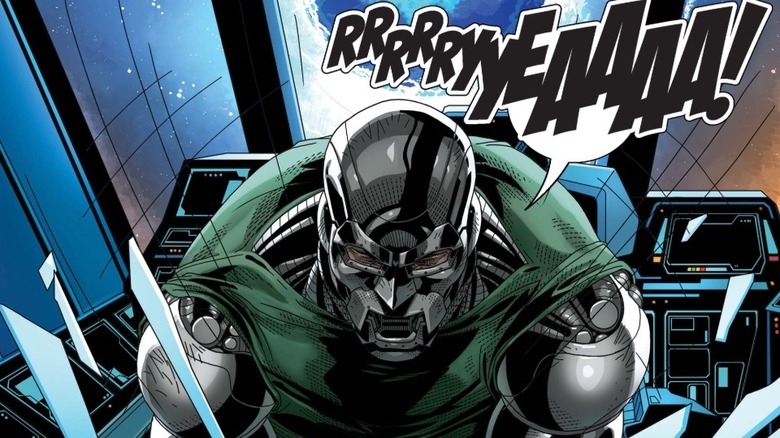
In Doom's warped view, his crusade is vengeance against Reed for the "sabotage" that stole Doom's face. Now, deep in Victor's soul, he knows that the mistake was his own, but he never lets his conscious self even consider that, and focuses on destroying Richards to drown out self-doubt. In turn, one of the key ways Reed has often been able to defeat Victor is by playing on his ego; take "Fantastic Four" #60, when Doom stole the powers of the Silver Surfer. Doom is defeated when Reed tricks him into striking a barrier left by Galactus to imprison his former herald on Earth.
One of Doom's villainous trademarks is self-aggrandizing, third-person monologues. Whenever he whips out a new invention, or pulls off an impressive feat, he's sure to brag about how Doom acomplished what the feeble-minded Richards couldn't even dream of doing. Yet, note how Doom's cloak is green, the color of envy. Despite all of Victor's protests, Reed is smarter than Doom and he doesn't need to constantly assert it. If Reed was the inferior mind, then surely Doom would've beaten him by now.
Prolific "Fantastic Four" writer/artist John Byrne added more sympathetic layers to Doom, like a strong code of conduct, that the people of Latveria adore him, etc. Whenever fans whitewash Doom, it's because of the qualities Byrne gave him. Yet, even in Byrne's "Fantastic Four" #258, Doom strikes his own young ward, Kristoff, for innocently suggesting Magneto might rival Doom's power. Keeping Byrne (who wrote/drew a definitive "Superman" run in the 1980s) in mind, Doom's hatred for Reed is similar to Lex Luthor's hatred for Superman. Doom/Lex has accomplished so much, but when he sees Reed/Superman, all he can think of is how he doesn't measure up.
Reed Richards and Doctor Doom are 'two halves of the same soul'
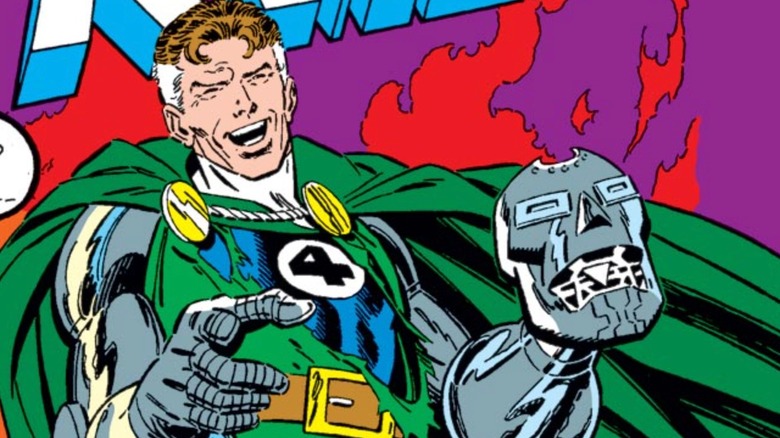
Rivals can share not just a competitive spirit or hatred, but also a mutual respect. Current "Fantastic Four" writer Ryan North noted (in an interview with CBR) that Reed and Doom are like this; Reed admits Doom's genius, and though Doom hates Reed too much to respect him, he does sometimes acknowledge him as a "worthy adversary."
They are "two halves of the same soul that have made wildly different choices," North said, and he's right. Both Reed and Doom are geniuses, driven by the same fundamental impulse: to solve problems and make the world a better place. Reed achieves that through science, discovery, and superheroics. Doom thinks the world would be better off with him as its absolute ruler; he's out to build a utopia where everyone is free from want, though subservient to him. (But does Doom want to make a better world to help his fellow man, or does he do it to prove only he, Doom, could make such a better world?)
Reed and Victor also differ in tools they use to problem solve. Reed's genius brain works by wrapping itself around the logical and scientific rules of reality. Thus, he struggles with the human factor, as seen by his social stiffness. In North's "Fantastic Four" #21, Reed tours a museum with sculptor Alicia Masters and admits he doesn't connect with art on an emotional level, since his impulse is rationalization. Doom, the son of a medical doctor and a witch, understands science too but wields magic like Reed never could. Victor outclasses Reed in sorcery, and in charisma. In North and R.B. Silva's "One World Under Doom," it's observed that "Reed and Doom can both win minds. But only Doom can win hearts."
Reed and Doom's rivalry echoes across the Marvel multiverse
In issue #9 of Christopher Cantwell and Salvador Larocca's excellent "Doctor Doom" comic series, Doom is trying to save the world from a black hole. Reed calls to wish him, in earnest, good luck. But Victor hears nonexistent doubts and insults in all of Reed's words, and sabotages the machine because of it.
Once this happens, Doom again blames Reed, saying Richards would rather destroy the world than let Doom save it. This projection, of course, goes full-circle to what sparked their feud. In the 10th and final issue, Doom meets himself from an alternate universe, who is the world's savior and greatest hero. All it took was getting over himself and his feud with Reed — but that's a monumental ask of Victor, who across the Marvel multiverse is driven by his hatred of Reed.
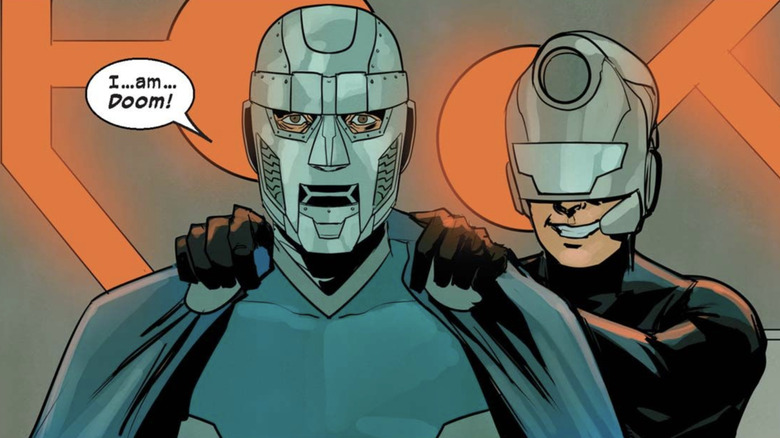
As the premier villain of "Fantastic Four," Doom is a package deal with the FF. Whenever they're reimagined in animation, cinema, or comic reboots, Doom comes along to menace them. One of the most intriguing Doom reimaginations is in the comic "Ultimate Fantastic Four." This Doom, Victor Van Damme, plays a surprisingly minor role in the series — but after the event mini-series "Ultimatum," Reed Richards turns evil. Styling himself "The Maker" (and even getting a mask and scar), "Ultimate" Reed becomes a more destructive force to his universe than Van Damme ever was; Reed and Doom, two halves of the same soul, indeed.
Recently, the Maker created his own "perfect" world, Earth-6160. As part of the Maker's toying with history, he systematically tortured the world's native Reed Richards, and finally locked him in an iron mask. Reed accepts the Maker's new name for him: "Doom," because that's all this Reed brought to his loved ones.
In Secret Wars, Doom steals Reed Richards' Fantastic family
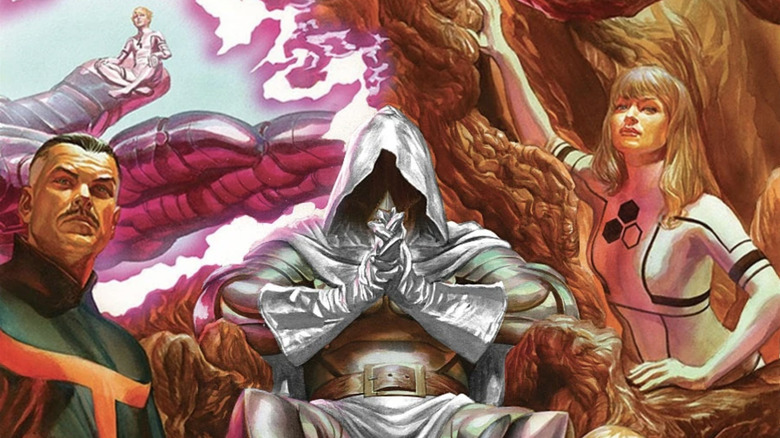
In "Fantastic Four" Volume 3, #54, trouble arises as Sue Storm-Richards/the Invisible Woman goes into labor, and it falls to Doom to save Reed and Sue's newborn daughter. His condition for doing so? Victor takes the girl as his goddaughter and names her Valeria, explicitly saying he wants Reed to remember how Doom saved his family whenever he looks at Valeria.
Besides his own parents and himself, Valeria is one of the few who Doom truly loves; part of that is because she's living proof that he accomplished something Richards couldn't. In the 2015 "Secret Wars" series by Jonathan Hickman and Esad Ribic, when all of reality collapses and an empowered Doom rebuilds it to rule, he goes from Valeria's honorary uncle to her father — because in this new Battleworld, Victor is married to Sue.
When Reed eventually arrives on Battleworld, he's not just appalled, but bemused; as he puts it, Doom had the power to become God, and all he could think to do was to steal Reed's life. Both the 2005 and 2015 "Fantastic Four" movies made Doom romantically interested in Susan, suggesting part of Doom's hatred is because she chose Reed. As if Doom needs another reason to hate Richards. Doom giving into romantic jealousy would also be him admitting another soul holds power over his, and he would never do that.
"Secret Wars" frames this relationship much better; Doom only marries Sue as a way of defeating/supplanting Richards. After "Avengers: Doomsday" comes "Avengers: Secret Wars," and if it adapts God Emperor Doom and his queen Susan (Vanessa Kirby), hopefully it'll understand — like the comic did — that Doom's relationship with Sue is defined by his dynamic Reed, not vice versa.