

A Forgotten Sherlock Holmes Flop Gave Us The First Fully CGI Character
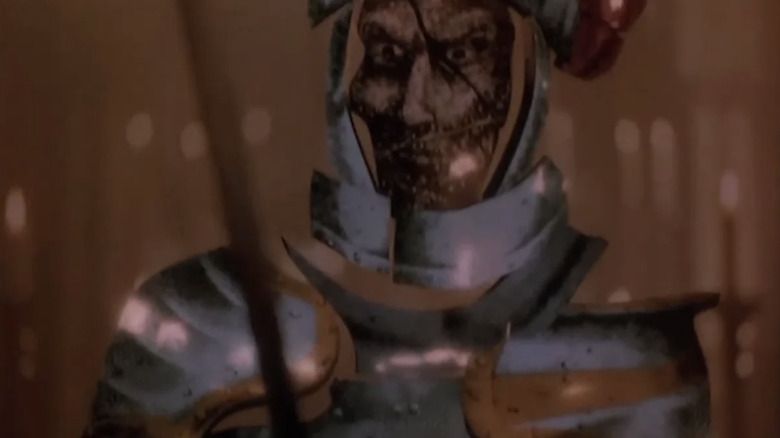
For casual moviegoers, CGI (Computer Generated Imagery) seemed to arrive with a bang. Depending on who you ask, it was either the T-1000 as seen in James Cameron's "Terminator 2" or the dinosaurs brought to life in Steven Spielberg's "Jurassic Park" that marked a sea change in the way fantasy and sci-fi creatures were created for cinema. Yet most cinephiles and students of the medium realize that cinema evolves on a spectrum, and that goes double for new technology. Experiments with computer animation began as early as the 1960s, and there were a number of watershed milestones that occurred on the path to those aforementioned breakout triumphs. Films like "Star Trek II," "Tron," and "The Last Starfighter" all provided pieces of the building blocks for the eventual CGI revolution.
Another milestone movie involved with the dawn of CGI is one that isn't talked about all that often, so much so that it could be called forgotten: "Young Sherlock Holmes." Directed by Barry Levinson and released in December of 1985, the film was an Amblin Entertainment production, which means that Spielberg was involved. As such, the executive producer reached out to his friends at Lucasfilm when the script called for a priest having a hallucination of a stained glass window coming to life and attacking him in the form of a knight. The folks at Industrial Light + Magic tapped a division known as Pixar to help with the scene, and their work resulted in the first fully CGI character ever created for a movie. It's an impressive, milestone sequence in a still-underrated film.
The stained glass knight in Young Sherlock Holmes set the stage for fully CG characters
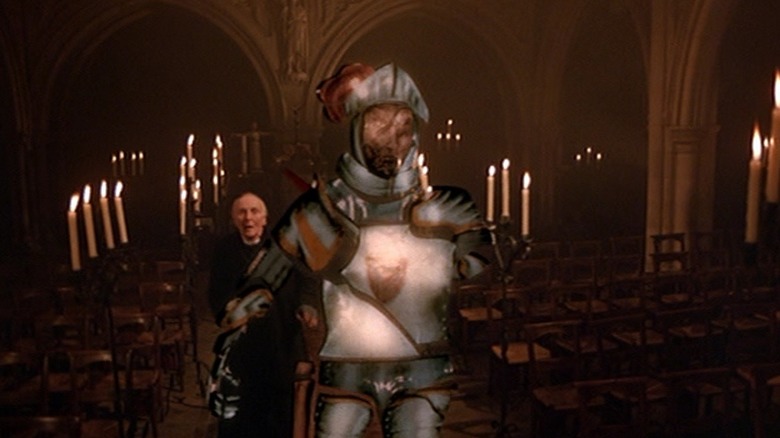
The central mystery in "Young Sherlock Holmes" concerns the murders of several prominent figures in Victorian-era London by way of horrific hallucinations that lead them to their deaths. One of these drug-induced hallucinations occurs when Reverend Duncan Nesbitt (Donald Eccles) sees the Stained Glass Knight attack him, scaring him so much that the man flees into a busy street and is run over by a carriage. It's a brief scene, and the Knight wasn't required to do more than appear threatening and intimidating enough to motivate Nesbitt's fear. Yet Levinson, Spielberg, and writer Chris Columbus needed the Knight to be autonomous and credible. In other words, while a previous all-CG creation like Bit from "Tron" could be considered a character, the Knight needed to have presence.
For this, the team at the Pixar Computer Animation Group were brought onboard, as the folks there (including John Lasseter) were proving themselves adept at this burgeoning technology. Working under ILM visual effects supervisor Dennis Muren, the trick didn't just involve making the Knight a reality, but finding a way to depict him that would be worth the scene's expense. As Muren explained during a 2020 keynote speech at VIEW Conference, what the scene needed was "a design that looked like you were getting your money's worth for CG." That's when Muren's wife, Zara, stepped in, designing the Knight as a series of flat, individual pieces of glass working in tandem. It's a look which sold the effect, justified the CG approach, and made the film worthy of an Academy Award nomination.
Young Sherlock Holmes feels like an early, superior version of the 'Harry Potter' films
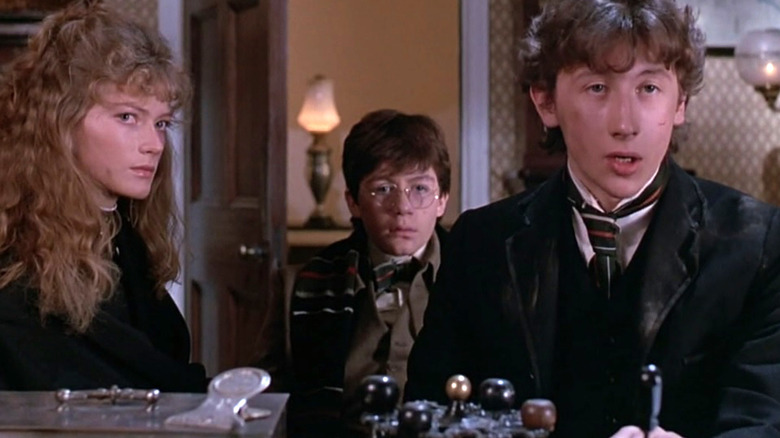
In the 40 years since release, the Knight and its significance to cinema and visual effects history has been the reason anyone has talked about "Young Sherlock Holmes," which was not a box office yet. Yet it's a film which deserves more attention and affection. For one thing, its approach to the Holmes legend is pretty novel, looking in on the character (played by Nicholas Rowe) as a teenager. Rather than generally being a murder mystery story or an action movie (as with the Robert Downey Jr. films), "Young Sherlock Holmes" harkens back to 1930s and '40s style pulp adventure, a mixture of mystery and horror.
Levinson makes the hallucination sequences genuinely eerie, and the dangers that Holmes, Watson (Alan Cox), and Elizabeth (Sophie Ward) face aren't treated frivolously. There's an edge and real sense of stakes to Columbus' screenplay, a tone which feels carried over from his other Spielberg production the previous year, "Gremlins." While the movie's treatment of Egyptian culture is very problematic by today's standards, it's on par with the antiquated worldview and serial adventure tropes of the time period, similar to Spielberg's own "Indiana Jones and the Temple of Doom."
What's also remarkable is how the film foreshadows the appeal of the "Harry Potter" series. This isn't too surprising given how the director of the first two films in that franchise was Columbus himself. Still, the dynamic between Holmes, Watson, and Elizabeth feels like a more mature version of Harry, Ron, and Hermione. Yes, it may have flopped domestically upon release, but the 1980s is littered with financial failures which have subsequently endured. That "Young Sherlock Holmes" deserves to be counted amongst them is, at least to me, elementary.