

5 Reasons Why Hunger Games: Mockingjay - Part 2 Ruled The Box Office
We may receive a commission on purchases made from links.
In the realm of YA franchises, there are a few contenders for the crown but "The Hunger Games" is at or very near the top of that list. The franchise shot out of the gate in 2012 when the first movie hit theaters, becoming an unexpected smash hit to the tune of $694 million worldwide. That kicked off a multi-billion dollar enterprise for Lionsgate.
The whole thing culminated in 2015 when "The Hunger Games: Mockingjay – Part 2" hit theaters. Not unlike "Harry Potter" splitting "The Deathly Hallows" into two parts, Lionsgate wanted to squeeze as much juice from the saga of Katniss Everdeen as possible. Though "Mockingjay – Part 2" would prove to be the lowest-grossing entry in the series up until the release of the prequel "The Ballad of Songbirds and Snakes" in 2023, it was still a monster hit for the studio, pulling in $653.4 million worldwide.
With another prequel in the form of "Sunrise on the Reaping" on the way next year, and with "Mockingjay – Part 2" celebrating its 10th anniversary, it feels like a good time to revisit its box office run. Why did it drop from the high highs of "Catching Fire" and "Mockingjay – Part 1" in theaters? Why, in the grand scheme of things, is that unimportant? How did Lionsgate hit such a big home run with this series? We're going to dive into the biggest reasons why this movie was a massive hit back in 2015.
The holiday season box office gave Mockingjay - Part 2 a boost
Directed by Francis Lawrence, "Mockingjay – Part 2" opened in the lucrative pre-Thanksgiving holiday window, which was key to its success. All of the movies save for the original, which opened in March, capitalized greatly by arriving in this holiday window and, though it couldn't match "Catching Fire" ($865 million) or "Mockingjay – Part 1" ($766.5 million), the final entry in Katniss Everdeen's tale was a monster hit.
It easily topped the charts with $102.6 million domestically, as newcomers "The Night Before" ($9.8 million) and "The Secret in Their Eyes" ($6.6 million) were no match, while "Spectre" ($15 million) was already on its third weekend and running out of steam. Things continued to go well over Thanksgiving, as the movie held onto the number one spot with $75.9 million, while Pixar's "The Good Dinosaur" flopped (by Pixar standards) with $55.4 million over the full five-day holiday stretch. "Creed" ($42.1 million) was a big hit, but worked as counter-programming.
The movie didn't have to surrender the crown until "Star Wars: The Force Awakens" arrived in December with a record-breaking $247.9 million opening. All told, "Mockingjay – Part 2" finished with $281.7 million domestically to go with $371.7 million internationally for a grand total of $653.4 million worldwide against a $160 million budget. Numbers any studio would be thrilled to have any day of the week.
A perceived decline in quality didn't matter that much
As mentioned, "Mockingjay – Part 2" was the lowest-grossing entry in the franchise's original run. But $653 million is pretty damn high for a low bar, especially by 2025 standards. Hits that big are exceptionally hard to come by in the pandemic era. In the here and now, if a sequel takes a perceived quality dip, it's easier to imagine it taking a huge plunge. In this case, the critical response only mattered so much.
The movie holds a so-so 70% approval rating on Rotten Tomatoes, the exact same as "Mockingjay – Part 1." Far below "Catching Fire" (90%) or the original (84%). Lawrence did later acknowledge that telling half a story in one movie was a mistake. All the same, the decrease in reception didn't kneecap the sequel by any means. Yes, it dropped off by around $112 million in terms of global box office, but it also still finished as the ninth-biggest movie globally of 2015, ahead of Ridley Scott's "The Martian" ($630.1 million) and not far behind "Mission: Impossible – Rogue Nation" ($682.7 million).
Would Lionsgate have liked the sequel to match its predecessor? Of course. But a big win is still a big win no matter how one wishes to slice it. There is no denying the fact that this was still a huge win for the studio and, by any definition, a massively successful blockbuster. Just because a couple of other movies in this franchise happened to be outsized hits takes nothing away from what this one accomplished.
Audiences were invested in the conclusion of the Hunger Games saga
Author Suzanne Collins hit a home run when she wrote "The Hunger Games" books, which have sold more than 100 million copies worldwide. That immediately indicated that there was a huge audience for these stories. It's just good luck that Lionsgate, as well as directors Gary Ross and Franchise Lawrence, largely did right by fans with these adaptation, save for perhaps splitting "Mockingjay" in two.
By the time this fourth movie rolled around, not only were fans of the books on board, but many audience members around the world were as well. Lawrence had become a gigantic star and audiences were incredibly invested in how the story of Katniss Everdeen would conclude. Not unlike with "Harry Potter and the Deathly Hallows: Part 2" or even "Avengers: Endgame" to a lesser degree, a certain amount of that audience was always going to show up to see the conclusion.
If anything, it's a testament to how well Lionsgate executed the previous entries in the franchise before arriving at this conclusion. Viewers were wrapped up in it in a way that was never a guarantee from the outset. Plenty of promising source material has been botched on the big screen in the past. This is an example of it panning out extremely well, from a business perspective at least.
The YA movie boom was in full swing
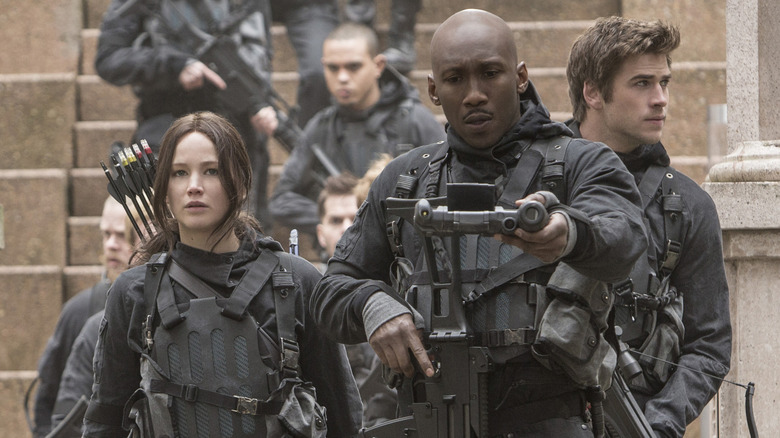
Hollywood pretty consistently ignores certain audience demographics. Then, inevitably, once someone hits it big within that demographic, there will be a gold rush of others attempting to repeat that success. Lionsgate did indeed strike gold with "Twilight" in 2008, generating one of the studio's biggest franchises ever. Not that Hollywood had ignored YA material in the past, but this kicked off another boom within the industry for such material.
Lionsgate was able to parlay similar success in this arena with the first "Hunger Games" in 2012, but that was just part of the larger trend. 20th Century Fox also did very well with "The Maze Runner" in 2014, in no small part thanks to a surprisingly thrifty budget. The less said about the "Divergent" series the better, but the point is, YA movies were absolutely booming at this time. While superheroes were still the biggest thing around, this was a business worth being in.
YA done right had a sizable audience and "Mockingjay – Part 2" managed to catch that wave before it tapered off a bit. Lionsgate, though not generally successful in the realm of big-budget blockbuster filmmaking, absolutely found a lucrative niche to tap into during the 2010s, with this movie serving as just one part of a broader trend. An underserved audience was being well-served and there's something to be said for that.
Big franchises were king of the world in 2015
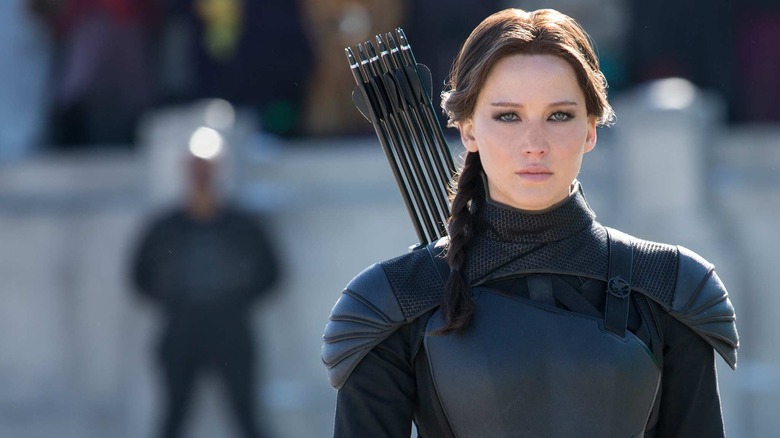
Hollywood's obsession with franchises and IP is nothing new, but 2015 felt like a major tipping point. "Star Wars" made its grand return to the big screen with "The Force Awakens" making over $2 billion globally. "Minions" managed to become a $1.1 billion spin-off from the "Despicable Me" series. Even the not-very-well-liked "Taken 3" made $326 million. Franchises were absolutely booming.
To that end, only two movies in the global top ten in 2015 weren't part of franchises. "The Martian" being one and "Inside Out" ($858.2 million) being the other. This is the year that saw "Jurassic World" make a dizzying $1.67 billion, shattering records along the way. "Spectre" seemingly coasted to $880.6 million despite being a major step down for "Skyfall" in the quality department. Audiences were all-in on franchise obsession.
Marvel even managed to turn "Avengers: Age of Ultron" into a $1.4 billion behemoth despite a mixed response. Meanwhile, "Furious 7" made an outlandish $1.51 billion, obliterating expectations for what that franchise could be. The point is, this was a watershed year in the landscape of franchise filmmaking and "The Hunger Games: Mockingjay – Part 2" was a part of it. Even if it wasn't a high watermark for this particular franchise, it was a giant success in a year filled with giant successes. Most of it hinging on the idea of audiences being invested in a given universe, which is something that continues to hang over Hollywood to this day. Case in point, we're getting another "Hunger Games" movie. That's how it goes.
You can get "The Hunger Games" 5-film collection on Blu-ray or DVD from Amazon.