

Alan Hale Jr.'s 1949 Sci-Fi Movie Has An Incredibly Wild Premise
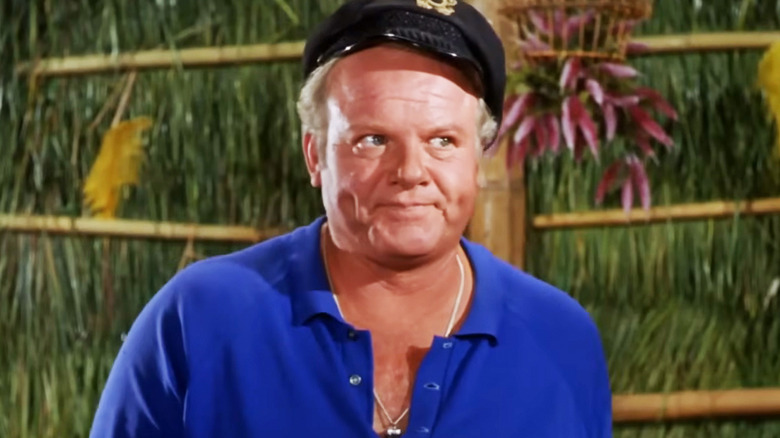
Alan Hale Jr. might be best known for dealing with the antics of Bob Denver's Gilligan on "Gilligan's Island." But beyond his beloved portrayal of the Skipper, he had a prolific and varied career that often saw him dabble in science fiction. He guest starred on America's first fantasy sci-fi sitcom and later appeared in several sci-fi movies post-"Gilligan's Island." 1949's "It Happens Every Spring," however, remains his only foray into sci-fi sports comedy territory, making it a notable entry in his filmography — especially since its premise involved a magical substance that repels wood and turns a chemistry professor into a baseball star.
Hale Jr.'s career really got going in the 1950s when he fronted two of his own TV shows, starting with the adventure series "Biff Baker U.S.A." in 1952. Hale Jr. then went on to headline his own Western series "Casey Jones" in 1957 before finally landing the role of Captain Jonas Grumby in "Gilligan's Island" in 1964. In the late '40s, however, the future Skipper actor was just following in the footsteps of his father, himself an accomplished character actor, by trying to make a name for himself in Hollywood.
Hale Jr. got his start in 1941, playing small roles in dramas such as "I Wanted Wings" and "Dive Bomber." He appeared in some significant projects as the decade wore on, sharing the screen with the likes of Clark Gable and taking direction from such greats as Raoul Walsh. Then, in 1949, he joined Ray Milland and Jean Peters in "It Happens Every Spring."
It Happens Every Spring is a charmingly wacky sci-fi sports comedy
"It Happens Every Spring" isn't one of Alan Hale Jr.'s best roles, but only because he's not in it that much. Otherwise, the film is delightfully wacky. It opens with a quote from Albert Einstein: "The results of scientific research very often force a change in the philosophical view of problems which extend far beyond the restricted domain of science itself." This, it seems, was enough justification for a story in which a scientist accidentally discovers a wood-resistant substance that turns him into a pitching superstar.
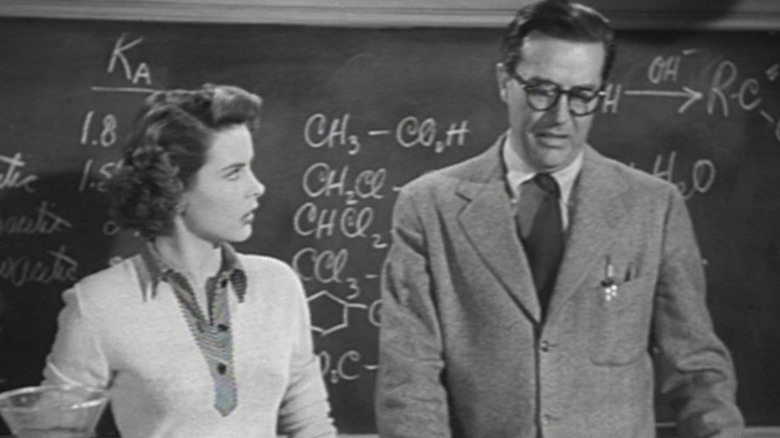
Ray Milland plays the professor in question, Vernon K. Simpson, whose lab is destroyed when an errant baseball crashes through his window. The shattered beakers release a mix of chemicals that form a substance named "methylethylpropylbutyl" which then gets on the baseball. Soon after, Simpson realizes the baseball is repelled by wood, and so he does what any college professor would do under the circumstances: heads straight for the big leagues. Not only does he manage to secure a spot on the St. Louis team, thanks to concealing a dab of the substance in his pitcher's glove, but he also makes sure no hitter can make contact with his pitches and eventually takes his team all the way to the World Series.
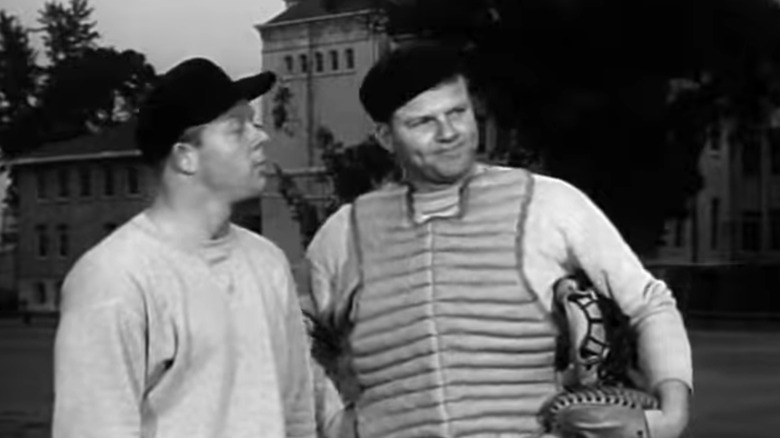
Before he departs for St. Louis, however, Simpson decides to test his new discovery on the school baseball field, and enlists college hitter Isabell (Bill Murphy) and catcher Schmidt (Alan Hale Jr.) to help. After Simpson dabs his "methylethylpropylbutyl" on the ball and it jumps over Isabell's bat, Hale Jr.'s catcher exclaims, "Did ya see the hop on that ball? That's a regular dispy-do you got there, Mr. Simpson!" God knows what he's talking about, but it sure is charming.
It Happens Every Spring was a departure for everyone involved
"It Happens Every Spring" was directed by Lloyd Bacon, who had previously overseen Warner Bros.' 1933 musical "42nd Street" before going on to direct multiple features throughout the 30s and 40s. With his 1949 sci-fi sports comedy, he departed somewhat from his usual fare. In fact, everyone involved with "It Happens Every Spring" was taking something of a detour, though Alan Hale Jr. would return to sci-fi multiple times, including in the 1960s film "The Crawling Hand." The film's unique premise made it unlike anything else at the time, and it didn't necessarily go over well with every critic.
The New York Times' Bosley Crowther, for instance, accused writer Valentine Davies of making a major error in "assuming that the idea [of a wood repellent substance] was sufficiently funny by itself and that it needed no great elaboration or clever writing to make a winning show." According to Turner Classic Movies, however, Time magazine's reviewer was more complimentary, writing, "With remarkable skill, this single-cylinder fantasy has somehow been kept in motion by director Lloyd Bacon ('Mother Is a Freshman,' 1949) and writer Valentine Davies ('Miracle on 34th Street,' 1947), who apparently have a gift for making a fairly funny movie out of a downright silly idea."
Of course, Hale Jr. wasn't in the film enough to worry too much about the reviews. After Professor Vernon K. Simpson confirms his plan will work, he leaves his college — and Hale's catcher — behind. But in his short scene, Hale Jr. is just as endearing and relaxed as he ever was. Like the film as a whole, then, his brief appearance is a charming little relic of the late 1940s.