

The Three Most Beloved Sci-Fi Western Anime All Debuted In 1998
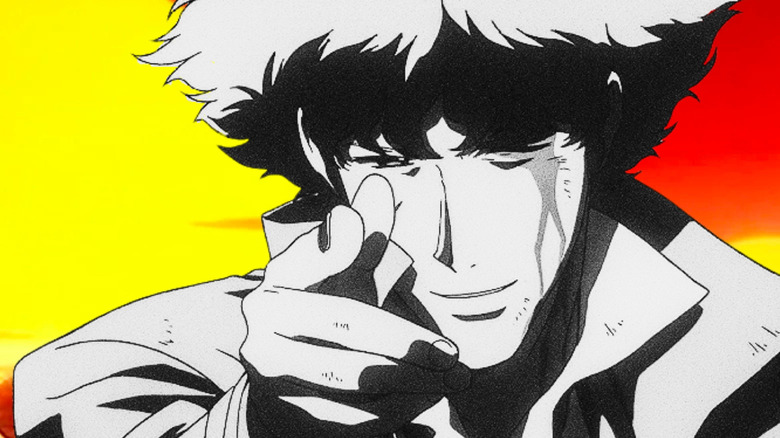
Two genres that meld together better than you might expect are Westerns and science fiction, to the point the "space Western" is its own mini-genre. Both genres tap into living on an unexplored frontier where a freer life goes hand in hand with a more dangerous one. We've explored all there is to see on Earth, so the only way to feel like there's an untamed world out there is to tell stories of a nostalgic past or look to the stars. That's why Gene Roddenberry saw "Star Trek" as a space Western: It's a show all about exploring "the final frontier."
If you asked most science fiction fans what the best ever space Western TV show is, most would answer Joss Whedon's short-lived but long-loved series "Firefly." Animation fans, though, won't draw their answer so quickly. While the Western is the most American of film genres, Japanese filmmakers highlighted how far the space Western genre can bend with "Cowboy Bebop," "Outlaw Star," and "Trigun." Yes, all three series have stark differences and unique identities, yet each one fits into the space Western bucket. Even more amazingly, they all debuted on Japanese TV in the same year: 1998.
"Outlaw Star," based on a short-lived manga by Takehiko Itō, came first in January 1998. "Cowboy Bebop" (an original creation, produced by the same studio as "Outlaw Star," Sunrise) and "Trigun" (also based on a manga, this one by Yasuhiro Nightow) both followed soon after in April. Even if their overlapping genres and release windows mean you can't help but compare them, all three anime enjoy strong legacies on their own terms — including in the country that popularized the Western.
Cowboy Bebop's genre melting plot includes science fiction and Westerns
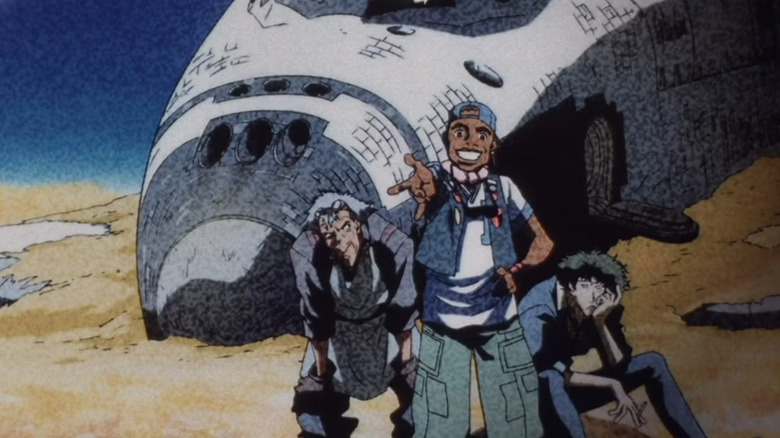
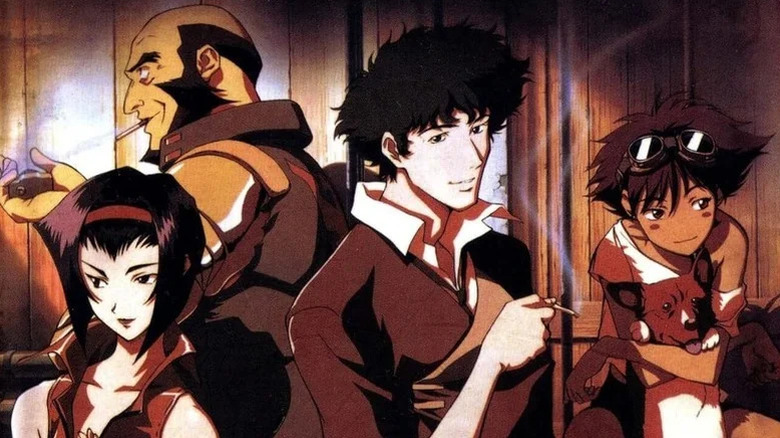
"Cowboy Bebop," directed by Shinichirō Watanabe, is the most famous and beloved of these three series. It made Watanabe into one of anime's most celebrated directors, it's often ranked as one of the best anime series ever, and it later received both a theatrical movie and a short-lived live-action Netflix remake.
Hidden text in the "Cowboy Bebop" opening sequence describes the series as "a new genre itself." "Cowboy Bebop," which reads like a nonsense phrase, can be taken as a label for that new genre: "Cowboy" because the show follows a crew of bounty hunters called "cowboys," and "bebop" for the show's jazzy, mood-setting score composed by Yoko Kanno. But while the Bebop crew (Spike Spiegel, Jet Black, and Faye Valentine) are called cowboys, they don't dress or act the part much. In fact, they feel more like they stumbled off a film noir set onto a spaceship.
Still, it's not hard to spot the Western influences. The Bebop crew even gets information on bounties from a TV show titled "Big Shot," where hosts Punch & Judy drew up like old school cowboys.
Similarly, the very first episode, "Asteroid Blues," takes place on Tijuana, a small asteroid named after the city in Mexico. The action then kicks off when the criminal Asimov Solensan walks into an old-school bar that looks like something out of the Old West. Other Western-flavored episodes of "Cowboy Bebop" include "Mushroom Samba," when the Bebop crash lands on the moon Io (which has been terraformed into a desert right out of Monument Valley, cacti and all), and "Cowboy Funk," where Spike runs across Andy, a bounty hunter who takes the "cowboy" label a little too literally.
Trigun confronts a Western gunslinger with unique moral challenges
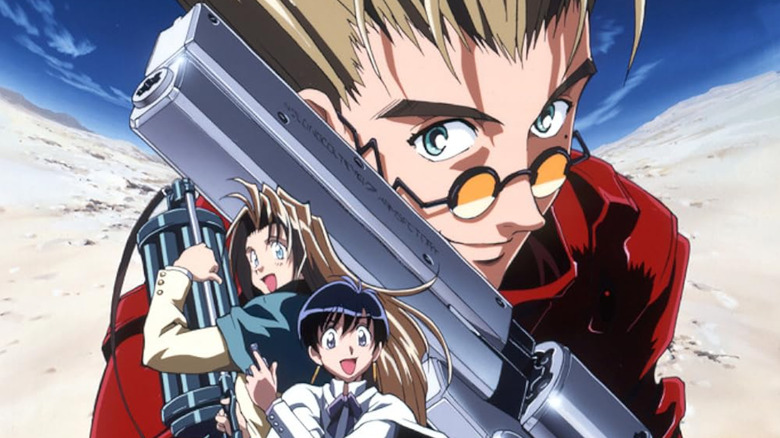
Of these three anime, "Trigun" is the one that is strictest about being a Western in its aesthetic and storytelling. The series takes place on a desert planet known as No Man's Land or Gunsmoke, depending on the translation. The lead character is also a wanted gunslinger: Vash the Stampede, distinguished by his red overcoat and spiky blond hair. Traveling alongside Vash are Meryl Stryfe and Milly Thompson, two insurance adjusters assigned to limit the destruction he causes.
Unlike in "Cowboy Bebop" and "Outlaw Star," the characters in "Trigun" don't regularly travel in spaceships. Rather, the towns they come across tend to be single-street towns of wooden houses and saloons. These small oases are surrounded by miles and miles of desert, just like in the Wild West. There's plenty of other Western flourishes, too, like Vash's face and bounty being plastered on paper wanted posters.
As the series goes on, the sci-fi elements take hold. Humanity came to No Man's Land by accident after a fleet of colony ships crashed there after leaving Earth to seek a new home. The people of No Man's Land are descendants of the crash survivors, and Vash's backstory is intertwined with this crash. He's not as human as he looks and has been alive for more than a century, yet he hasn't aged a day.
That's not the only thing unusual about him. Even though he wields guns and is an unrivaled sharpshooter, Vash is a pacifist at heart. He preaches "love and peace" and refuses to take a life, a lesson imparted on him by his adopted mother, Rem. Whether Vash can abide by that nonlethal principle, and whether he causes more damage by doing so, is what makes "Trigun" a surprisingly philosophical Western.
Outlaw Star is a space opera styled after Treasure Island
"Trigun" enjoys acclaim and a dedicated fandom almost on par with "Cowboy Bebop." It received a standalone film, "Trigun: Badlands Rumble," in 2010, as well as a 3-D animated remake called "Trigun Stampede" (retitled "Trigun Stargaze" for Season 2) in the 2020s.
While "Outlaw Star" came first, it's the most obscure of these three series and has yet to receive a remake or a follow-up. It also does not currently have official distribution in the U.S., being absent from anime streaming services like Crunchyroll. But that shouldn't be taken to mean "Outlaw Star" is lesser. If you're in the mood for an eclectic space opera that recalls "Guardians of the Galaxy," "Outlaw Star" is your huckleberry.
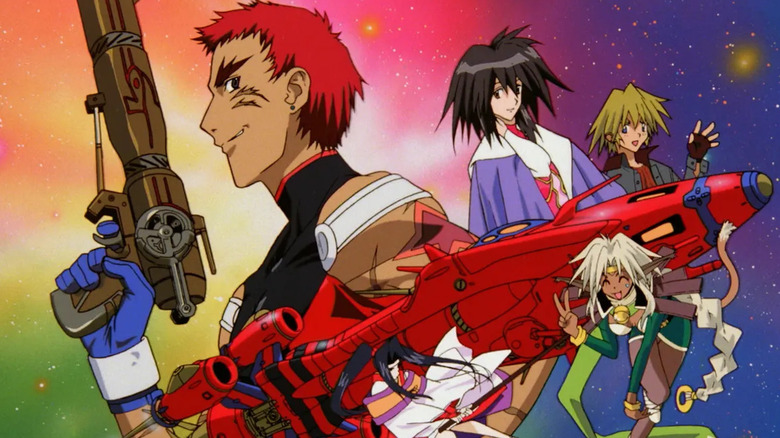
"Outlaw Star" is the name of the main spaceship in the series, one that falls into the hands of two motley business partners: Gene Starwind and his kid sidekick Jim Hawking. Rounding out their crew is android Melfina, assassin Twilight Suzuka, and cat-girl alien Aisha. The Outlaw Star quintet spend the series pulling odd jobs, dodging space pirates, and searching for a treasure called the "Galactic Leyline." It's an old-school adventure in the vein of Robert Louis Stevenson's "Treasure Island" (note Jim's name is one letter off from that book's hero, Jim Hawkins). Before there was "Treasure Planet," there was "Outlaw Star."
The title, "Outlaw Star," is the one that most explicitly suggests a combination of a Western and science fiction. The outlaw is another classic Western archetype, sometimes overlapping with and sometimes opposed to the cowboy. Indeed, while Gene and co. aren't necessarily criminals, they are still "outlaws" in the sense that they make their own way in the world and have the perfect, rocket-shaped vehicle to liberate them from any ennui.
Cowboy Bebop, Outlaw Star, and Trigun all helped the 1990s anime boom
Anime has reached the cultural mainstream in the U.S., and that tide started to turn in the late 1990s and early 2000s. A chief reason why is the Cartoon Network programming blocks Toonami and Adult Swim imported several anime series. Adult Swim awed American kids staying up late with cartoons cooler and more adult than anything made stateside.
"Cowboy Bebop," "Trigun," and "Outlaw Star" (the latter of which originally debuted on Toonami) were all staples of Adult Swim in the early 2000s. One reason they, especially "Cowboy Bebop," continue to be recommended as gateway anime is that they're among the first anime that American millennials fell in love with. In fact, many American anime fans hold this trio of space western series in a higher, more vaunted regard than Japanese fans do.
One reason the shows translated to the West so well goes back to literal translation. The 1990s is when anime English dubbing started to improve in quality. "Cowboy Bebop" especially is often cited as the best anime dub ever, thanks to a cast and crew that recognized the series as something special. But the "Outlaw Star" and "Trigun" dubs are nothing to sneer at, either. After all, Johnny Yong Bosch's performance as Vash (which he reprised in the "Trigun: Stampede" and "Stargaze" dubs) made him into a voice acting superstar.
But this success also speaks to more fundamental qualities baked into these anime. All three series took quite a bit from Western/English-language cinema, from film noir to "Star Wars" to Sergio Leone's Spaghetti Westerns and repackaged those stories with dynamite animation. So, when the space Westerns made their way to the U.S., the land of their chief influences, of course the audiences there loved them.