

5 Best Fantasy Sitcoms, Ranked
Many TV sitcoms, since the inception of the format, have dealt with the recognizable foibles of ordinary suburban life. There are heaping handfuls of shows about middle-class families, or perhaps loving acquaintances, living in average multi-bedroom houses or posh city apartments, learning how to better interact with one another, and reversing their personal problems with a sense of comedic whimsy. In some cases, the families are large ("Just the Ten of Us"). In some, the families are blended ("The Brady Bunch") or star adopted children ("Diff'rent Strokes"). In yet others, the family hates each other ("Married... with Children").
While family dynamics remain a bedrock of the genre, one can often see sitcom creators getting bored and introducing fantastical elements into the mix. Picture a sitcom, but one of the characters is an alien ("ALF"), or bigfoot ("Harry and the Hendersons"), or a living car ("My Mother the Car"), or they're all talking dinosaurs ("Dinosaurs"). The average sitcom formula still works, but that's not going to prevent curious comedic mixologists from swirling in a few high-proof fantasy ingredients to see what kind of buzz they can get. Sometimes the ingredients produce terrible flavors (like "The Secret Diary of Desmond Pfeiffer"), but one can't fault writers for trying something new.
Fantasy sitcoms have been so plentiful over the years, they now take up a measurable percentage of all sitcoms produced. Here at /Film, we're honing in on the best fantasy sitcoms ever made, and we're ranking them too. Read on, gentle travelers, and enjoy the celebrations and the reminiscences of sitcoms with fantastical ingredients.
5. Out of This World (1987 - 1991)
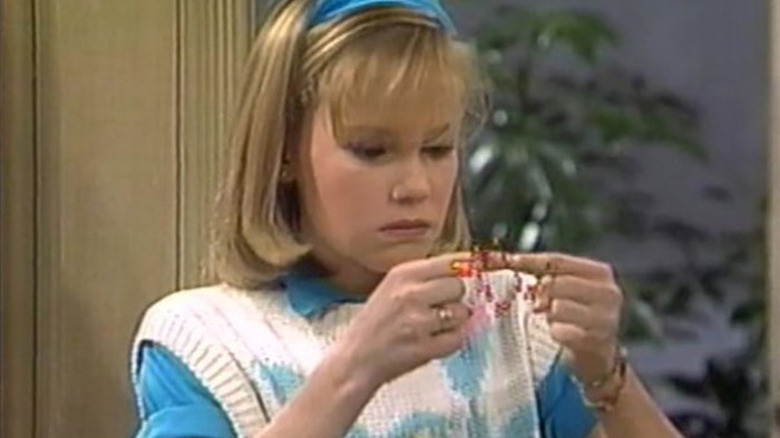
Jon Boni's and Bob Booker's 1987 sitcom "Out of This World" is technically a sci-fi series, as it stars Evie (Maureen Flannigan), a teenage girl who is half-human and half-alien. The Antarean aliens in "Out of This World," however, are more like Kryptonians than Vulcans, as they all play host to a raft of inexplicable magical superpowers. Evie, for instance, has found that she can touch her index fingers together and freeze time. She lives with her mom Donna (Donna Pescow), who has admitted that she once had a relationship with a space traveler named Troy (Burt Reynolds), and Evie can communicate with Troy using a magical glowing cubic crystal. Troy cannot be there to help raise Evie, as he was called back to Antareus to fight in some kind of intergalactic war. The show is only sci-fi in the way that Superman is sci-fi. That is to say, it's largely fantasy.
The plots of "Out of This World" tend to surround Evie discovering some kind of new, unusual superpower that springs from her magical alien genetics. In one episode, she finds that she has been granted wishes for her birthday. In another, she finds that she can duplicate herself. She usually needs advice from her mom or her irascible uncle (the great Joe Alaskey) to get herself out of a bind. Evie and Donna are also, curiously, friends with the local mayor (Doug McClure), who's too dumb to notice that Evie has magical powers.
In terms of its humor, "Out of This World" features typical off-the-rack sitcom jokes that possess only an average level of wit. Where the series shines is in how well it meshed its fantastical premise into the world of sitcoms. This isn't just a sitcom with a super-powered alien in the middle, but a show that highlights the alien as often as possible.
4. Bewitched (1964 - 1972)
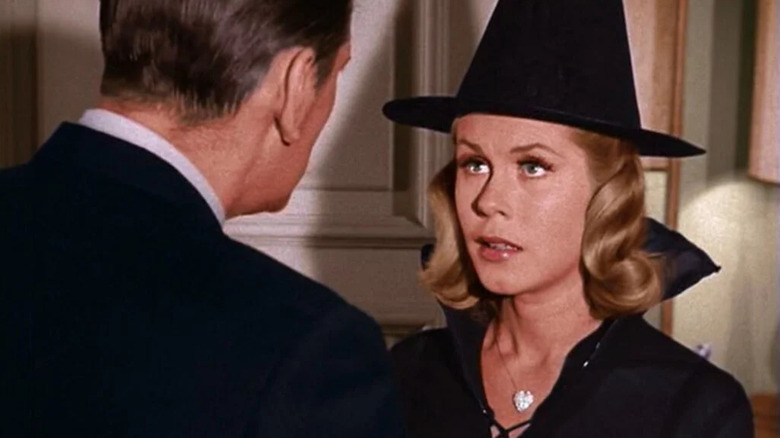
Sol Saks' 1964 sitcom "Bewitched" was a hit when it was first released, and it lasted a whopping eight seasons and 254 episodes, not going off the air until 1972. This was a very strange show to be a hit, as the main character, Samantha (Elizabeth Montgomery), is a 400-year-old witch who has moved to the suburbs with her kinda-dumb human husband, Darrin (Dick York from 1964 to 1969, Dick Sargent through 1972). Samantha possesses her own magical powers, and she still tools around with her magical, immortal family members, most notably her mother, Andora (Agnes Moorehead). One can probably find plenty of sitcoms wherein a beleaguered suburban husband has to interact with the strange dealings of his energetic wife and/or eccentric in-laws, but "Bewitched" might be the first to make the wife and in-laws beings from a higher magical plane.
The standout detail of "Bewitched" is how mercifully powerless Darrin is. He's the supporting player in Samantha's life. The audience spends more of their time with Samantha and her supernatural abilities than they do with Darrin at the ad agency where he works. Samantha is trying to behave like a 20th-century housewife at her husband's request — she does love him — but one gets the constant impression that Samantha is far beyond humanity. Indeed, she seems to be a little bemused and/or baffled by many situations and secretly uses magic to manipulate reality to make life a little easier (often to comedic results).
While Samantha is a kind, approachable character, her inhuman qualities make "Bewitched" stand out. What if a nonhuman witch lived in the suburbs? In many ways, "Bewitched" is almost satirizing the medium, right when it was at one of its highs.
3. What We Do in the Shadows (2019 - 2024)
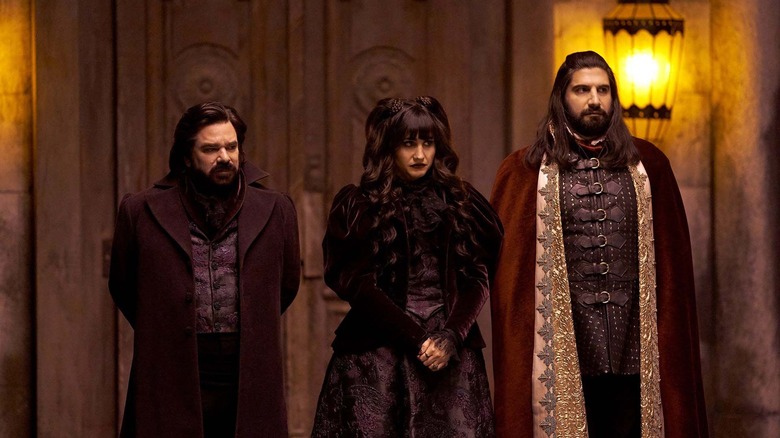
Based on Jemaine Clement's and Taika Waititi's hysterical 2014 film of the same name, "What We Do in the Shadows" is one of the funniest TV shows you will ever see. Like the film, the show is a documentary-style exposé of vampires living among us, this time in New York instead of New Zealand. The vampires, however, are so very ancient that they have lost sight of how regular humans interact, and they certainly have no sense of modern American technology. They still dress in the robes of conquerors, despots, and monsters as they attempt to traverse the petty financial burdens of sharing a flat on Staten Island.
Each actor is the best actor on the show. Matt Berry plays Laszlo, an ultra-sexual British vampire who is married to Nadja (Natasia Dimitriou), the spikiest of the lot. Kayven Novak plays Nandor the Relentless, a 760-year-old conqueror who once ruled over an ancient Eastern kingdom. Bringing them into the modern day is Colin (Mark Proksch), an energy vampire who has no fangs but can hungrily feast on energy when people are bored or feeling ennui. Naturally, he has a talent for talking at length about boring things. Nandor is served by Guillermo (Harvey Guillén), a human familiar who is more exasperated than exhilarated to be part of the vampire clan.
It's every bit as funny as it sounds, with the vampires only able to comprehend the world from the perspective of ancient monsters. Whenever they try to get a handle on something of human origin, they fumble, and the "Superb Owl" episode is one of those highlights. The world just doesn't know what to do with vampires anymore, even though they, as immortals, have to keep on interacting with the world.
2. Galavant (2015 - 2016)
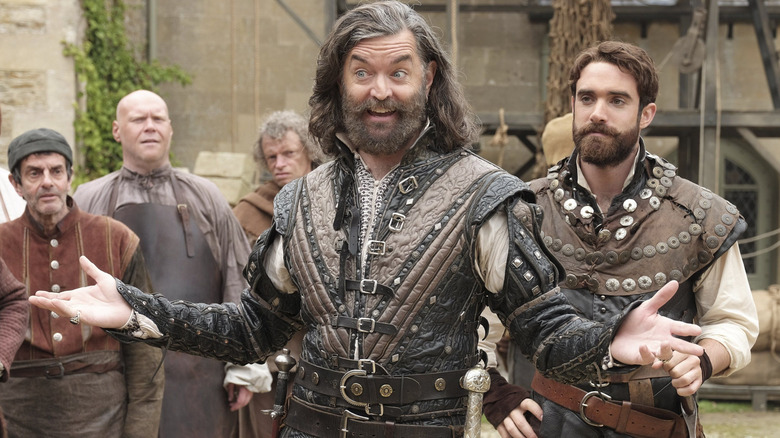
Dan Fogelman's "Galavant" is one of those legendary shows that will eternally be talked about because it was canceled too soon. It only lasted for two seasons and 18 episodes in 2015 and 2016 before being yanked from the airwaves, and the population lost out on one of the most sprightly, satirical programs this side of Mel Brooks. Indeed, "Galavant" is actually better than Mel Brooks' own dumb Robin Hood sitcom "When Things Were Rotten" from 1975. It has a manic Monty Python energy and the whimsical self-awareness of "The Princess Bride." It's pretty great!
"Galavant" has two notable features that will make one perk up. For one, it's a musical program, and each episode featured numerous original songs, many of which are super-catchy; keep an eye out for "Weird Al" Yankovic as a singing monk. The other main feature is Timothy Omundson as the evil King Richard, a comedic revelation if ever there was one. Omundson has enjoyed a steady TV career since the early 1990s, but didn't start landing main roles until the early 2000s on shows like "Judging Amy" and "Psych." "Galavant" proved that he's one of the great comic talents of his generation, giving a lot of character and joy to King Richard that I can't imagine anyone else bringing.
Galavant (Joshua Sasse) is a brave knight who aims to rescue his beloved Madalena (Mallory Jansen) from the evil clutches of King Richard, even though she has actually grown accustomed to the wealth and power that being married to a king provides. There are wizards, warriors, dragons, and a lot of celebrity cameos. It's a pity that the series lasted for so brief a period, but at least it got made at all.
1. The Good Place (2016 - 2020)
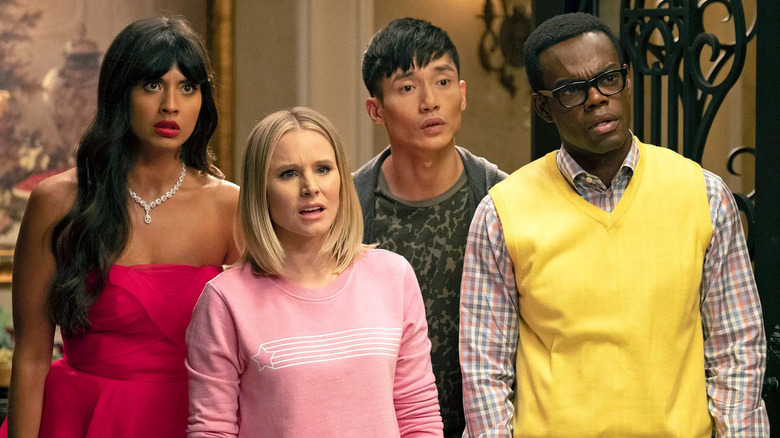
The premise of the first season of "The Good Place" was tantalizing. A quartet of people — Eleanor (Kristen Bell), Chidi (William Jackon Harper), Tahani (Jameela Jamil), and Jason (Manny Jacinto) — have died and gone to Heaven, or, as they call it, the Good Place. The gag of the series is that they are all actually terrible people and only ended up in the Good Place through some kind of divine clerical mix-up. They really deserve to be in the Bad Place. Their overseer is a supervising figure played by Ted Danson, and their whims are catered to by sentient robots named Janet (D'Arcy Carden). Without spoiling anything, the end of the season also comes with quite a shocking revelation.
I get the impression that the showrunners assumed the show would be canceled at the end of the first season, but then had to scramble to redo the premise when the series was renewed. Whatever the reason, "The Good Place" was suddenly afforded every opportunity to go philosophically hog-wild, with characters having their memories erased, and existing in the afterlife for hundreds of Jeremy Beremies. (That's a unit of time in the afterlife, and some fans have figured that a Jeremy Beremy is about a century.) The series, while a whimsical comedy program, often tipped heavily into notions of ethics, and the moral ramifications of a soul purifying itself from evil to good.
"The Good Place" ran for four seasons, and it remained strong throughout, careful to balance slapstick sitcom humor with larger notions of modern theology. It might be one of the more thoughtful comedies of recent vintage.