

This Controversial '90s Civil War Sitcom Was Canceled After Just Three Episodes
We may receive a commission on purchases made from links.
This one is, uh, pretty bad.
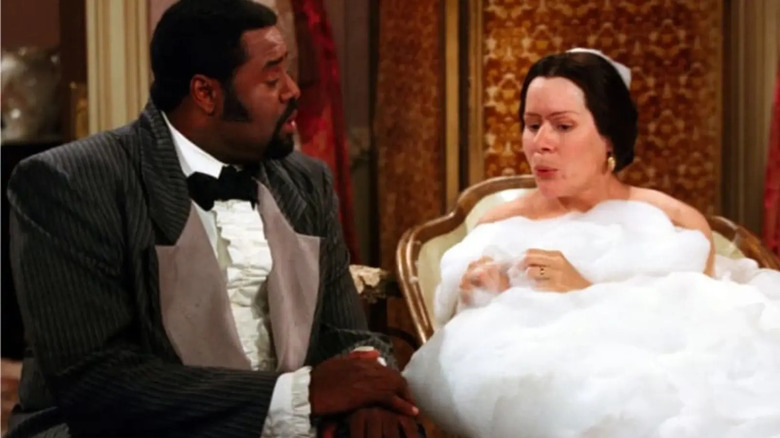
Some of us were TV savvy enough in the year 1998 to remember the debacle that was "The Secret Diary of Desmond Pfeiffer." The 30-minute sitcom aired on Paramount's long-gestating network, the UPN, and sold itself on an outrageous premise, perhaps hoping to court a mass audience through controversy alone. Chi McBride played the titular Desmond Pfeiffer, a shamed British aristocrat who fled to the United States in the 1860s, and took up a job as Abraham Lincoln's personal valet in the White House. Desmond Pfeiffer kept a personal diary that, the show claimed, told the real truth about Lincoln (played by Dan Florek). The "real" Lincoln, audiences learned, was a sex-crazed fratboy. In the first aired episode, for instance, Lincoln was caught having "telegraph sex" (a spin on cybersex, so topical in 1998) with an unseen stranger.
The series made whimsical light of the horrors of the Civil War, perhaps trying to emulate the "shock" jokes Mel Brooks might have made about World War II. Everyone hated it right away, including critics ... which the UPN bragged about. Some of the show's print advertising declared, in big stark letters, that "Critics hate it." If it came with such negative reviews, it must at least be interesting, right? "Clerks: The Animated Series" made a reference to it.
Or perhaps it was just bad. "The Secret Diary of Desmond Pfeiffer" debuted on October 5, 1998, and the public rejected it outright. Nine episodes were produced, but the show was canceled after its third episode and taken off the air on October 26, just after its fourth aired. The remaining five episodes can be found online by resourceful internet sleuths, but one may want to do some reading on the matter before they go seeking.
The NAACP protested The Secret Diary of Desmond Pfeiffer
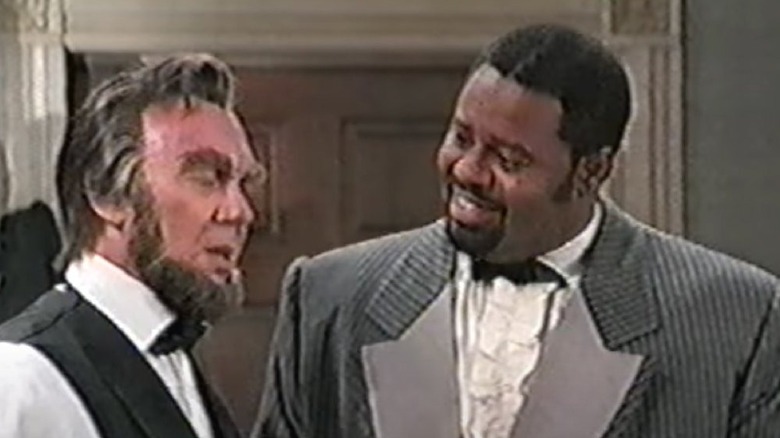
"The Secret Diary of Desmond Pfeiffer" was drawing criticism even before it debuted. According to an article in the Los Angeles Times, Paramount was met with a massive protest, led by a Los Angeles city councilmember and joined by both the Brotherhood Crusade and the National Association for the Advancement of Colored People. The protest was over the perception that the sitcom made a comedy out of the United States history of slavery. The council member in question, Mark Ridley-Thomas had seen an episode of the series, and feared that it would do irreparable harm to the community.
Paramount's counter-rhetoric may sound familiar to readers in 2026. UPN president Dean Valentine noted that the protests were little more than "an indication that political correctness has gone haywire," and that they represented a "scary harbinger for freedom of expression." The term "politically correct" was, for the younger readers, wielded in nearly the same way modern-day right-wing politicians sneer at the word "woke." Valentine added that "this guy has something better to do with his time than worrying about what UPN is putting on its fall schedule." This was a salient thing to say, as the UPN was notoriously unsuccessful, and very few people paid much attention to what it was putting on its schedule.
Dean Valentine was president of UPN from 1997 until 2002, and had briefly courted controversy before. In 1997, the Chicago Sun-Times reported that Valentine, when he took over, began to skew away from TV shows that starred Black characters. He denied any bias or race-based decision-making.
It's worth noting that "Desmond Pfeiffer" featured no jokes at the expense of slaves, and didn't make light of slavery.
The Secret Diary of Desmonf Pfeiffer was so bad
In David Hofstede's book "What Were They Thinking?: The 100 Dumbest Events In Television History," the author rightfully pointed out that the protesters of "The Secret Diary of Desmond Pfeiffer" were angry for the wrong reasons. The book noted that Danny Bakewell, the CEO of the Brotherhood Crusade claimed that such a sitcom "denigrates the bones of our ancestors." The series, however, didn't feature any on-screen slaves, and generally talked about slavery with a sensitive touch. What the series was aiming for was to lampoon the current-day presidency. President Bill Clinton was still in office at the time, and he had a reputation for being a womanizer; I shan't get into the Monica Lewinsky affair here. The makers of "Secret Diary" merely aimed to transpose Clinton's perceived lasciviousness onto Abraham Lincoln.
The series barely worked, however. The jejune sex jokes were largely crass and unfunny, and the writing was rarely sharp. The best part of the series was actor Kelly Connell as the drunken Ulysses S. Grant. He brought more verve to the role than it deserved. Chi McBride survived well enough; the entire cast continued to work after the series, but none of them created memorable characters for the ages.
"Secret Diary" was a throwback to shows like "Hogan's Heroes" that laid dumb sitcom plots and broad pratfall humor onto a historical situation, turning everything dark into a cartoon caricature. In such cases, it helps if the writing is sharp, and the historical details are lavished over (see: "Blackadder"). More than anything, though, the series was just bad. If there hadn't been any protests at all, it still would have failed. The protests didn't gain "Desmond Pfeiffer" any positive buzz, and pretty much assured it would die.