

One House Of The Dragon Season 3 Death Connects To The Aegon The Conqueror Movie

This is the song of ice and spoilers. Major plot details for the "House of the Dragon" Season 3 finale ahead.
"House of the Dragon" Season 3 was a wildly messy experiment. It felt like it dragged and rushed at the same time, and many of its deviations from its source material were so bad you understand why George R. R. Martin disavowed the adaptation of his book "Fire & Blood." Yet, the show still knows how to deliver incredibly good spectacle, moments of action and excitement, and character drama full of emotion, all of which is improved by Ramin Djawadi's excellent music score. Indeed, even if the Season 3 finale left a lot to be desired, it still delivered some truly stunning moments of dragon combat, among other things.
But arguably the biggest development in the finale — one that changes quite a lot not only for the character of Rhaenyra Targaryen (Emma D'Arcy) but for "House of the Dragon" as an adaptation — was when Rhaenyra had the High Septon (Simon Chandler) executed for refusing to anoint her. After this shocking turn of events (in which she essentially kills the Westeros equivalent of the Pope), Rhaenyra just goes out and tells all of King's Landing about the super secret prophecy we're meant to believe no one knows about by the time "Game of Thrones" begins.
However, for all the attention that was given to the prophecy reveal and Rhaenyra's whole "I am the Kwisatz Haderach" speech, we shouldn't ignore how monumental the High Septon's murder was. This plot point may have been invented for "House of the Dragon," yet it comes with huge repercussions for other projects based in Westeros, including the previously-announced Aegon the Conqueror movie.
The High Septon solidified Aegon's reign
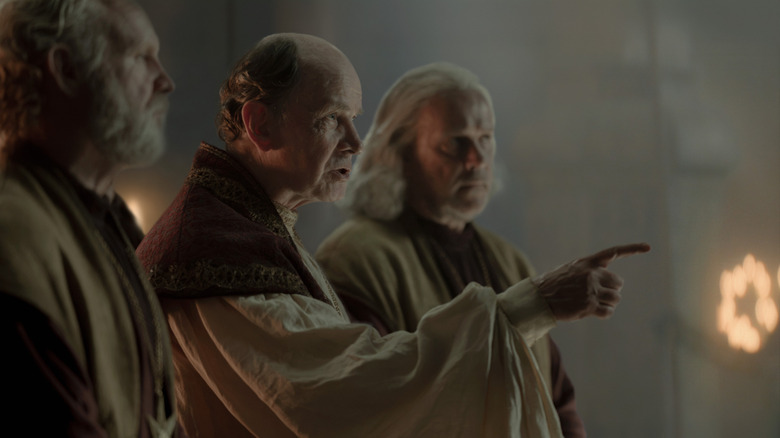
In George R. R. Martin's "Fire & Blood," we learn about the history of the Targaryens and the Faith of the Seven. A big part of what made Aegon's conquest of Westeros so quick and easy was his embracing of the Seven and customs like knighthood, despite the Seven being the faith of people enslaved by and subordinate to the Valyrian Empire. At the time, the High Septon decided that he and his septs would be burnt if they opposed Aegon, so he believed the conqueror when he claimed he was willing to convert. As such, this is likely to be a key part of the planned Aegon the Conqueror movie (even if the idea is boring as hell).
And so, Aegon was crowned with the official blessing of the Seven. He also agreed to build a grand sept in King's Landing, known as the Sept of Remembrance.
Soon after, though, the church and the Targaryens found themselves in constant conflict, and after Aegon's death, the incestuous marriages of his grandchildren, combined with his son Maegor taking multiple wives, led to a breaking point. In response, a religious militia known as the Faith Militant rose in open rebellion against the Targaryens, spurring Maegor to carry out a campaign in which he brutally murdered the septons, destroyed their septs, and eventually marched on their home base in Oldtown, threatening to literally burn down the entire religion.
Yet, Maegor never actually executed the High Septon himself. He may have considered it, and his mother Visenya certainly wanted him to do it, but he didn't. Instead, Maegor's open war and tyranny ultimately led to his murder.
Still, I'd argue "Game of Thrones" proved Rhaenyra should've gone even further.
House of the Dragon has proved Cersei was right
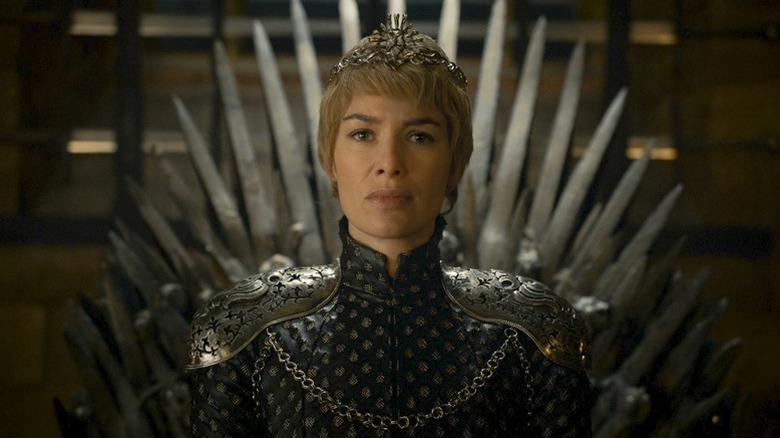
Remember the end of "Game of Thrones" Season 6? Specifically, the part where Cersei Lannister (Lena Headey) blew up the entire Sept of Baelor and killed not only Jonathan Pryce's High Sparrow (whom Cersei had already named High Septon) but the entire Faith Militant, several other royal figures, and who knows how many other folks inside and surrounding the Sept with him?
Setting aside the problems with this turn of events (itself proof positive that the issues with "Game of Thrones" started way before its dreadful final season), Cersei faced no punishment for blowing up the Sept of Baelor. Again, she literally blew up the Westeros equivalent of St. Peter's Basilica in the Vatican, killing a whole lot of high-ranking religious figures and even multiple members of one of the richest and most powerful families in Westeros. This should've been the end of her, causing her to lose all support and inspire a nation-wide rebellion.
But what happens instead? Cersei somehow winds up getting crowned Queen of the Seven Kingdoms, and her reign is immediately accepted and embraced by everyone. The entire point of "House of the Dragon" is that the realm would rather burn than see a woman on the Iron Throne, yet all it took was blowing up the church, and Cersei's reign was unquestioned. That means Rhaenyra simply didn't go far enough at the end of "House of the Dragon" Season 3. On top of killing the High Septon, she should've just burnt down the entire Sept and everyone inside to fully cement her legitimacy. Well, at least the Battle of Tumbleton went Rhaenyra's way (kinda).