

Christopher Nolan Has Already Made The Perfect Companion Piece To The Odyssey
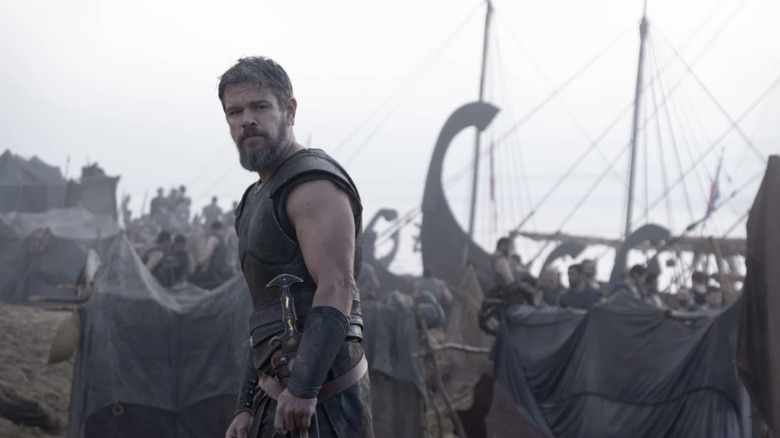
This article contains spoilers for "The Odyssey."
Back when it was announced that Christopher Nolan was going to make a film about J. Robert Oppenheimer, it seemed like a pretty notable departure for the filmmaker on paper. Sure, he'd made "Dunkirk" in 2017, which also deals with historical events during World War II. Yet "Oppenheimer" was not to contain any extravagantly staged battle sequences or other types of spectacle which Nolan had come to be known for through his work as an unabashed maker of genre films. Upon the release of "Oppenheimer," however, it was immediately apparent how much of Nolan's usual themes, structure, and style were on display. Perhaps more than any one of his prior movies, the film underlined just how much of an auteur Nolan is. It also helped further illuminate and define his interests as an artist.
The importance of "Oppenheimer" and its place in the Nolan canon is only made more apparent upon watching his latest film, this month's "The Odyssey." Again, on paper, it would seem like an adaptation of Homer's epic would have little in common with "Oppenheimer," especially as most adaptations and interpretations of "Odyssey" treat its story of Odysseus as a fairly straightforward tale of adventure and vengeance, and not a nuanced look at a problematic historical figure. Yet Nolan's "Odyssey" and "Oppenheimer" turn out to have much in common. Nolan's made complimentary features before: "Following" and "Memento," the Dark Knight trilogy, "Inception" and "Tenet," and even the aforementioned "Dunkirk" and "Oppenheimer," for instance. In this way, "Oppenheimer" and "The Odyssey" are informed by each other. Their overlapping approach to structure, theme, and character is what make them perfect companion pieces.
The Odyssey and Oppenheimer are films about the telling of tales
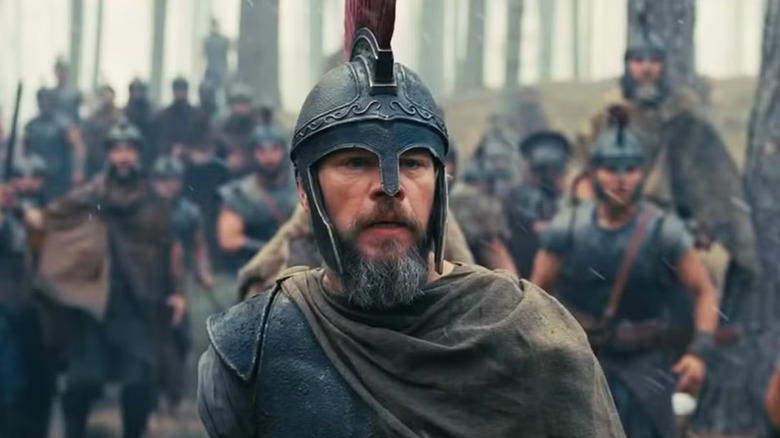
All of Christopher Nolan's films boast some sort of uncommon narrative structure to varying degrees. Sometimes this structure is intensely pronounced, as with the totally-out-of-linear-sequence "Following," the backwards (and forwards) "Memento," and the matryoshka-like epistolary story of "The Prestige." There's a little bit of the latter in "The Odyssey," yet Nolan's latest feels more akin to "Oppenheimer" given that the various out-of-linear-order tales we see in "Odyssey" are orally recited to other characters on-screen, not written down. Where "Oppenheimer" was made up of subjective recollections, explanations, and testimony, "The Odyssey" is comprised of the film's various yarns told by one character to another. Although this means there's also an element of subjectivity involved with almost everything we see in the movie, the point of view has less to do with facts and more to do with their meaning and interpretation.
This is most pronounced through the different accounts of the Trojan Horse and subsequent sacking of Troy that we see in the movie. First seen as part of a performance by a bard (Travis Scott), the tale is openly broad and hagiographic. Later, when Telemachus (Tom Holland) is told the story of the Horse "from the inside" by Menelaus (Jon Bernthal), the soldier king provides more details but still lines the tale with victorious bluster. Finally, it's the account delivered by Odysseus (Matt Damon) which contains the greatest amount of harsh, ugly truth. Yet even this can't be seen as wholly objective. Instead, like "Oppenheimer," Nolan is providing us with the pieces of the narrative puzzle for ourselves. Though it's clear he shares Odysseus' view, he refuses to give the story a single interpretation, acknowledging that it has malleability and life as its own legend separate from history.
Odysseus and Oppenheimer are guilty heroes
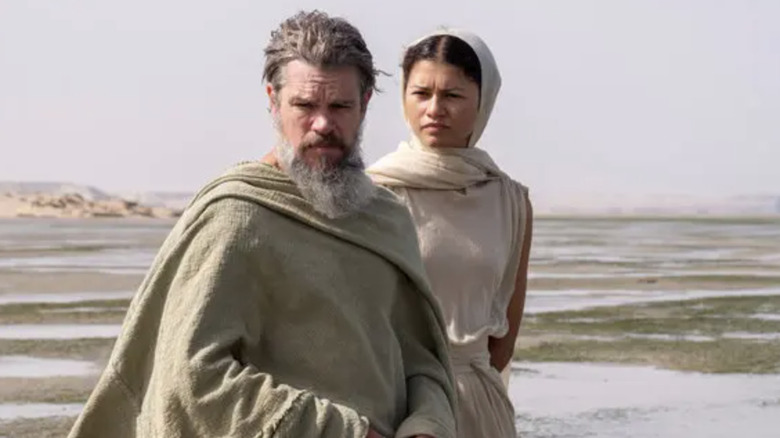
When I analyzed "Oppenheimer" as the epitome of Christopher Nolan's work, I pointed out how his films are perennially centered around guilty heroes. While it's too soon to say "The Odyssey" is the new ultimate Nolan film, I can say with a full chest that Odysseus is Nolan's guiltiest hero to date, edging out Oppenheimer (Cillian Murphy) by a hair. Oppenheimer's guilt is based around the idea that his part in creating the atomic bomb has doomed the world, though that's based partially in fact and partially in the man's fears for the possible future. Odysseus, meanwhile, believes that he and his fellow Greeks' Trojan Horse gambit violated Zeus' law of honor.
Unlike Oppenheimer, who was wrongfully accused of treason, Odysseus has mountains of evidence of his guilt that he also believes. As the film's opening title card states, "The Odyssey" is set in "A time of apparent magic," where most everyone believes in the Greek gods and their influence. Odysseus sees his plight as direct punishment for his part in the sacking of Troy and the violation of its people. To put it in Biblical terms, "The Odyssey" views the Horse as an original sin, something humanity can never recover from or rectify. That said, Odysseus is able to find some absolution that Oppenheimer does not, which says a lot about the differences in their characters. For Oppenheimer, his certainty of science means that destruction is extremely likely, if not imminent. For Odysseus, his faith and determination allows him to believe that humanity may find a way back to its nobler self. Like him, we could find our way back home. In this way, "The Odyssey" is Nolan's rejoinder to "Oppenheimer": doom may be likely, but nothing is set in stone.