

William Shatner's First Show After Star Trek Was A Failed Western Series
As any Trekkie will tell you, NBC's decision to cancel "Star Trek" after its third and final season in 1969 was an incredibly short-sighted call, especially in hindsight. To be fair, the series was not cheap. Nor was it entirely unknown, as a fan letter-writing campaign successfully secured the show's renewal for a third season after it faced cancellation following the second. Yet the fact that the show became even more popular after years in syndication, leading to its being mounted as a long-running film franchise, is as good an example as any that some series deserve time to build an audience before they start paying dividends. It's a lesson that some present-day executives (*cough* Netflix *cough*) would do well to heed.
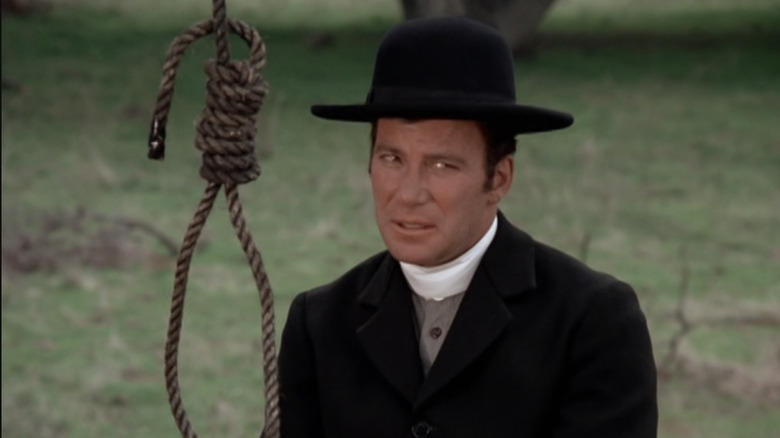
That said, there are many instances where a series just can't find its footing and doesn't manage to make it. That's the case with "Barbary Coast," the first show to star William Shatner after his leading role as Captain James T. Kirk on "Star Trek." "Barbary Coast" only lasted 13 episodes, airing on ABC from September 8, 1975, to January 9, 1976, following a backdoor pilot movie (directed by none other than Bill Bixby of "The Incredible Hulk" fame) that aired on May 4th of '75. The series was a western-spy hybrid, following the shenanigans of government agent Jeff Cable (Shatner) and his pal, conman Cash Conover (Doug McClure in the series, Dennis Cole in the pilot film), who owns a casino on the titular San Francisco coast in the 1870s. Despite Shatner's presence, a cast and crew with a solid television pedigree, and an enjoyable premise, "Barbary Coast" failed to catch on with audiences, proving that successful art is as much alchemy as it is science.
Barbary Coast was an attempt to emulate recent successful shows and movies
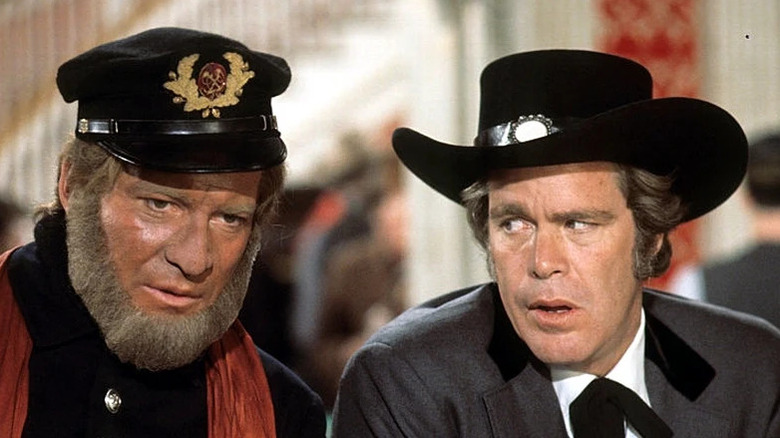
On paper, "Barbary Coast" nearly sounded like a sure thing. The series was produced by Paramount Television, the same production company behind "Star Trek." It was created by Douglas Heyes, who had directed some of the most well-received and iconic episodes of "The Twilight Zone" (though neither of the episodes in which William Shatner starred). Additionally, its premise seemed to blend two recent hit movies starring Paul Newman and Robert Redford: 1969's "Butch Cassidy and the Sundance Kid" and 1973's "The Sting." The show's theme tune, composed by John Andrew Tartaglia, sounds like a fusion of Burt Bacharach and Scott Joplin, making the comparison to those George Roy Hill films feel deliberate.
One additional wrinkle in Shatner taking the role of Jeff Cable is the idea that Cable would wear a variety of disguises throughout the episodes as part of his investigations into criminal activity. Having begun his acting career on the stage, Shatner has always embraced his sense of the theatrical, and this attribute has given him the opportunity to do some broad character work within the series. It also might have appealed to Shatner, given how similar it was to what his "Star Trek" co-star, Leonard Nimoy, had done in the wake of the sci-fi series' cancellation. Immediately after "Star Trek," Nimoy joined the cast of "Mission: Impossible" for its fourth and fifth seasons. He played The Great Paris, a magician-turned-spy who would wear various disguises on each mission.
Perhaps Shatner believed that Cable would have a similar appeal, but it was not to be. Although "Barbary Coast" became a footnote in television history, it just goes to show that neither success nor failure in art can be consistently predicted.