

Marshals' Shocking Villain Reveal Highlights The Yellowstone Spin-Off's Biggest Failure
This article contains spoilers for the "Marshals" Season 1 finale.
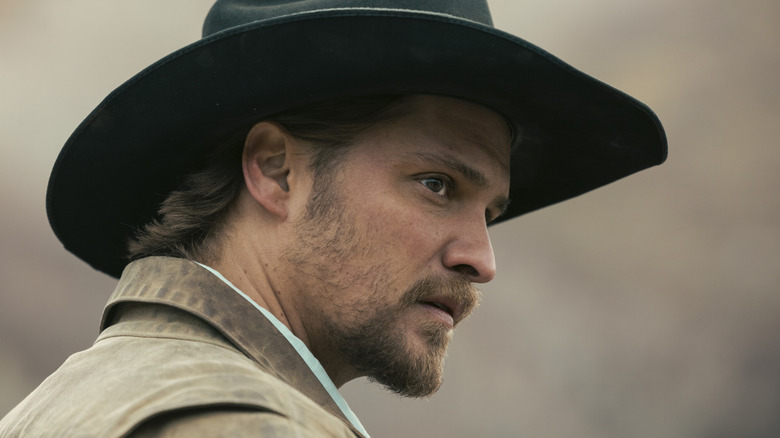
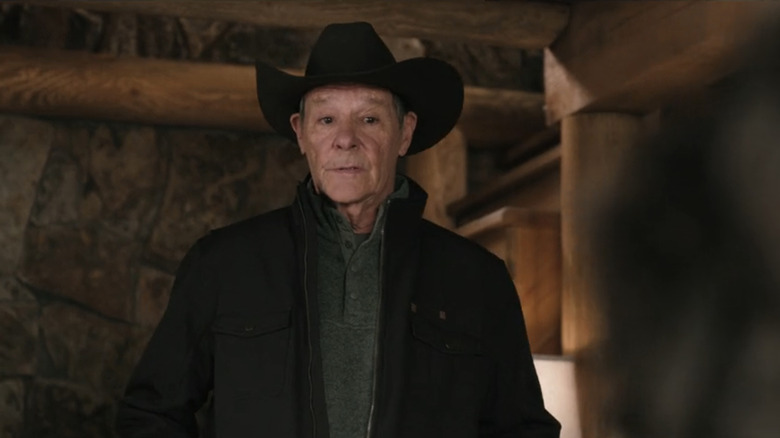
Well, "Marshals" Season 1 has finally come to a close, and it turns out a central antagonist was lurking at the heart of this episodic procedural all along. The final episode of the season reveals that Weaver Ranch owner and former stockbroker Tom Weaver (Chris Mulkey) is behind the violence visited upon Luke Grimes' Kayce Dutton and his family. This was supposed to be a big deal, but "Marshals" has had no idea what it's about since Episode 1, packing in so many storylines and diversions that by the time Weaver's dark side is revealed, it all feels a little underwhelming.
"Marshals" began by killing a controversial "Yellowstone" character in the worst possible way. Now, it has ended with a big reveal that doesn't actually feel all that significant. We first met Weaver in Episode 4 as a man who claimed to have grown tired of the stock market before moving to Montana and establishing the Weaver Ranch. Initially, the character seemed to be something of a surrogate John Dutton for Kayce — a kinder version of the Yellowstone Ranch tyrant who might just help Kayce heal from his past experiences.
Then, Weaver disappeared for two episodes as Kayce and his crew investigated their cases of the week. He then returned briefly in Episode 7 before disappearing again until Episode 12, where he put the pressure on Kayce to sell his East Camp property so that Weaver Ranch could expand. By the time we got to Episode 13, we hadn't actually seen all that much of a man who, it turns out, was the season's big bad all along.
The Tom Weaver reveal in Marshals doesn't hit like it should
"Marshals" Episode 3 introduced a powerful Dutton family rival who looked set to be the season's main villain. Michael Cudlitz's Randall Clegg and his family had, according to the show, been in Montana as long as Kayce Dutton's own family, suggesting there were some old scores to settle. Except that those scores were settled by the end of Episode 9. With four more installments to go, it remained unclear why these bargain bin Duttons had been dispatched so quickly. Now, we know.
The Weavers were the real villains all along. At least Tom and his foreman/enforcer, Jeb (Kevin McNamara), were. Episode 13 sees Thomas Rainwater (Gil Birmingham) haul up in Kayce's cabin alongside Mo (Mo Brings Plenty) and Tate Dutton (Brecken Merrill) after an attempt on the Broken Rock chairman's life. Soon, a squad of armed hitmen arrives to finish the job, but is repelled by Kayce and his Marshals. Later, Tom Weaver and his daughter Dolly Weaver (Ellyn Jameson) arrive at the cabin to lend their support, with Tom offering to take Tate on a fishing trip in Texas to help him move past the trauma. All seems well, but we soon learn that Tom has effectively kidnapped Tate and sent Jeb to take out Skinner and Logan Marshall-Green's Pete Calvin.
While it's not initially clear why Weaver wanted Rainwater dead, we know he needs Kayce's land to expand his ranching operation, and he now has Tate as leverage. It remains unclear whether Dolly was in on it the whole time, but whether she was or not, it all feels a little anticlimactic, highlighting one of, if not the, biggest problems with "Marshals:" This show still doesn't know what it's about.
Marshals has too much going on for its big twist to work
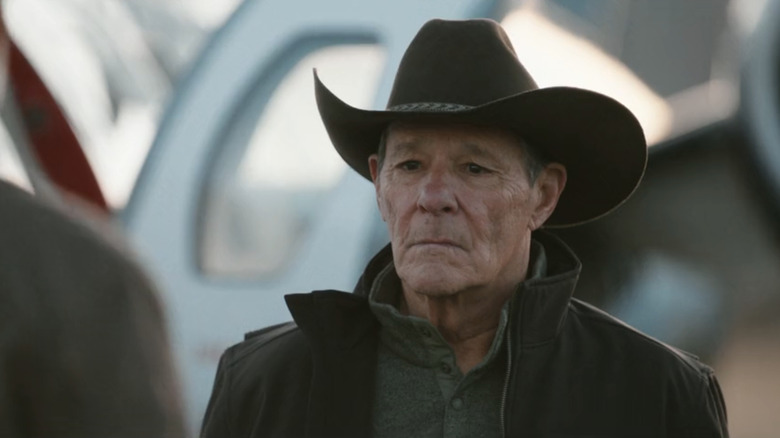
Tom Weaver appears in four of 13 episodes in "Marshals" Season 1. Otherwise, the show has remained beholden to its crime-procedural format. But not only has the crime-of-the-week element been one of the weakest parts of "Marshals," but this series also has so many B-stories it can't find any sense of direction.
While Tom Weaver has presumably been ranching, entire storylines have played out that should have taken an entire season. For example, Riley Green's Garret — Kayce Dutton and Pete Calvin's former Navy SEAL teammate — showed up in Episode 8, made his ex-brothers-in-arms relive their military trauma, and perished in a freak explosion in the space of four episodes. Meanwhile, the show has flitted between various forms: a crime thriller about a man working for law enforcement while trying to keep his own family's crimes hidden, a commentary on the socio-political issues faced by reservations, and a naturalistic drama about a man struggling to balance his family and professional commitments. Why can't it be all three? Because that conflict between a trio of different shows is just one small part of this cursed series, which at one point even borrowed one of the best storylines in TV history for a truly bizarre episode.
All of which is to say that revealing Tom Weaver as the villain would have been much more effective if we'd spent more time with him. By comparison, fellow "Yellowstone" spin-off "Dutton Ranch" has taken its time building up every one of its characters to the point that, even a few episodes in, it would be a genuine shock if a supposed Dutton ally turned out to be a surprise enemy. "Marshals," however, has so much going on that it simply can't make its big twist work.