

Clint Eastwood's Only '80s Western Was A Box Office Win And A Critical Triumph
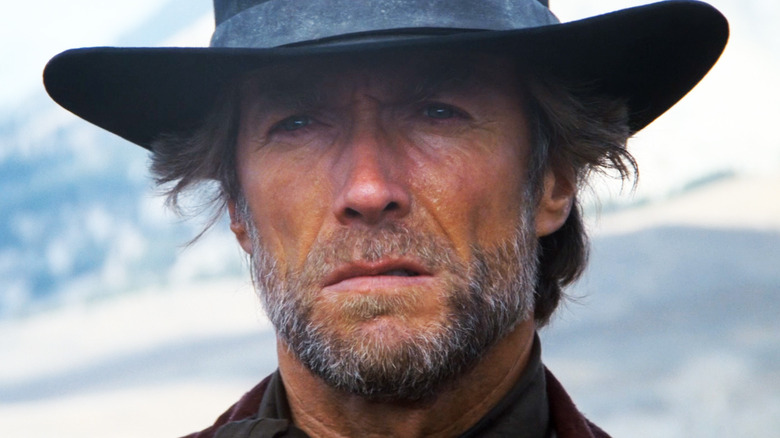
The Western supposedly died in the 1970s, though, judging by the modern-day success of "Yellowstone" and its many imitators, the genre never truly went away. Still, if you were Clint Eastwood, who'd made his name as the archetypal Western anti-hero, you'd probably feel a little worried about the genre suddenly being superseded by sci-fi. Perhaps that's why the actor only made one Western in the 1980s: "Pale Rider." But he probably should have made more, as the film was one of his most financially and critically successful in a decade that saw him struggle to maintain his standing as the biggest star in the world.
That is to say, the 1980s were not a good time for Eastwood. In fairness, he did manage to deliver a few decent projects. His 1982 comedy "Honkeytonk Man" was a major pivot for the Western actor that somewhat paid off, while Eastwood's best film of the '80s ("Tightrope") was dirtier than "Dirty Harry." But he also made things like "Pink Cadillac" "City Heat," and the limp final entry in the "Dirty Harry" saga, "The Dead Pool."
When he debuted as The Preacher in 1985's "Pale Rider," then, audiences were no doubt relieved to see Clint back in the saddle. The movie was also directed and produced by Eastwood, who had helmed several of his own Westerns throughout the 1970s, starting with 1973's "High Plains Drifter." Not only was he returning to his gunslinging way as an actor, then, Eastwood was also back in the director's chair for "Pale Rider," and it paid off.
Clint Eastwood returned to the mysterious stranger archetype with Pale Rider
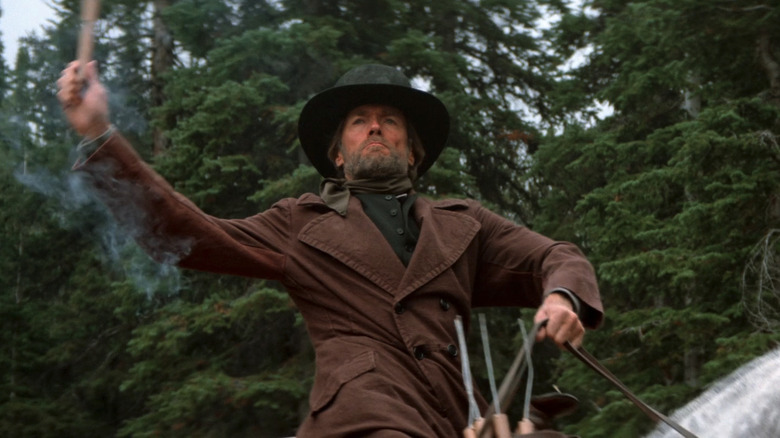
The 1980s gave us several of the worst Clint Eastwood movies, including the aforementioned "City Heat" which Roger Ebert hated enough to describe as a "travesty." A year after that blunder, Eastwood decided he'd better remind everyone why he became such a big star in the first place and returned to the Western with "Pale Rider."
Technically, you could argue that both 1980's "Bronco Billy" and 1982's "Honkeytonk Man" were Westerns, but the former was set in what was then the modern day and the latter was a musical. What's more, neither saw Eastwood embody the Western anti-hero with which he had become synonymous in the 1960s and '70s. "Pale Rider," however, saw him return to the Old West and the role of the mysterious stranger, this time as an enigmatic man known only as The Preacher.
The story plays out in and around the town of LaHood, California, where mining baron Coy LaHood (Richard Dysart) is menacing the local prospectors so as to keep all the resources for himself. Hull Barret (Michael Moriarty), Sarah Wheeler (Carrie Snodgress), and her teenage daughter Megan (Sydney Penny) are among those bearing the brunt of LaHood and his goons' intimidation tactics. But that's where Eastwood's hero comes in. Riding a pale steed, The Preacher arrives in town and is welcomed by Barret, who notices that his new guest appears to have bullet wounds in his back. Like "High Plains Drifter," then, there's a heavy implication that Eastwood's character is some sort of vengeful spirit returning from the grave to right a horrific injustice. This time, however (as the Book of Revelation-inspired title suggests), the actor is playing Death himself.
Pale Rider was a much-needed hit for Clint Eastwood
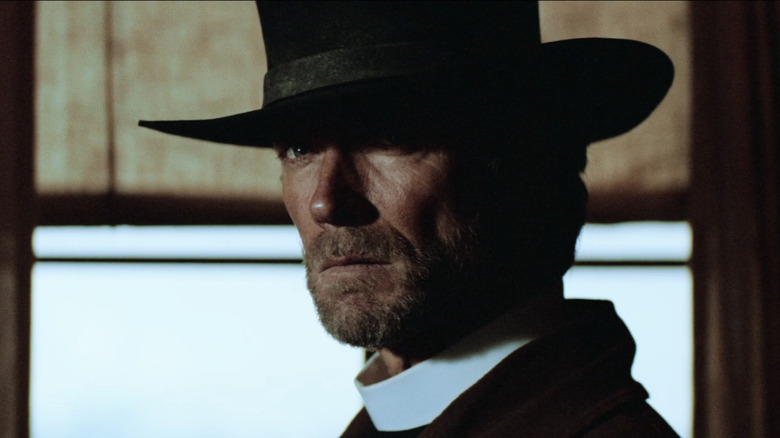
"Pale Rider" sees Clint Eastwood's Preacher take on Coy LaHood and his men, as well as John Russell's corrupt Marshal Stockburn and his deputies in a final shootout that's as good as anything from the best Eastwood oaters. It also refuses to provide any concrete answers about Preacher's past, making for a delightfully ambiguous lead character who combines the best of Eastwood's Western anti-heroes into one intriguing mystery man.
It all paid off for the actor/director. "Pale Rider" ended up earning $41.4 million at the box office on a $7 million budget and received near-universal acclaim from critics. Today it maintains a 94% critic score on Rotten Tomatoes, with reviewers praising everything from its performances to its direction. The New York Times' Vincent Canby even admitted that it had taken critics and audiences too long to recognize Eastwood's "very consistent grace and wit as a filmmaker," and dubbed "Pale Rider" the "first decent western in a very long time." Roger Ebert, who only a year earlier had excoriated Eastwood for starring alongside Burt Reynolds in "City Heat," heralded "Pale Rider" as "a considerable achievement" and "a classic Western of style and excitement." The critic even gave the movie a perfect four stars — though I'll leave it to you to decide if this was one of those times when Ebert got it completely wrong.
Not everyone was convinced the Western was deserving of resurrection by way of Eastwood's similarly revived gunslinger. The Washington Post's Rita Kempley surmised that "the trail is all too familiar and pretty soon we recollect why Westerns lost their appeal." Still, Kempley was very much in the minority, and today "Pale Rider" easily stands as one of the best Westerns of the 1980s.