

We Asked A Real Life Lawyer: Is Daredevil's Matt Murdock A Good Lawyer?
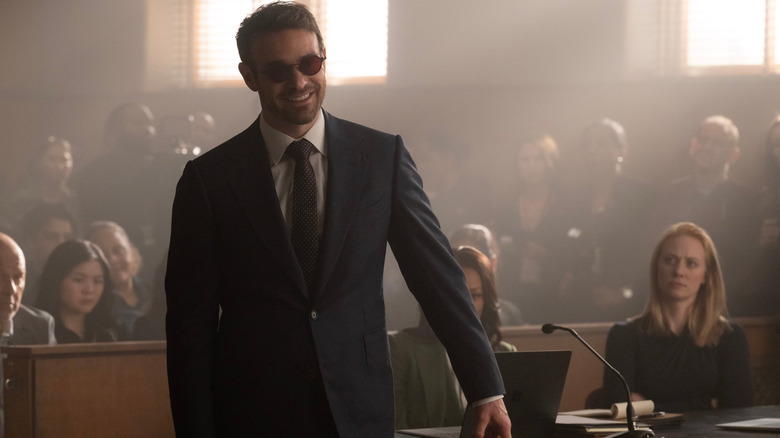
In "Daredevil," both the comics and on television, Matt Murdock (Charlie Cox) being a defense attorney is no simple day job. It's an essential part of his characterization as a defender of the innocent. Frank Miller, the definitive "Daredevil" writer who fleshed out Matt's Catholic faith, once said "only a Catholic" could be both a vigilante and a lawyer. "Daredevil" and its sequel series "Daredevil: Born Again" often feature Matt in court, and his side hustle has an inconvenient habit of intertwining with the cases he takes on.
While Matt is certainly written as if he's a skilled attorney in "Daredevil," does the show's depiction match up with what that means in real life? How accurate is the legal side of "Daredevil," and does Matt Murdock conduct himself like a "good lawyer"?
For answers, we asked real defense attorney Alexander Conley, who has been practicing criminal law in Massachusetts since he graduated from the private law school New England Law Boston in 2017. He served as an attorney at the Coughlin Law Group, then as a partner at Aprodu Conley, PLLC. In 2024 he founded his own firm, Conley Law, based in Danvers, Massachusetts, where he currently practices. During his legal education, Conley worked as a law clerk for a judge of the Boston Municipal Court and was an editor of the New England Law Review. He now "moonlights" as an instructor of Legal Research and Writing at his alma mater.
"Probably 75% of my practice is criminal defense law with some other civil litigation there as well," Conley tells us. That makes him a qualified judge of Matt Murdock's legal skills. While Conley believes "Daredevil" often skimps on the exhaustive detail and timelines of real legal cases, he does think that Matt is portrayed as a good lawyer.
Matt Murdock has the compassion for his clients that a real lawyer needs
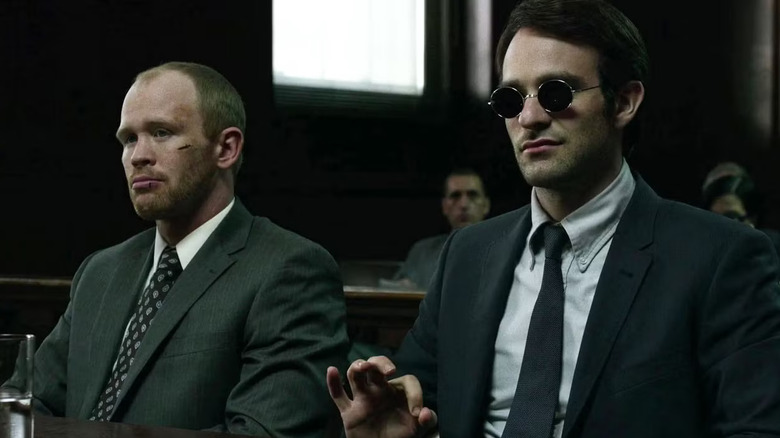
What actually makes a lawyer "good"? Is it as simple as winning a lot of cases, or is it deeper than that? Alexander Conley offered his professional opinion that it takes a mix of competence, care, integrity and "just the general legal skills."
"If you're in court and you're a good litigator, then being able to speak and think on your feet is very important," he explained. "It really depends on what kind of law you practice. But overall, no matter what you do, competence and integrity and care is important." Conley continued:
"Most of the things that [Matt] does is show compassion. Certainly, I think they don't really go into details of the amount of work he does, but, it seems like he's relatively well-prepared for everything they show and knows his cases well. He certainly has the care required for everybody he's representing."
For all Matt's personal failings (like an addiction to violence), he's highly principled about helping people who can't help themselves. In the comics, especially, he makes it a point to try and only defend clients he knows are innocent, by using his enhanced hearing to listen to their heartbeat and test if they're telling the truth. For Conley, though, Matt's approach to weeding out potential clients is not how it usually goes (even without the fantastical super senses).
"I don't usually even ask people [if they're innocent] because it actually creates harder representation sometimes [...] You want to avoid learning information that could be something that you have to disclose or explain away, because you can't ignore it in a litigation setting sometimes," Conley explained. "Anybody could determine that they would only represent people they believe to be innocent, but that would just be a gut feeling."
How Matt Murdock being a vigilante violates attorney ethics
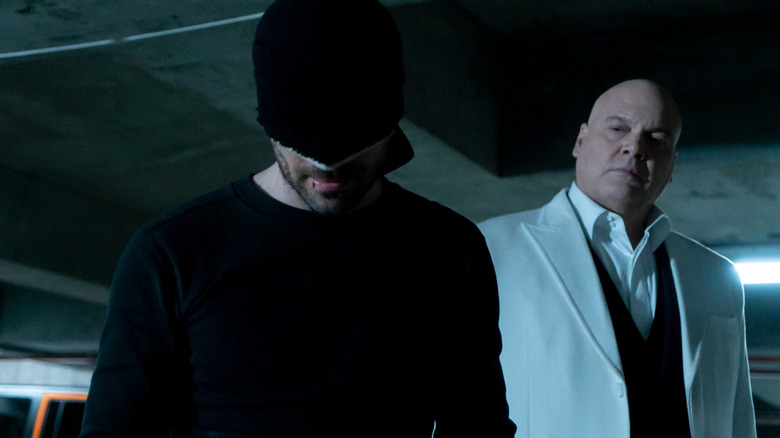
"Daredevil" comic writer Chip Zdarsky has described Matt Murdock as a man of messy contradictions. One of them is his job as a lawyer. Matt is an officer of the court, but every time he suits up as Daredevil, he breaks the law by taking it into his own hands. "Daredevil: Born Again" Season 2 is all about Matt working outside the law after his nemesis, Mayor Wilson Fisk (Vincent D'Onofrio), puts New York under martial law. Matt will break laws if he believes they're morally wrong.
Alexander Conley tells us that, unsurprisingly, a lawyer being a vigilante is "definitely not something [he's] ever come across or heard about." But are there real legal ethical rules that apply to this unprecedented situation? One of the responsibilities of a lawyer is disclosure of relevant information to a case (within the confidentiality privileges of an attorney-client relationship, of course). Matt, by keeping a secret identity as Daredevil, is by nature often not disclosing relevant information about his connection to cases.
"[Matt's] involvement in his own cases could create problems where he could become a witness in this case," Conley noted. "And that's definitely something that you want to avoid at all costs as a lawyer, to become a potential witness in your own case. So his involvement in that kind of thing with his clients and their cases and what the evidence could be in a trial could certainly create issues."
Full disclosure: this interview was conducted on Monday, April 20, 2026, before the conclusion of "Daredevil: Born Again" Season 2. But in the season finale, Matt does testify in his own case about some information he acquired through his activities as Daredevil, and it's depicted as him falling on a sword of personal and career ruination.
The legal ramifications of Matt Murdock's secret identity

The "Daredevil: Born Again" Season 2 finale adapts, in part, "Daredevil" #36 by Mark Waid and Chris Samnee, wherein Matt takes the witness stand and admits his identity as Daredevil. In light of his many past ethics violations to conceal his secret identity, he is disbarred as a lawyer in New York state. (In the show, Matt is not only disbarred, but sent to prison.) Is this a realistic punishment for an admittedly unrealistic scenario?
"Every bar has their own character evaluation they have to do," Alexander Conley told us. "So you [as a lawyer] have to disclose if you're charged with crime or you have lawsuits against you, things like that. I'd imagine obviously the anti-vigilante law in New York [in "Born Again" Season 2], that would probably be something to a bar. But yeah, generally that'd be disclosed. If it's definitely [of] a criminal nature, [it] could lead to disbarment."
In the comics, Matt finds a loophole to get around his disbarment. He'd previously been licensed as a lawyer in California, so he moves to San Francisco to continue practicing law on the west coast. When asked about this particular story development, Conley said it is "certainly not impossible" for a lawyer disbarred in one state to move to another to practice there.
"That could work that way, especially if [Matt had] previously been barred there. Every state runs their own bar, so they're allowed to determine if you're able to practice in that state, but they don't have control of other states. Obviously, the requirements for every state are different."
How accurate is the legal procedure on Daredevil?
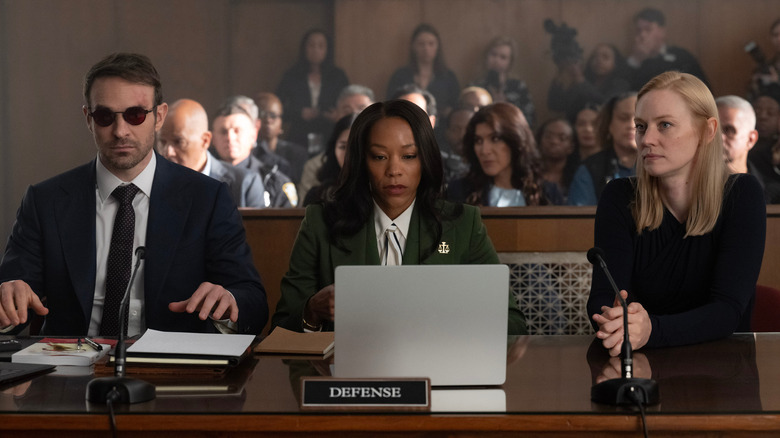
In both "Daredevil" and "Daredevil: Born Again," Matt's clients — including Frank Castle/The Punisher (Jon Bernthal) and Hector Ayala/The White Tiger (Kamar de los Reyes) — take the witness stand. I'd previously read that defendants testifying in their own cases is a common Hollywood legal inaccuracy, but Alexander Conley says it's a bit more nuanced.
"I've had cases where I tell my clients they shouldn't take the witness stand, there's too much risk involved, and I've had cases where you basically have to take the witness stand," Conley recalled, noting there's sometimes evidence that can't be brought up any other way, as well as the "human nature" side of how much a jury will like a defendant. "One thing to know, though, [taking the witness stand] is ultimately a decision your client gets to make."
In "Daredevil," the pretrial period for cases is also much quicker than it is in real life. "[Legal shows] always are much more fast-paced than a real trial and litigation, which takes years to get from the start to a trial, not a matter of weeks," Conley said.
One unique inaccuracy is in the comic "Daredevil" #22 by Charles Soule (a former lawyer himself) and Goran Sudzuka. Daredevil testifies in court as Daredevil while preserving his secret identity. (He's also later sent to prison as Daredevil, not Matt Murdock.) Conley said this is unrealistic and would "create lots of issues."
"Both sides have access [to a witness] to potentially be able to interview them prior to a trial, you have to make sure that you do have to actually be able to have their names and dates of birth and addresses so you can investigate them, run the criminal records," Conley explained. "So you certainly can't allow an unidentified witness to testify."
The White Tiger case in Daredevil: Born Again Season 1 uses dramatic license
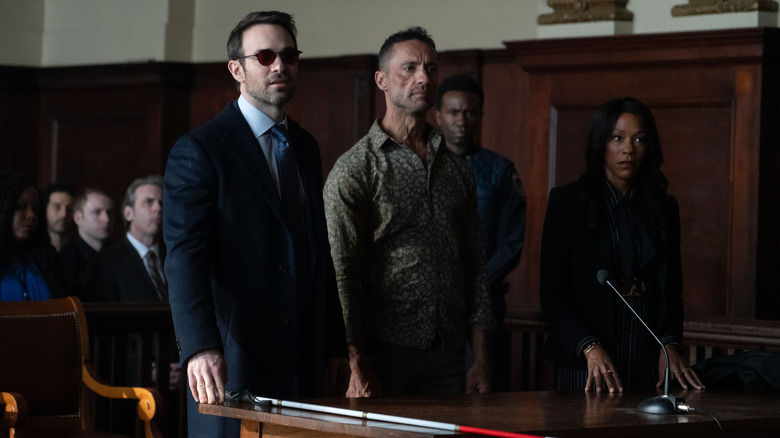
White Tiger's trial in "Daredevil: Born Again" Season 1 Episode 3 is a mostly faithful adaptation of a comic story arc, but how accurate is it to legal procedure?
During the trial, Matt outs Hector as the White Tiger, taking the judge, the prosecution, and his own client by surprise. Matt had previously disclosed his client's secret identity to the judge and prosecution, but argued (successfully) that the evidence should be suppressed to not bias the jury. Matt's 180-turn is a desperate gambit.
The bombshell revelation is a common dramatic device in legal dramas, whereas in real life (as Alexander Conley explained below), the sharing of evidence is always hashed out well ahead of time:
"Legal drama[s], they always have these 'trial by surprise' type situations where things always are coming out, but it doesn't really happen very often. If it does, it's usually much more slight. Obviously a person starts giving up their witness, the witness can say anything unexpected and things like that, but you can't really not disclose evidence that you plan to admit."
The show acknowledges Matt was out of bounds, a key display of why he's one of Marvel's most morally ambiguous heroes. If a real lawyer entered some surprise evidence during witness testimony, would it lead to a mistrial?
"The judge would have some discretion over that, depending on the nature of the evidence," Conley explained. "Born Again" acknowledges this when the judge (Andrew Polk), though infuriated by Matt's stunt, decides striking the evidence or a mistrial would be pointless since the truth about White Tiger's secret identity can't be suppressed anymore.
Matt played fast and loose with legal ethics, but his White Tiger bombshell shows he can think on his feet like a good lawyer.