

Clint Eastwood Wasn't Afraid To Criticize John Wayne's Entire Acting Philosophy
We may receive a commission on purchases made from links.
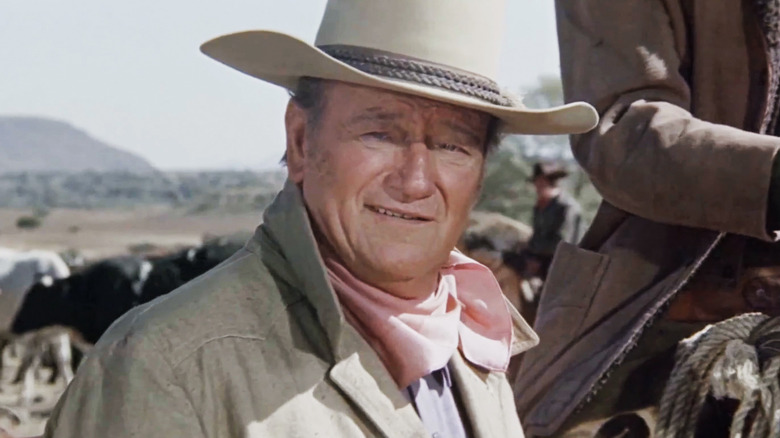
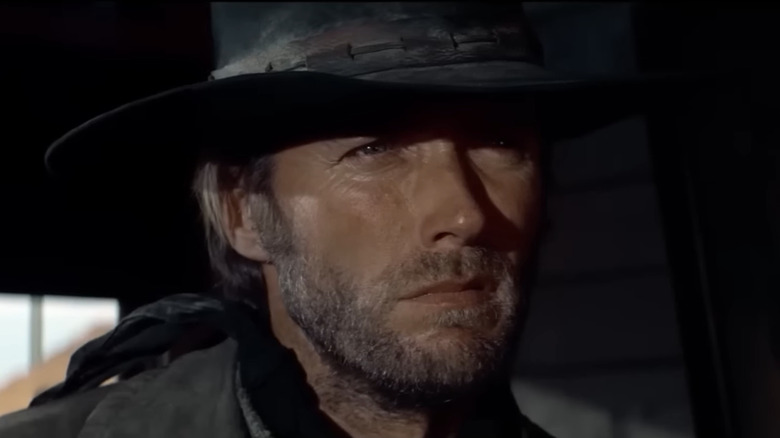
Any Western fan will know about the feud between Clint Eastwood and John Wayne. These two giants of the genre stood either side of a generational divide that ultimately kept them from ever collaborating on-screen — "The Hostiles" might have been the greatest Western never made. To this day, that unrealized project remains one of the most tantalizing "what-ifs" in cinema history. Just what would a Wayne/Eastwood collaboration have looked like and how would it have affected the history of this once great genre?
Unfortunately, all fans are left with is a couple decades-worth of jibes and sneers being traded between the two legends (though their relationship was characterized by more than mere hostility). Whether it was Wayne writing an angry letter to Eastwood over "High Plains Drifter" or Eastwood expressing some harsh thoughts about Wayne's final Western — the pair never seemed too bothered about disparaging one another in public. In fact, they didn't seem too bothered about disparaging anyone they didn't like.
In her book "John Wayne: My Father," Aissa Wayne recalls how her father took aim at Clark Gable, saying the "Gone with the Wind" star "acts because it's the only thing he's smart enough to do." According to Aissa, Wayne elaborated on his disdain for Gable by talking in more general terms about how he thought of himself as a star rather than an actor. For the Duke, acting was all about reacting, and Gable couldn't understand that. It's only fitting, given how this all emerged out of enmity between two performers, that Eastwood later continued the trend and took issue with Wayne's philosophy, questioning exactly what it means to rely solely on reacting when crafting a performance.
Clint Eastwood didn't understand John Wayne's view of acting as 'reacting'
As recounted in "John Wayne: My Father," the Duke once told the press:
"I don't act at all, I react. In a bad picture, you see them acting all over the place. In a good picture, they react in a logical way to a situation they're in, so the audience can identify with them. All I do is sell sincerity, and I've been selling the hell out of that since I started. I was never one of the little theatre boys. That arty crowd has only surface brilliance anyway. Real art is basic emotion."
Eastwood strongly disagreed. In "Conversations with Clint: Paul Nelson's Lost Interviews with Clint Eastwood, 1979-1983" Nelson asks the actor outright what he thinks of the idea of acting as reacting. "I don't know what that means. I never have," he replied. "I think where that comes from is John Wayne used to make statements like that. He said, 'I'm not an actor, I'm a reactor.' You don't just sit and react, though. You have motivating forces that drive you on as an actor, as a performer performing that character." Eastwood went on to say, "There's no such thing as a reactor. It's not a very concise statement on what acting's all about — if there is a concise statement on what acting's all about."
It was another fundamental disagreement between the two stars, with Eastwood unequivocally challenging Wayne's basic view of their profession. It's easy to see, then, why Wayne refused to join Eastwood in what would have been a thrilling Western. But it's a shame "The Hostiles" never came to be as, aside from anything else, we would have seen a battle between these two fundamentally opposed approaches to acting.