

The Wild History Of John Wayne And Clint Eastwood's Unmade Team-Up, The Best Western Never Made
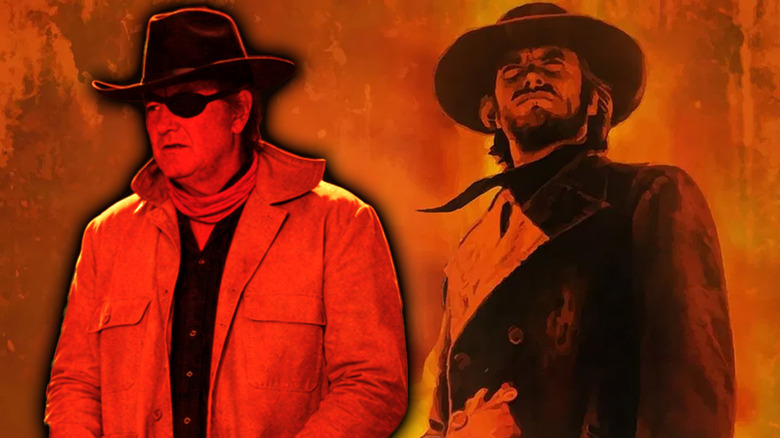
We may receive a commission on purchases made from links.
Welcome to The Best Movies Never Made, a look back at the most fascinating, strange, and tantalizing films that never actually made it in front of cameras — and maybe should have.
You couldn't come up with a better name for a film featuring Clint Eastwood and John Wayne than "The Hostiles." This never-realized Western would have united the two most prominent figures of the genre in a film that was surely destined to become one of the best Western movies ever made. But Wayne and Eastwood's relationship was simply too contentious for that to happen.
Ostensibly, these were two diametrically opposed figures, making their reconciliation seemingly impossible. The Duke and his younger colleague clashed early in Eastwood's career, and the hostilities remained in place for years. But the pair had much more in common than their tumultuous relationship suggested, and Eastwood likely knew as much. The actor tried hard to convince Wayne to star alongside him in a movie penned by Larry Cohen, but the Duke simply wasn't having it.
Today, "The Hostiles" remains one of the great what-ifs in cinema history. This particular what-if would have been a hugely symbolic project, uniting two seemingly opposed generations at a crucial time. The film even had the potential to prolong the lifespan of the waning Western genre, or perhaps give it the grand, ceremonious send-off it truly deserved. In that sense, it's damn near heartbreaking to think about what could have been. Alas, a project that had all the hallmarks of a classic ended up as an unrecognizable shell of itself on, ironically, the Hallmark Channel.
John Wayne and Clint Eastwood had a rocky relationship
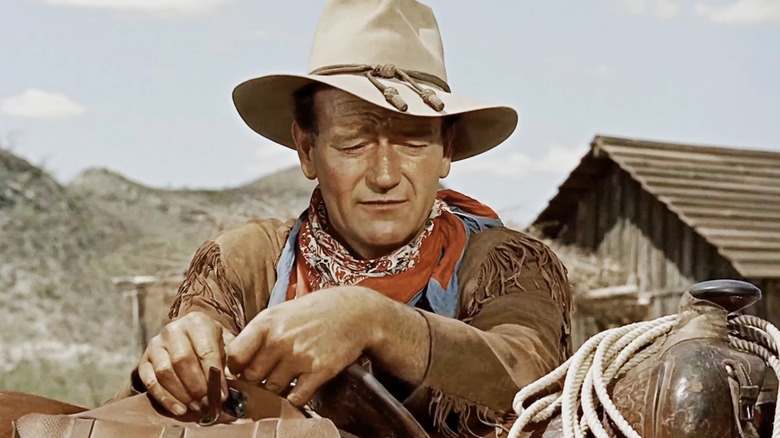
John Wayne and Clint Eastwood were essentially avatars of their respective western generations; Wayne the broad-shouldered apotheosis of early 20th century machismo, Eastwood the dangerous and subversive leader of a new revisionist ethos. Fans were understandably hopeful that these two legends would bridge the gap and star alongside one another, but it never happened.
Eastwood and Wayne's relationship started out cordially enough. In "Conversations with Clint: Paul Nelson's Lost Interviews with Clint Eastwood, 1979-1983," the actor claimed that, upon first meeting Wayne, Duke told him, "We ought to do a movie, kid." That almost happened when Eastwood was offered a role in "True Grit." The 1969 Western saw Wayne win his first Oscar for portraying U.S. Marshal Reuben J. "Rooster" Cogburn. Eastwood was offered the role of Ranger La Boeuf, but turned it down because, as he explained, "it wasn't much of a role, and I was occupied." The part eventually went to Glen Campbell.
After that, John Wayne wrote Eastwood an angry letter about Eastwood's film "High Plains Drifter." The 1973, R-rated Western saw Eastwood once again portray a mysterious stranger who arrives in a town where the residents have long since compromised their morals by allowing a U.S. Marshal to be whipped to death by outlaws. At one point, Eastwood's gunslinger orders the townspeople to paint every building red before defacing the town sign by painting the word "Hell" over it. It was a striking image, especially after decades of an idealized on-screen Old West. Unsurprisingly, the Duke wasn't impressed.
In a 1992 Los Angeles Times interview, Eastwood recalled Wayne writing, "That isn't what the West was all about. That isn't the American people who settled this country." Eastwood immediately recognized how big the generational divide really was. "I realized that there's two different generations," he said, "and he wouldn't understand what I was doing." This was ultimately a big part of the reason Wayne refused to join Eastwood in what would have been a thrilling team-up.
Larry Cohen's The Hostiles script impressed Clint Eastwood
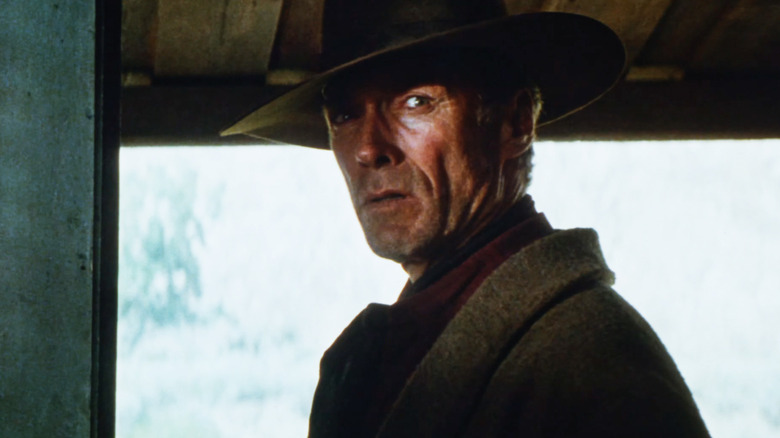
B-movie legend Larry Cohen passed away in 2019, but contributed to multiple low-budget classics in his time, from "The Stuff" to "It's Alive" to "Maniac Cop." Cohen was born in 1936, and came of age just as Wayne's career was taking off following his star turn in John Ford's seminal 1939 Western, "Stagecoach." Though Cohen grew up in a culture that venerated the Duke, he also admired Clint Eastwood, who had come to prominence on CBS's "Rawhide" in the 1960s before rewriting the rules of filmmaking alongside Sergio Leone with the "Dollars" trilogy. Cohen wanted to see him share the screen with his formidable forebear.
According to the Clint Eastwood Archives (an archival platform for the star), Cohen completed a script in 1970 that would finally unite Eastwood and Wayne. "The Hostiles" envisioned Eastwood as a gambler who wins half a ranch owned by an older man (Wayne). The gambler and rancher clash almost immediately, but after the former's past brings trouble to the ranch, they must unite to fend off the titular hostiles.
The film would have been so much more than a story about a young gun and an old timer working together. It would have been a monumental passing of the torch, immortalizing the transition from traditional to revisionist Westerns in a movie that united its two biggest and most important mascots. Exploring this major cultural shift via Eastwood and Wayne's interactions could have been something truly special, representing a meta take on the Western itself long before Eastwood's seminal 1992 effort "Unforgiven." Beyond that, it would have seen two undisputed screen legends go toe-to-toe. Surely, they could find a way to make it work...
Clint Eastwood reached out to John Wayne for The Hostiles
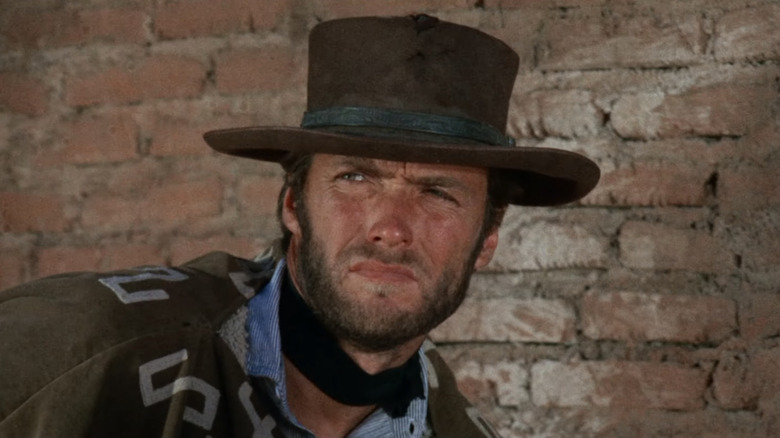
A copy of Larry Cohen's "The Hostiles" script arrived at John Wayne's Batjac production company in November 1970. Clint Eastwood's Malpaso Productions received another copy. Scott Eyman's book "John Wayne: The Life and Legend" details how Eastwood forwarded his script to Wayne with a note saying he thought it looked "promising." According to Eyman, the reply was as terse and mysterious as The Man with No Name himself: "No, thanks."
After relocating Malpaso to Warner Bros., Eastwood optioned the script again. The actor liked the way Cohen's script "leaned deeper into moral conflict rather than resolution," but felt it needed "not compromise — honesty. The kind that made both of [the main characters] uncomfortable." He added extensive notes to Cohen's screenplay, then sent it to Batjac again. "I thought maybe if [Wayne] saw where we were going with it," Clint told the Archives, "he'd see there was room for both of us in there. I wasn't trying to rewrite him — I was trying to make it real."
Wayne was having none of it. Rather than addressing "The Hostiles" directly, he responded with his infamous letter attacking "High Plains Drifter." The sentiment was clear: Wayne wasn't a fan of Eastwood's revisionist sensibility. Eastwood didn't reply, but he did remember the back-and-forth in an interview from "Conversations with Clint." "I gave Wayne a story I'd read once, which wasn't complete," he recalled. "It was a far-out Western idea. I sent that to him, and he didn't like it [...] I was looking at it as something as a potential vehicle if developed, and somehow I wasn't very good at explaining myself."
John Wayne eventually grew hostile over The Hostiles script
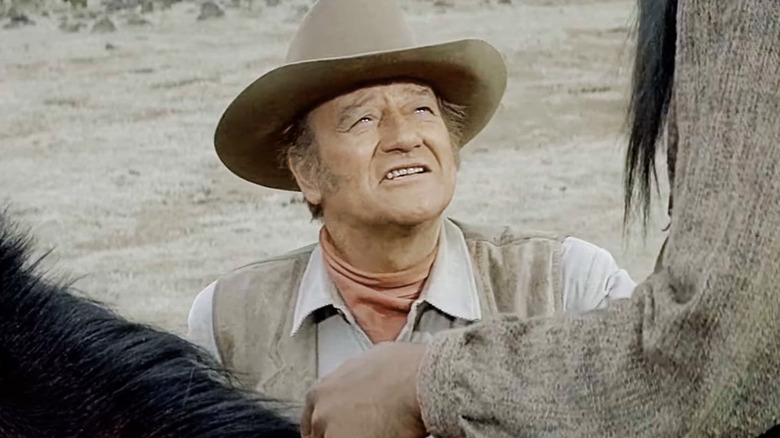
"High Plains Drifter" was one of several Westerns directed by Clint Eastwood, and helped establish him as a filmmaker. It also seemed to be the film that indirectly killed "The Hostiles" due to John Wayne's viscerally negative reaction. But as detailed in "John Wayne: The Life and Legend," Batjac's Michael Wayne held out hope. Wayne's son contacted Larry Cohen, who told him, "You've held that script up for two years; if you want to buy it, buy it." The younger Wayne promised to show Duke the screenplay one more time during a trip on the actor's yacht, The Wild Goose. It didn't go well.
Cohen spoke to Michael Doyle, author of "Larry Cohen: The Stuff of Gods and Monsters," and recalled talking to Michael the following week:
"I got Michael on the phone and asked him what had happened. He said, 'Well, Dad was sitting on the boat and I handed him the script. He looked at it for a few minutes and then said, 'This piece of s*** again!' And then he threw it overboard.' I quietly thought to myself, 'Oh, there goes my beautiful script, slowly sinking beneath the blue Pacific along with the hopes and dreams of Clint Eastwood and Bob Barbash [who'd contributed to the 'Hostiles' script]!'"
Wayne's long-time secretary Pat Stacy briefly recalled his aversion to the "Hostiles" script in "Duke, a Love Story: An Intimate Memoir of John Wayne's Last Years." According to Stacy, Wayne was "disgusted," telling her, "This kind of stuff is all they know how to write these days: the sheriff is the heavy, the townspeople a bunch of jerks; someone like me and Eastwood ride into town, know everything, act the big guys, and everyone else is a bunch of idiots."
The Hostiles became a Hallmark movie
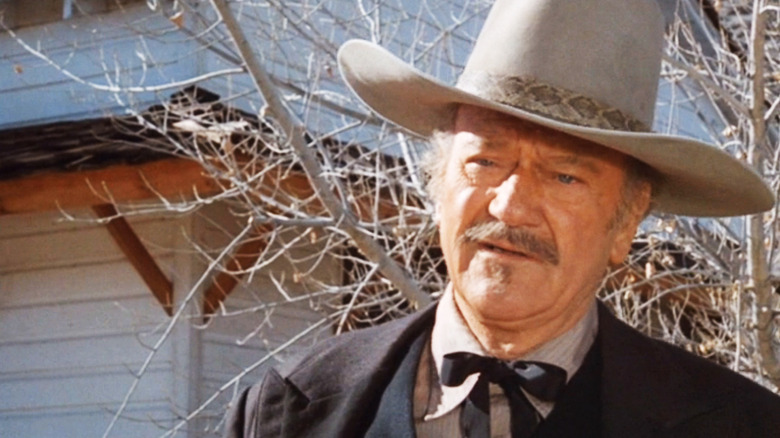
In "Larry Cohen: The Stuff of Gods and Monsters," author Michael Doyle explains how, almost 30 years after Wayne sent the screenplay into the abyss, "The Hostiles" was made into TV movie. "The Gambler, the Girl, and the Gunslinger" aired on the Hallmark Channel in 2009 as a pallid Western drama starring Dean Cain in the Eastwood role. It follows Cain's Shea McCall, who after winning half a ranch from James Tupper's BJ Stoker in a card game, teams up with his co-owner to defend the ranch from bandits.
It might seem fitting for a Larry Cohen script to evolve into a TV B-movie, but the writer was despondent. In "John Wayne: The Life and Legend," Cohen told Scott Eyman, "Writing a John Wayne picture would have been the highlight of my career. But he did dull f****** pictures like 'Cahill' and 'The Train Robbers' instead of a picture with Clint Eastwood. Can you imagine?"
Imagining is all we can do. In 1976, Wayne teamed up with a "Happy Days" star to make "The Shootist," his final movie. Though the Duke fought a battle behind the scenes of the film, he did at least appear to reconcile with Eastwood, who was photographed visiting the set. The image, taken three years before the Duke passed away, is bittersweet. It shows the two stars smiling in a way that belies none of their prior hostilities. Wayne, in his Old West wardrobe, stands alongside Eastwood in his regular attire — an oddly fitting representation of the generational divide. But the two seem genuinely at ease, as if they both recognize that their connection somehow spanned that gap and perhaps even remain hopeful of a future collaboration that, sadly, never came.