

5 Best Movies Directed By Gus Van Sant, Ranked
As was detailed in a biography for the New York Times, filmmaker Gus Van Sant started shooting his own Super 8 movies as a child, and attended the Rhode Island School of Design in the early 1970s to learn more about photography. Like many college students before him, Van Sant started developing an interest in outsider filmmakers like Stan Brakhage and Andy Warhol. He moved to Los Angeles in 1976 to be a production assistant, but L.A. proved disappointing, leading him to make the 45-minute film "Alice in Hollywood," an unreleased short about a "fallen woman" who loses hope with the Hollywood system. Appropriately armed with cynicism about the film industry and an interest in arch art films, and after spending time with the L.A. queer scene and fringe-dwellers up and down Hollywood Boulevard, Van Sant became one of the premiere counterculture voices of the rising independent movie scene.
Throughout the 1990s, Van Sant rattled the zeitgeist again and again, garnering attention for his films about drug subcultures and hustler subcultures, plus one adaptation of a truly bizarre Tom Robbins novel. Van Sant pushed into Hollywood in the late 1990s with the success of his Matt Damon/Ben Affleck-scripted college drama "Good Will Hunting," and suddenly seemed to have two sides. There was the explorative, indie Gus Van Sant, and there was the slick "Hollywood" Gus Van Sant. We lucky audiences seemingly got two filmmakers in one.
Van Sant has made many great, fascinating films in his career that teeter alternately between arch and difficult, and slick and crowd-pleasing. The following five movies are, in this writer's opinion, his best.
5. Gerry (2002)
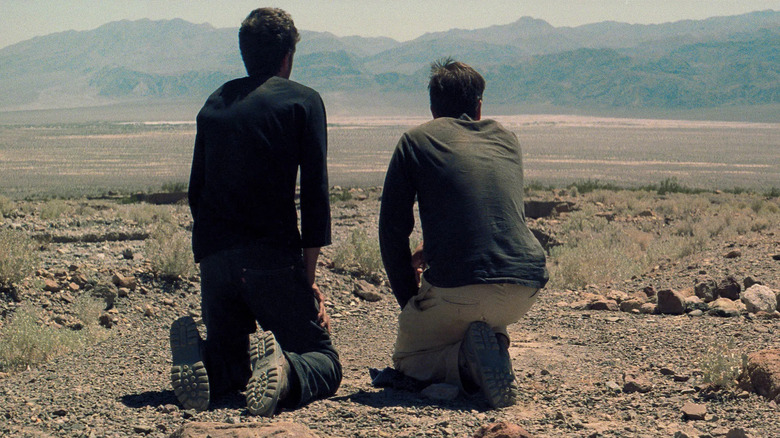
From 2002 to 2005, Gun Van Sant directed a trilogy of films that have sometimes been called his Death Trilogy. All three movies are slow and nearly dialogue-free, and all feature very, very long prolonged shots of people walking. The camera follows them, exploring their space as they stroll, exploring the mazes of their minds as they walk the mazes of their worlds. They were also all extrapolated from real-world acts of violence. "Gerry" is loosely based on the murder of David Coughlin in 1999. "Elephant" is a retelling of the Columbine High School shootings. And "Last Days" is a fictionalized take on the death of Kurt Cobain in 1994.
"Gerry" is the most striking of these three, and also the least accessible. Matt Damon and Casey Affleck play two men, both named Gerry, who decide to go for a hike in the desert. The camera lingers for a long, long, long time as they walk. And walk. And walk. And walk. There's more walking in "Gerry" than in "Lord of the Rings." Sometimes they walk together, sometimes not. Sometimes, one of them seems to be hallucinating. Sometimes nature seems to be messing with them, as when one Gerry somehow finds himself on top of a tall stone tower with no knowledge of how he got there.
Then one of them will kill the other.
"Gerry" is a masterful example of Slow Cinema, wherein the audience is invited to contemplate and observe, falling into a meditative state. But it's also dark and strange, as time is most certainly out of joint. Something is going to go wrong. Van Sant said in Filmmaker Magazine that he was influenced by Béla Tarr's 1994 film " Sátántangó," but also by "Tomb Raider." How odd.
4. Drugstore Cowboy (1989)
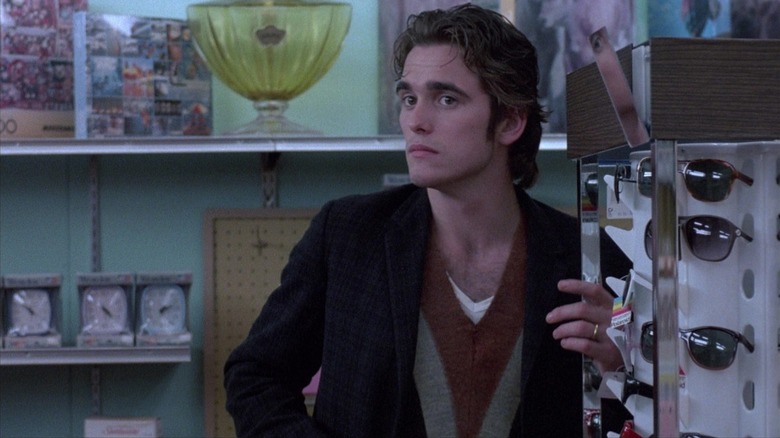
"Drugstore Cowboy" follows a group of drug addicts who scour the country's Pacific Northwest with a very particular hustle in practice. They break into drugstores, raid the pharmacies, and pinch all the drugs they need to keep their habit going. Van Sant films them as ultra-cool hipsters, however, making them seem appealing and attractive. It certainly doesn't hurt that the leader of the group, Bob, is played by a young and hunky Matt Dillon. Bob's wife, Dianne, is played by Kelly Lynch, James LeGros plays their buddy Rick, and Rick's girlfriend, Nadine, is played by a teenage Heather Graham.
Their addiction is treated matter-of-factly, like it's just the reality of their lives. They understand they are addicts, and their lives are now completely rearranged to accommodate their drug consumption. As William S. Burroughs once wrote in his book "Junky," "A junkie runs on junk time. When his junk is cut off, the clock runs down and stops. All he can do is hang on and wait for non-junk time to start. A sick junkie has no escape from external time, no place to go. He can only wait." Perhaps to hammer this notion home, Burroughs himself appears in the film as an elderly addict that Bob ends up helping. Some might be reminded of "Requiem for a Dream."
"Drugstore Cowboy" is a sojourn into a fringe culture, but presented with a kind of detached cool that communicates how appealing that universe is to addicts. Van Sant doesn't make the viewer want to try drugs, but he does capture a kind of chilly, romantic resignation. "Drugstore Cowboy" would become Van Sant's calling card, and lead to bigger and better things almost immediately.
3. Good Will Hunting (1997)
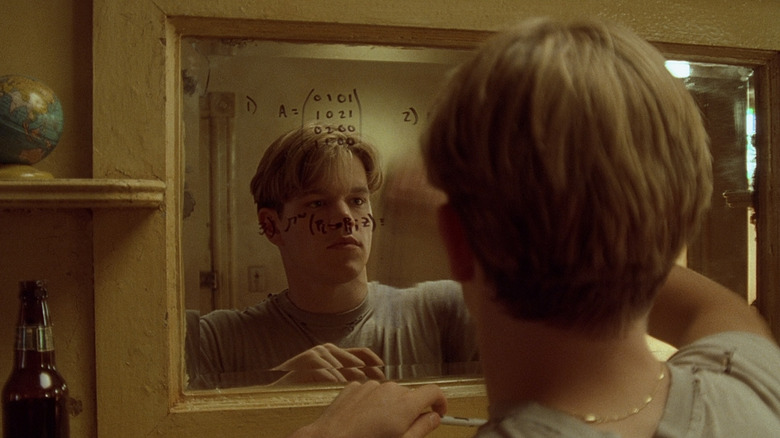
"Good Will Hunting" was a relatively small production, costing only $16 million to make. The big "get" was Robin Williams, who played Dr. Maguire, a shrink and professor at a small community college in Boston. The screenplay was famously written by the then-untested Matt Damon and Ben Affleck, and it helped launch the pair directly into the center of the Hollywood firmament. No one could have predicted that "Good Will Hunting" would make over $225 million at the box office and be nominated for nine Oscars, including Best Picture, Best Director, and Best Actor. Matt & Ben won an Oscar for their screenplay, and Williams won for his performance.
"Good Will Hunting" tells the story of Will Hunting (Damon) a handsome ex-con who works as a janitor at MIT. He's constantly in trouble with the law, as he has violent impulses and gets into a lot of fights. He's also secretly a mathematics genius, something an MIT professor discovers after Will idly solves a math problem on a random blackboard. The bulk of the film details Will's healing, mostly at the hands of Dr. Maguire, who offers him some very insightful therapy. He also begins dating the charming Brit Skylar (Minnie Driver), a Harvard student. At the end of the movie, he needs to go see someone about a girl.
"Good Will Hunting" is unbearably charming, and unexpectedly moving. Damon and Affleck created a rich, locally accurate Boston drama full of funny, intelligent people whose healing is well-earned and honest. It's a college drama, but it doesn't patronize college students; it feels honest and textured. It lacks a lot of the grit of Van Sant's earlier movies, but has just enough authenticity to be amazing. It's pretty great.
2. My Own Private Idaho (1991)
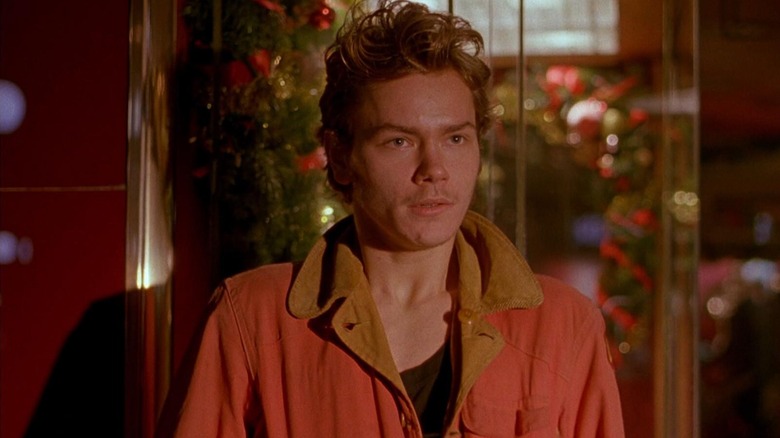
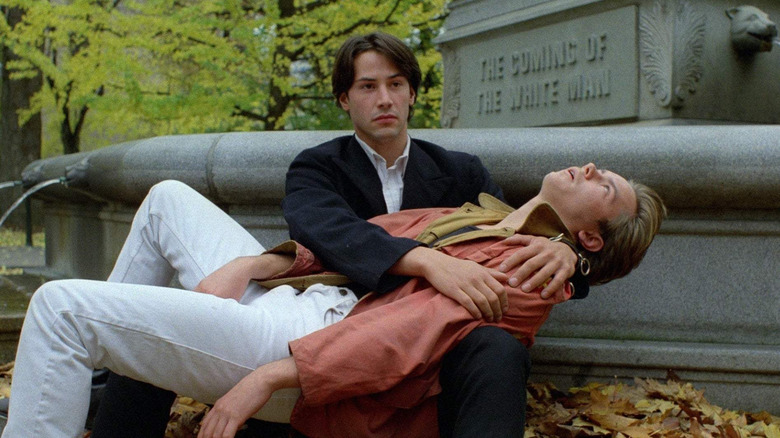
Like "Drugstore Cowboy," "My Own Private Idaho" is about a subculture of criminals who live out their lives in a frank and straightforward fashion. It's told from the perspective of Mike (River Phoenix), a sex worker in the Pacific Northwest. Mike is narcoleptic, and has a bad habit of fainting and staying asleep for extended periods at inopportune moments. Mike's best friend is Scott (Keanu Reeves at his sexiest), and Scott will be the one to more or less narrate the film, explaining, with utter frankness, the ins and outs of being a sex worker in the modern age. Sexuality is petty open, and the dangers of sex work are always plain and on the surface.
Scott is also the son of the mayor(!) and has a wealthy family to fall back on, should the street hustling not work out. He enjoys the company of a kooky older man named Bob Pigeon (William Richert) who often lies and exaggerates, usually in an amusing way. Wait a minute ... The wealthy heir is ignoring his royal duties to spend time with hustlers, all while listening to the stories of an older, comedic blowhard? Shakespeare fans will recognize instantly that "My Own Private Idaho" is a riff on "King Henry IV, part I" with Reeves stepping in for Prince Hal, and Richert standing in for Falstaff. It's Shakespeare, but blended with the 1963 novel "City of Night" by John Rechy, a book about a sex worker and his adventures in the business.
Queerness and sex work are presented as matter-of-factly in "Idaho," seemingly seeking to reduce their stigma. It's appealing, energetic, and literary. It's everything you want in a movie.
1. To Die For (1995)
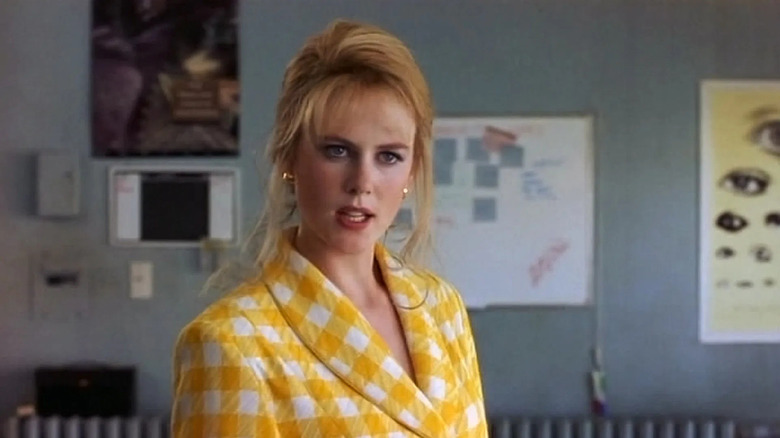
"To Die For" is one of Van Sant's more stylized movies, taking place in a heightened candy-colored fantasy that seems to exist mostly in the head of its protagonist, Suzanne Stone (Nicole Kidman). Suzanne is a bright, chipper, seemingly empty soul whose only ambition is to be a newsreader for a big TV network. She doesn't seem to realize how ignorant she is on such matters, though, and feels she has hit the big time when asked to give the weather reports for a local TV station. She also begins filming a docudrama about the local teens, and doesn't seem to realize that her subjects (played by Joaquin Phoenix, Alison Folland, and Casey Affleck) are kind of losers. When her husband (Matt Dillon) points out that she should quit her dreams of being a newscaster and settle down to have babies, Suzanne snaps. She embarks on an affair with Phoenix's character and begins plotting her husband's murder.
"To Die For" has a cartoon noir vibe, combining "Double Indemnity" with John Waters. Nicole Kidman gives her best performance as Suzanne Stone, a chilling character who can only think of the world through the lens of television tabloid language. She is also surrounded by a panoply of interesting character actors, including Illeana Douglas, Dan Hedaya, Kurtwood Smith, Wayne Knight, and even David Cronenberg. The screenplay was written by Buck Henry, who penned films like "The Graduate," "Catch-22," and "Heaven Can Wait," and it bears the writer's wry wit throughout. "To Die For" also undoubtedly features the very best score that Danny Elfman ever wrote, vacillating between the composer's signature Gothic sounds, hard rock guitars, and whimsical cartoon joy
"To Die For" has a tricky tone, but Van Sant nails it perfectly, delivering one of the best films of the 1990s.