

Wuthering Heights Review: A Breathtaking Twist On A Classic Righteously Doomed To Be Polarizing
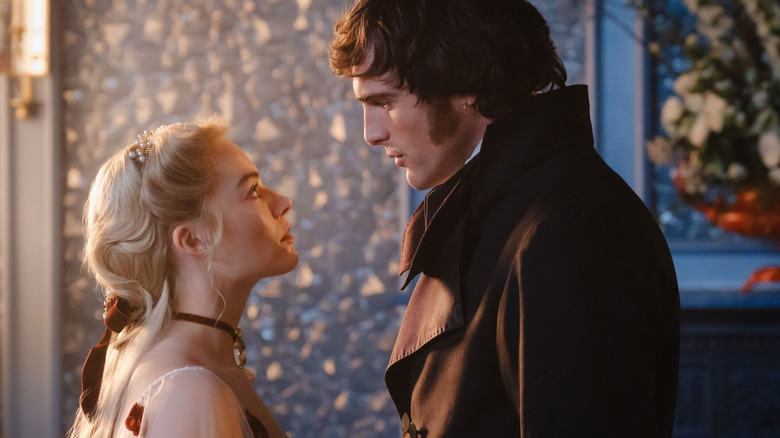
During the promotional tour for "Nosferatu" in 2024, director Robert Eggers told The Verge that he viewed the story of "Nosferatu" as a "demon lover story," and frequently returned to one of the great demon lover stories while writing his script — Emily Brontë's "Wuthering Heights." As he explained, "As a character, Heathcliff is an absolute bastard towards Cathy in the novel, and you're always questioning whether he really loves her, or if he just wants to possess and destroy her." Constantly misunderstood and continually misremembered, "Wuthering Heights" is a brutal, gothic study of class, landscape, inherited trauma, and imperial fallout, but it's also about breaking societal expectations, the dangers of obsession, and how love really can tear us apart.
Pop culture's insistence on distilling it down as nothing more than a "romance" misses the point so badly it borders on parody, which is why Emerald Fennell's adaptation (and that's pushing it) of Brontë's novel is so perplexing. A demon lover story this film is not, even if it will undoubtedly give the box office a much-needed shock to the heart. How does a person review a movie far removed from the source material and meet it on its own terms — even if the creative motivation behind those terms are deeply problematic at best and straight-up racist at worst — especially when there's an established history of whitewashed adaptations?
As a take on "Wuthering Heights," Fennell's approach to the thematically rich text leaves much to be desired, but as cinematic retelling of a 14-year-old's fanfic interpretation of a forbidden romance — it's breathtaking. The production ingredients and performances in "Wuthering Heights" are spectacular, but if the audience needs to essentially throw out the book entirely in order to enjoy the movie, why pretend it's an adaptation at all?
Emerald Fennell's aesthetic eye remains unmatched
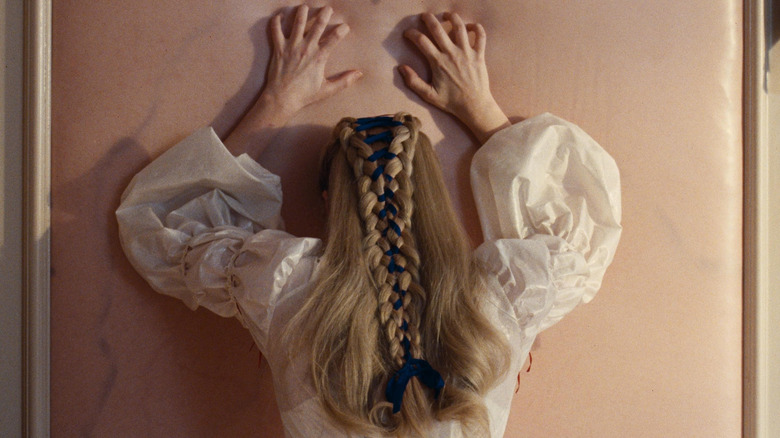
Regardless of how anyone feels about Emerald Fennell's previous outings, "Promising Young Woman" and "Saltburn," no one can or should ever deny that her aesthetic eye is truly unmatched. "Wuthering Heights" is her most confident and realized film yet, and every frame is dripping with production design, costuming, hair and makeup styling, cinematography, and lighting that is of the highest caliber of quality. Costume designer Jacqueline Durran ("Barbie," "Little Women") delivered multiple gowns that elicited audible gasps from fellow members of my press audience, and one montage moment showcasing Margot Robbie's Cathy and Shazad Latif's Edgar Linton looking like they stepped out of Francis Ford Coppola's "Bram Stoker's Dracula" is a styling choice I'll be thinking about all year.
Period romance stories run the risk of looking like every other adaptation, but "Wuthering Heights" takes an anachronistic approach to fashion and interior design that is incredibly effective. Production designer Suzie Davies ("Saltburn," "Conclave") deserves every award possible for a wall meant to resemble and feel like Cathy's skin (modeled after Margot Robbie's own flesh), and cinematographer Linus Sandgren ("Saltburn," "Babylon") turns Fennell's fantasies into lavish dens of lust and displays of class disparity. There are countless moments where "Wuthering Heights" looks as if it's transported the audience into a clinch cover, and the visual elements work in tandem to prey on the Pavlovian association the audience likely has from reading the salacious stories hidden within the pages.
The look of "Wuthering Heights" is so stunning and so striking that it makes the thematic shortcomings all the more frustrating. It turns the film into a "great gowns, beautiful gowns" adaptation, overshadowing the gorgeous albeit impractical accomplishments on screen.
Everyone titillated by Wuthering Heights needs to get freakier, fast
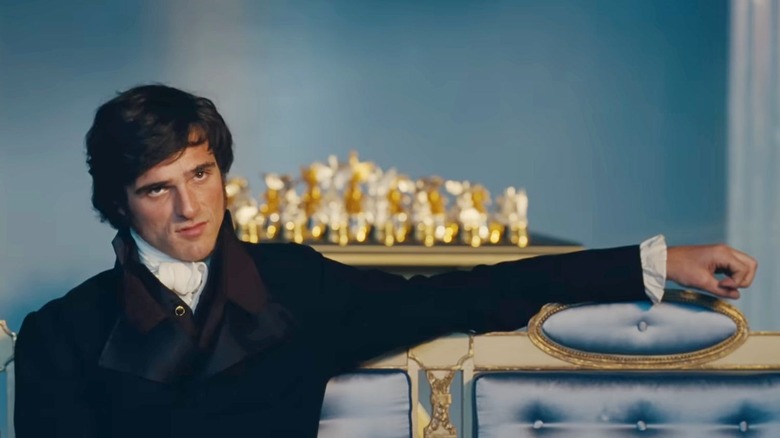
If we learned anything from the great "Bathtub Scene" moral panic following the release of "Saltburn," it's that Emerald Fennell has no problem weaving erotic imagery into her stories ... and that the average audience member is so repressed that it doesn't take much to have them squirming in their seats. "Wuthering Heights" decently captures the lust of Cathy and Heathcliff's impermissible tryst, but some of the film's most explicitly suggestive moments are close-ups of hands kneading bread dough, runny egg yolks dripping between two fingers, and a slug's mucus trail against a window. While Margot Robbie and Jacob Elordi have undeniable chemistry, their steamy scenes often feel a little chaste in a post-"Heated Rivalry" world.
The aesthetics of a bodice ripper? Sure. The execution of such? Hmm. I'm not sure! This could always be the result of my being allergic to repression, but as other people in the theater giggled with discomfort at their own public arousal creeping in, I was questioning if I was just too much of a deviant for Fennell's view of what makes a moment haughty, naughty, or titillating. For a film that so clearly wants to be about yearning, the overreliance on montage undercuts the intention. Without the groundwork of the doomed couple's love story laid early in the film by Charlotte Mellington as young Catherine Earnshaw and Owen Cooper as young Heathcliff, there's little in the story that signals to the audience how badly Cathy and Heathcliff want to be with each other beyond Robbie and Elordi being skilled at their craft.
We're not exposed to the societal pressures keeping them apart, so the catharsis we're supposed to feel when the pair finally gets their freak on is lacking.
Throw the book out before you watch Wuthering Heights
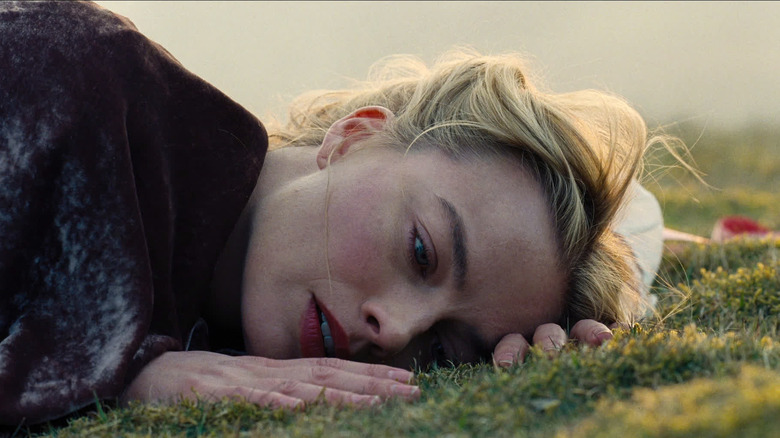
The one person who truly matches Emerald Fennell's freak in "Wuthering Heights," however, is Alison Oliver as Isabella. In what is perhaps the most interesting departure from the source material, Isabella is reimagined from a victim of Heathcliff's rage and abuse into a young woman seduced by the chance to be a live-in submissive pet. While plenty will be outraged at the reframing of her character, Oliver's commitment to Isabella's inevitable role as someone who gets off on crawling on all-fours and barking like a dog (which may or may not be an act meant to shock Nelly to get Cathy's attention? It's not super clear) from moment one makes for the best performance in the film.
Shazad Latif makes for an interesting casting choice as literature's finest cuckold, Edgar Linton, but one that feels immediately undercut by the fact Heathcliff — famously non-white — is being played by Jacob Elordi. The decision to cast Hong Chau as Cathy's longtime servant Nelly Dean is also an interesting one, but the film barely whispers at the racial implications of their characters in their respective roles while completely whitewashing Heathcliff. Casting without the acknowledgement of an actor's race allows for an idealized dream of society, but one that also allows viewers to disengage and escape to the palatable confines of denial.
Isabella has a dollhouse of the Linton's manor and it's hard not to see this inclusion as Fennell's attempt to explain her process with this adaptation to the audience. This is not an adaptation of "Wuthering Heights," but the result of what happens when you're playing an approximation "Wuthering Heights" without a full grasp on the material but all the money in the world to bring your questionable imagination to life.
/Film Rating: 5 out of 10
"Wuthering Heights" is in theaters everywhere on February 13, 2026.