

X-Men: The Animated Series' Rogue Voice Actor Has An Issue With The Movies (And She's Right)
We may receive a commission on purchases made from links.
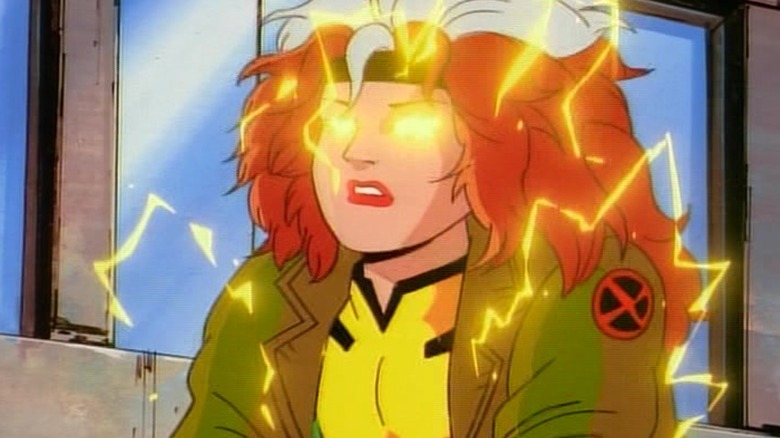
While you can't actually hear comic book superheroes talk, the X-Men's Rogue is still known for her Mississippi accent. (When Rogue says "I," it's typically written as "Ah" to indicate her pronunciation.)
This voice was first brought to life by Canadian actor Lenore Zann in the 1992 cartoon "X-Men." Zann was one of the voice actors to return in "X-Men '97," and voiced Rogue again in the popular video game "Marvel Rivals." If Zann wasn't already the definitive voice of Rogue, she sure is now. In the book "Previously on X-Men: The Making of an Animated Series" by the show's story editor Eric Lewald, he includes a conversation with Zann. Apparently, many X-Fans missed the movies' Rogue (Anna Paquin) having the animated version's southern belle charm: "With the movies I heard from a lot of people asking, 'Why doesn't [Rogue] have your voice?'"
In the first "X-Men" movie, Rogue is aged down to a teenager, and the movie uses her to show what it's like for a young person to learn they're a mutant. Running away from home after her mutant powers manifest, she hitchhikes with Wolverine (Hugh Jackman). Both Rogue and Logan meet the X-Men as the audience do.
The animated "X-Men" used the teenage Jubilee (Alyson Court) as the audience's stand-in character, like how Chris Claremont's "X-Men" comics had used the character Kitty Pryde. Both Kitty and Jubilee had close mentor relationships with Wolverine. Rogue, true to form, absorbed these attributes in the movies. Zann clocked this change in "Previously on X-Men."
"They basically melded Jubilee and Rogue together. It was probably an age thing, probably trying to go for another demographic, so they said, 'Well let's just make Rogue younger and make her a bit like Jubilee.' I just think it weakens the character."
It sure does!
The X-Men movies did not capture Rogue's strength
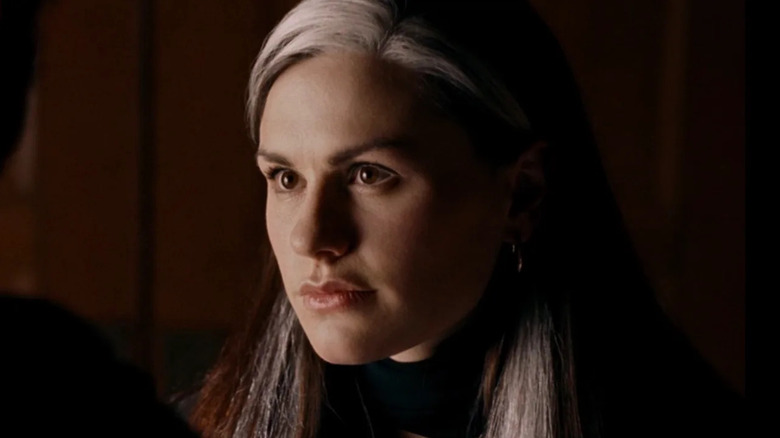
Now, I see the thought process behind turning Rogue into the teenage POV character for the "X-Men" movies. Rogue absorbs the vitality and thoughts of other people; she can't touch anyone without hurting or possibly killing them. This shows that not all mutants have cool powers, which makes the mutant metaphor of otherness more potent to audiences who'd never read any "X-Men" comics. Rogue's powers also work as a metaphor for puberty, where you feel like your body is betraying you and you both desire and are scared of intimacy.
But in defining Rogue by her angst, the movies made her a much weaker character than the comic or animated iterations. Rogue's costume in "X-Men: The Animated Series," pulled right from Jim Lee's '90s "X-Men" comics, is a green-yellow skinsuit with a bomber jacket. Her brown-and-white hair is as big and curly as Farrah Fawcett's. It's a flashy, rough-and-tumble look worthy of a loud brawler like Rogue.
Anna Paquin's Rogue is shy and self-conscious, unlike the brash, flirty, and confident Rogue from the source material. She's also literally a weaker character. In the comics, Rogue is super strong and can fly, thanks to some powers absorbed from Carol Danvers. Rogue has no such powers in the movies, which leaves her pretty helpless in the action scenes, and she never grows past it.
Compare how the 1995 "Rogue" mini-series by Howard Mackie and Mike Wieringo introduces Rogue: flying next to fighter jets and kissing the cockpit goodbye.
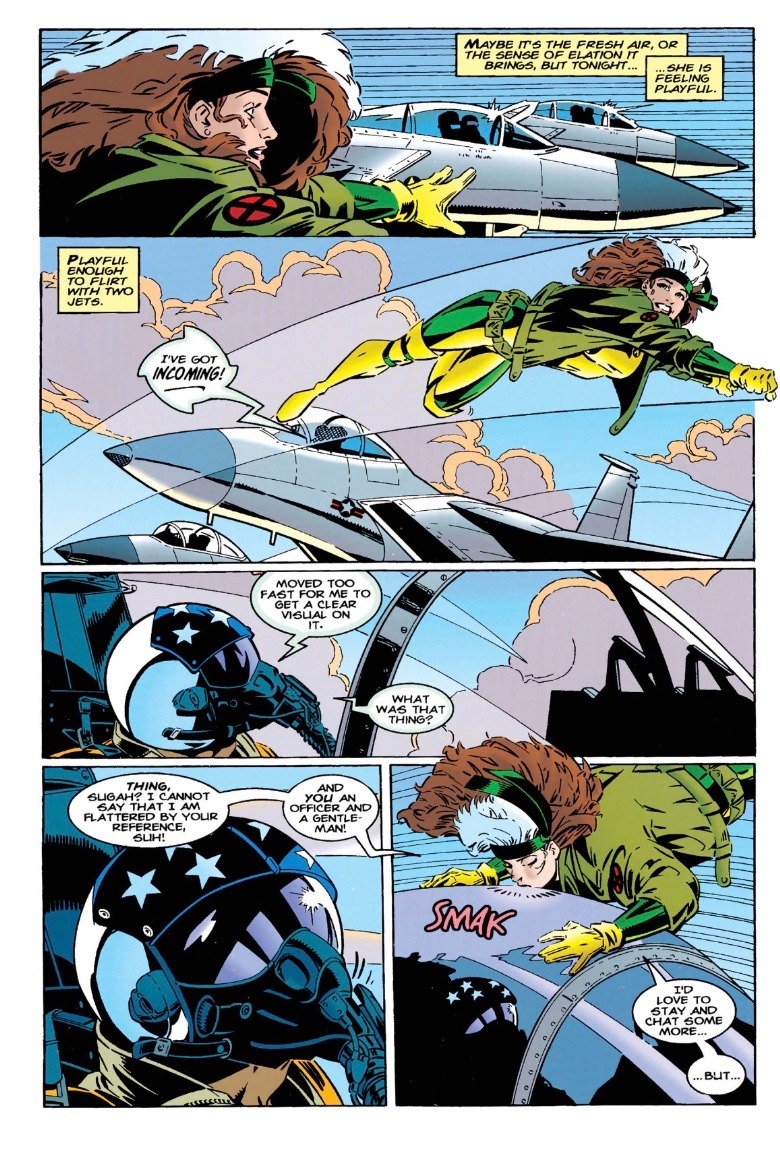 Marvel Comics
Yes, Rogue is a tease, but only because it covers her loneliness. She and her love interest Gambit have such sizzling chemistry because he's a flirt too, but their back-and-forth belies how sincere their feelings for each other are.
X-Men's Rogue is more than just her lethal touch
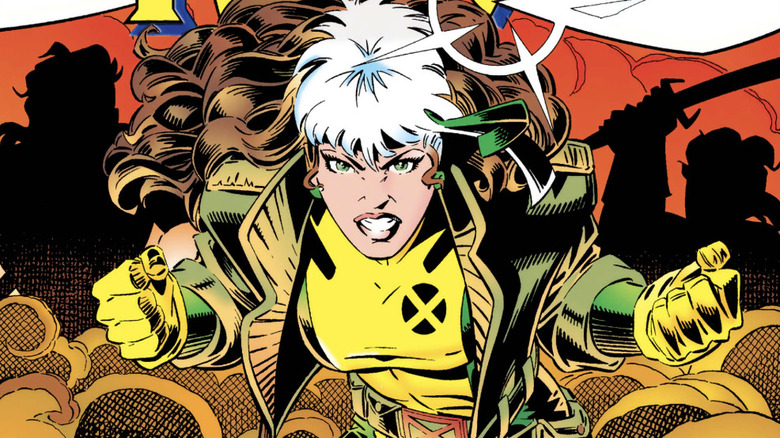
The "X-Men" movies lifted out Gambit to give Rogue a flavorless romance with Iceman/Bobby Drake (Shawn Ashmore). She never even calls Bobby, "Sugah!"
The third movie, "X-Men: The Last Stand," elevated Kitty Pryde (Elliot Page) to a starring role. If that seems redundant with Rogue having taken Kitty's role, the movie leans on that feeling. Kitty has a crush on Bobby, and Rogue fears she's being usurped. So, Rogue's story ends with her taking a "cure" for mutant powers, violating the core theme of "X-Men" and suggesting that assimilation to be "normal" can be the answer. Compare this to Mike Carey's comic run on "X-Men: Legacy," where Rogue finally accepted and controlled her powers.
The sanding down of Rogue is part of a theme; the "X-Men" movies largely shoved the strong women characters of the comics and cartoon to the side. Halle Berry had to plead for Storm to get a deserved bigger role, while Mystique (Rebecca Romijn) was reduced to Magneto's (Ian McKellen) henchwoman.
"Though there are things I really liked about the 'X-Men' movies, I don't think they've developed Storm or Rogue very well," said Eric Lewald in his conversation with Lenore Zann. "X-Men: The Animated Series" had a rare gender-balanced main cast in a superhero cartoon, on the other hand, and used Rogue and Storm to their full potential.
Now, the movie's Rogue reinvention worked for some people. The 2000 cartoon "X-Men: Evolution" featured a goth Rogue (Meghan Black) modeled on the movie version. While writing comic "New X-Men," writer Grant Morrison had unrealized plans to revise Rogue to be more like the movies and "X-Men: Evolution." For this X-Fan, though, the movies were a simplification for the worse.