

Darkseid Vs Thanos: Who Is Stronger?
We may receive a commission on purchases made from links.
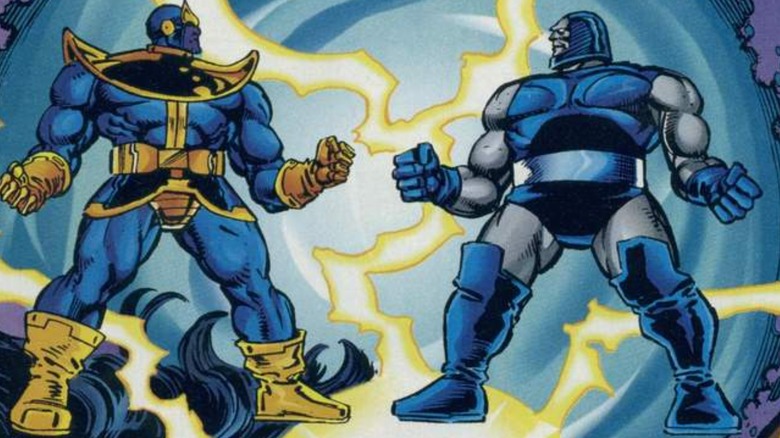
If you compare the Marvel Comics and DC Comics fictional universes, there are many characters from one company who feel ... inspired by a character from the other. Two of the most famous examples are the arch-villains, DC's Darkseid and Marvel's Thanos. Both are tall, stone-faced aliens that seek universe-shattering super-weapons. Darkseid seeks the Anti-Life Equation to make all life submit to him, while Thanos wants the Infinity Gems (aka Infinity Stones) to cull the cosmos of life.
Both Darkseid and Thanos have, in time, evolved into the go-to "main villain" of their respective universe; the Sauron or Emperor Palpatine figure, the overarching big bad who the heroes must unite to defeat. The Marvel Cinematic Universe used Thanos (Josh Brolin) as the villain of its "Infinity Saga," while the aborted DC Extended Universe intended to follow a similar storyline with Darkseid (Ray Porter), but it didn't pan out. (If/when James Gunn's DCU features Darkseid, it won't be in a big bad role like this.)
Since Darkseid and Thanos overlap so much, comic book fans wonder what they always do: which one would win in a fight? For characters who exist on opposite lines of the Marvel/DC divide, debates like this usually become a proxy for which company's comics you like more ("My dad could beat up your dad," etc.). So that's why it's important that I, more of a Marvel fan, still admit that Darkseid mops Thanos.
Thanos is the Mad Titan, but Darkseid is a (New) God. What did the gods do to the Titans? They killed them.
Darkseid is strong enough to bring Thanos to heel
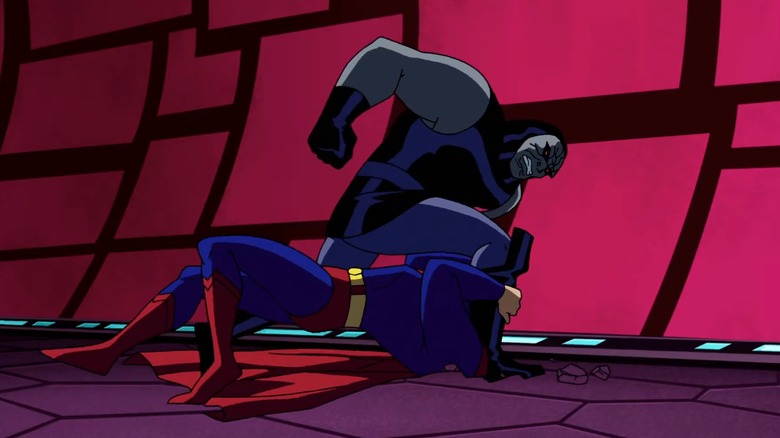
Yes, yes, Thanos handed the Hulk (Mark Ruffalo) his ass on a silver platter in "Avengers: Infinity War." And in the original movie-inspiring "Infinity Gauntlet" comic (by Thanos' creator Jim Starlin and artist George Pérez), Thanos — made omnipotent by the titular Infinity Gauntlet — slaughters an entire task force of the Marvel Universe's greatest champions. The Mad Titan is a formidable villain with a powerful aura who earns his fearsome reputation.
Yet as grand as Thanos is, Darkseid — who can throw Superman around like Thanos can the Hulk — is grander still. Thanos may be far above a human, but he's still a mortal, driven by mortal foibles. Darkseid, though, is the God of Evil and Tyranny. He can't be defeated anymore than those ethereal forces can be. It's why, since Grant Morrison and Howard Porter's 1998 storyline "Rock of Ages" (published in "JLA" #10-15), the phrase "Darkseid Is" has become so associated with the villain. Like God himself, Darkseid simply is; he's omnipresent and undefeatable. Thanos does not have that metaphysical edge to him.
Even published Marvel/DC crossovers back up that Darkseid has the edge. In 1996's "Marvel Versus DC" (written by the late Peter David), Darkseid and Thanos come face to face. Thanos weighs the two on equal terms, himself a Disciple of Death and Darkseid a Lord of Destruction, but Darkseid calls Thanos only a "pale imitation of me."
In the later crossover "JLA/Avengers" (by Kurt Busiek and Pérez), Darkseid gets his hands on Thanos' Infinity Gauntlet ... except, due to Infinity Gems only working in their native universe, he thankfully can't wield it. Even so, Hawkeye observes that Darkseid somehow looks even more evil than Thanos.
Darkseid came before Thanos
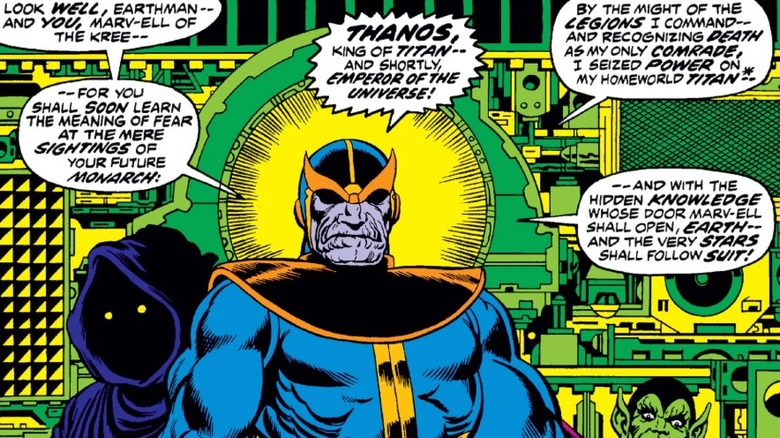
One reason Darkseid ranks over Thanos is the simple, undeniable fact that he came first. It took the MCU for Thanos to even begin to escape his reputation as a Darkseid knock-off. Debuting in 1970's "Superman's Pal Jimmy Olsen" #134, Darkseid is a creation of writer/artist Jack Kirby, famous as a co-creator of the Marvel Universe (some, including Kirby's estate, maintain he deserves more credit for the modern Marvel than even Stan Lee).
When Kirby was working at Marvel, he conceptualized a saga of "New Gods," including Darkseid, as a spiritual sequel to his work on "Thor." Kirby was already one foot out the door, though, so he kept Darkseid and the New Gods out of Marvel's reach; he saved their story for when he jumped ship to DC in hopes of more creative freedom. (It didn't quite pan out, and he eventually returned to Marvel.)
Jim Starlin, creator of Thanos and the architect of Marvel's Cosmic characters and stories, was a fan of Kirby's "New Gods." You know what they say about imitation and flattery. Starlin debuted "Thanos" in 1973's "Iron Man" #55 (plotted and drawn by Starlin, though with script input from Mike Friedrich), depicting his origin as an alien warlord born on Saturn's moon Titan. The issue features Iron Man teaming up with Drax the Destroyer, initially depicted as a homunculus created by Thanos' father, Mentor, to destroy his son.
Starlin cops to Thanos being a "New Gods" rip-off, but has said that initially, he based Thanos' design on a different Kirby creation — the all-knowing Metron. Starlin has said that Marvel's then editor-in-chief Roy Thomas told him to revise the design: "If you're going to steal one of the New Gods, at least rip off Darkseid, the really good one!"
Darkseid is a tyrant, Thanos is a serial killer
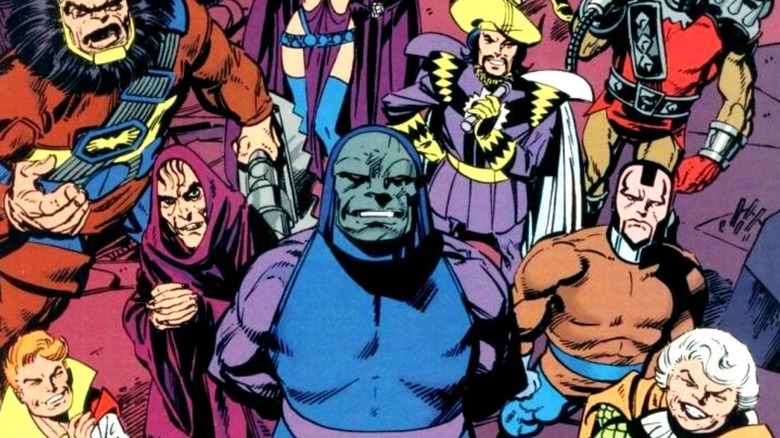
The New Gods are split between two planets: the benevolent New Gods live on the idyllic New Genesis, while Darkseid rules the evil New Gods from planet Apokolips.
Jack Kirby, a Jewish man who debuted his co-creation Captain America by having him punch out Adolf Hitler, really hated Nazis. He served in World War 2 himself, and his memories of seeing how fascism almost destroyed Europe came to the forefront as he created Darkseid. The Lord of Apokolips is a tyrant in the vein of the Führer, with the same court of corrupt schemers: Darkseid's elite includes the torturer Desaad, sadistic "educator" Granny Goodness, the god of propaganda Glorious Godfrey, etc. Apokolips exists to spread misery and destroy free will — fascist thought distilled into purity.
Though Thanos' earliest appearances depicted him as a conqueror, his goals and characterization have evolved. He's not out to rule like Darkseid is; he spreads death because he is in love with Death, literally and metaphorically. Though he has an army of alien ravagers to rival the hordes of Apokolips, Thanos behaves more like a serial killer than a true tyrant.
The 2013 series "Thanos Rising" by Jason Aaron and Simone Bianchi runs with this idea, depicting a young Thanos killing small animals and then eventually people before his exile from his homeworld, Titan. When he returns to Titan, it's to bring nuclear armageddon. ("Thanos Rising" suggests that Lady Death might be a hallucination, Thanos' subconscious mind giving his sadistic impulses a face, though most other stories do not go with this interpretation. )
Grant Morrison, in their book "Supergods," opines that if Kirby wrote Darkseid based on his experiences in WW2, then Starlin's Thanos, a more "gothic" villain, reflected a 1960s-'70s countercultural cynicism.
Both Darkseid and Thanos are terrible fathers
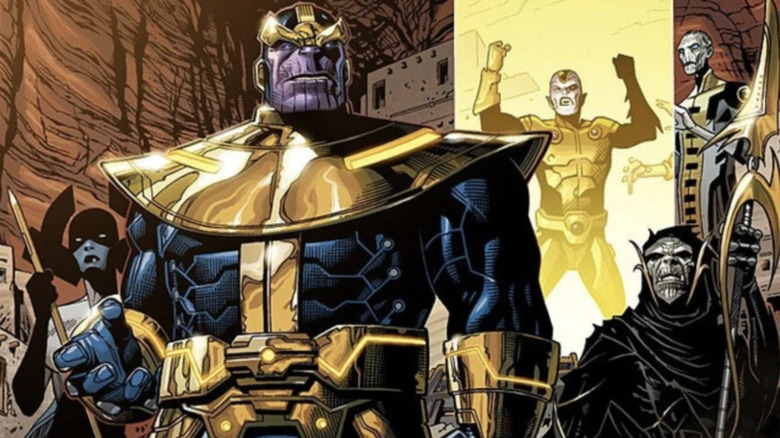
Darkseid and Thanos both have children, but they are not family men. One of Kirby's most famous "New Gods" stories is in issue #7, a prequel called "The Pact." The issue tells how Highfather, ruler of New Genesis, and Darkseid became kings of their respective worlds, how they warred, and then ultimately came to a truce; Highfather because he saw the corrosive effect of war, Darkseid because he needed to bide his time before resuming the conflict.
They sealed their pact by swapping sons. Highfather's son was tossed into Granny's torture pits (growing into escape artist Mister Miracle) while Darkseid's son, Orion, was raised by Highfather on New Genesis. Orion is a hero who despises his birth father, but he struggles to keep his own evil nature in check. Darkseid regularly battles Orion, but actually respects him more than his loyal son, the brutish Kalibak.
Jim Starlin introduced alien assassin Gamora in "Strange Tales" #180, and depicted her as Thanos' adopted daughter/ living weapon. The MCU adapted Gamora (Zoe Saldana) and her troubled relationship with Thanos, but also gave the Mad Titan more adopted children. The character of Nebula (Karen Gillan), a space pirate who in the comics claims to be Thanos' granddaughter, was simplified into Gamora's adopted sister. Thanos' elite warriors, the Black Order, were also renamed the Children of Thanos in the MCU; implicitly, Thanos cultivates many assassins from the worlds he raises.
"Thanos Rising" revealed that, in Thanos' travels across the galaxy, he sired many children with many lovers, but he killed them all in tribute to his grim love. The 2013 crossover "Infinity," written by Jonathan Hickman, also features Thanos invading Earth to kill his Inhuman son, Thane, who he believes may one day grow to surpass him.
Thanos seeks Death, Darkseid seeks Anti-Life
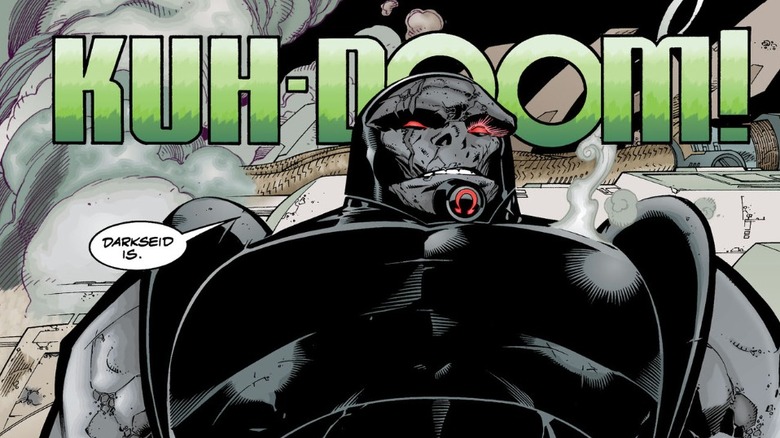
What is "Anti-Life," exactly? DC cartoon "Young Justice" offered a simple definition: Life minus free will equals Anti-Life. The Anti-Life Equation is the mathematical formula that produces this result. The equation offers proof that life and hope are meaningless, and in destroying hope, it also destroys free will, leaving the afflicted as automatons waiting to be ordered. Darkseid, the ultimate embodiment of tyranny, covets this equation and its power.
Thanos' goals are not so abstract; he's trying to win the love of a woman he fancies by impressing her. It just so happens that the woman he's in love with is Death herself. In 1973, Jim Starlin took over as artist and co-plotter (with Mike Friedrich) of "Captain Marvel." Starlin used Thanos as the villain of a multi-issue arc that revealed his fixation with Death; the Mad Titan seeks to conquer Earth not for his own glory, but for the glory of his mistress.
Starlin has said he named Thanos after Sigmund Freud's psychological concept Thanatos, or "the death drive." Thanatos describes how individuals are innately drawn to self-destruction and death, and Thanos sure is. But the death drive colors Thanos' actions in another way: self-sabotage. You see, his quest to make Death love him is doomed. She's never even spoken to him, much less returned his affections. Even in "Infinity Gauntlet," when Thanos murders half the universe in tribute to Death, she still won't acknowledge him.
Thanos' lovesickness makes him, in the end, a more pathetic villain than Darkseid. You don't see comic fans joking about how Darkseid is just a big, strong incel, for one. Thanos can be both terrifying and oddly pitiable, while Darkseid is always just plain terrifying.