

Every Western Directed By Clint Eastwood, Ranked
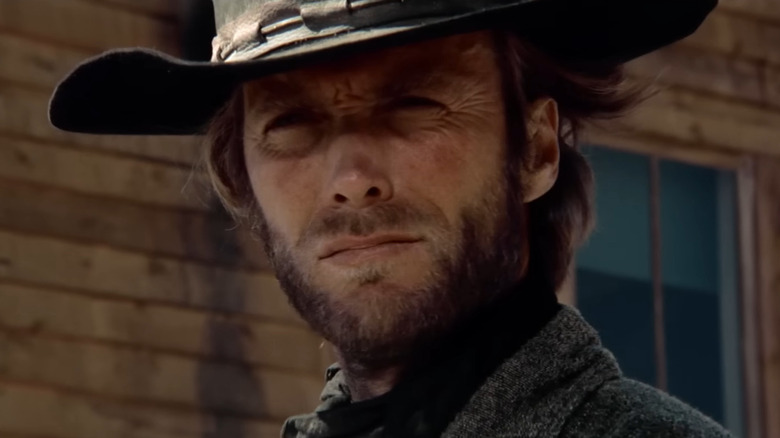
Clint Eastwood's career shows that he's never been one to pigeonhole himself within the boundaries of one genre, but it's highly unlikely he would have become one of the greatest talents of his generation without the Western. His first real foot in the door lied in his eight-season stint on the CBS television series "Rawhide" as ramrod Rowdy Yates, which Eastwood considered a fluke. That kind of consistent work allowed Eastwood to travel overseas to work with Italian filmmaker Sergio Leone on a trilogy of spaghetti Westerns that would become titanic landmarks within the genre ("A Fistful of Dollars," "For a Few Dollars More" and "The Good, the Bad, and the Ugly"). By the time these movies reached the United States, Eastwood had graduated from television cowboy to a bonafide movie star with a squint that was born to play to the crowds.
As Eastwood continued to branch out, he never seemed to leave the genre that made him into an international icon behind having starred in westerns from John Sturges ("Joe Kidd"), Ted Post ("Hang 'Em High") and his close buddy Don Siegel ("Two Mules For Sister Sara"). But once he became a filmmaker himself, starting with the psychological thriller "Play Misty For Me," it was all but inevitable that the head honcho of Malpaso Productions would make some Westerns of his own. All six of them aren't just stories Eastwood felt compelled to bring to the screen, so much as reflections on his legacy as the face of the movie cowboy.
6. Cry Macho
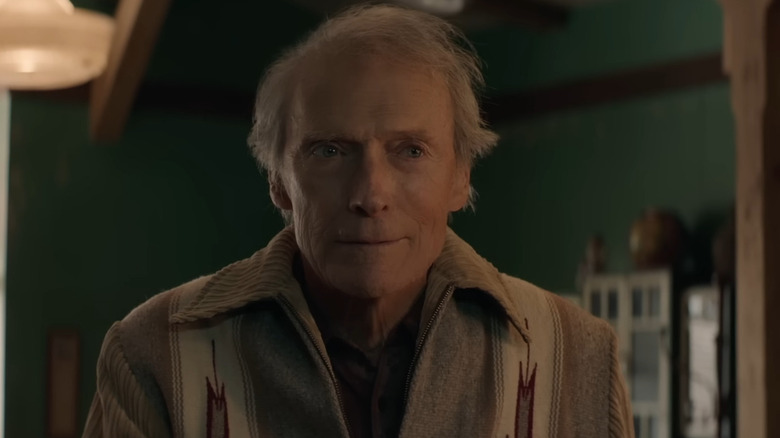
For all of the ways in which the Malpaso way of making movies often impedes "Cry Macho" from becoming a more fully realized film, it's still a very sweet little neo-Western drama about second chances in unlikely places. Set in 1979, the film follows Mike Milo (Eastwood), a once famous rodeo star who's been hired by his former boss Howard (Dwight Yoakam) to retrieve his 15 year-old son Rafo (Eduardo Minnett) down in Mexico. The N. Richard Nash-penned script had been floating around since the '70s, with stars like Roy Scheider and Arnold Schwarzenegger once set to headline. It's fitting, however, that it ended up back in Eastwood's camp considering he's cultivated such a brand of toughened masculinity over the course of his career, and now finds himself an older man on the other side of it.
"Cry Macho" is an admirable closing chapter on Eastwood's association with the Western that's just sentimental enough. It's a leisurely paced film about the profound effect people can have on one another through simple acts of kindness that can break through any language barrier. There's a large portion of "Cry Macho" that's mostly a tender hangout movie with Mike entrenching himself within a small little Mexican community where he woos a beautiful restaurant owner named Marta (Natalia Traven). It's definitely the nicer and less loaded movie written by Nick Schenk ("Gran Torino") about Eastwood forging a relationship with a good kid caught in a bad predicament.
Warner Bros. CEO David Zaslav had little faith in Eastwood's ability to make a movie that would turn a profit, as well as why anyone would keep giving him money. "Cry Macho" is far from Eastwood's best, but a heartbreaking monologue with Clint on the couch proves why he's still one of the greats.
5. Pale Rider
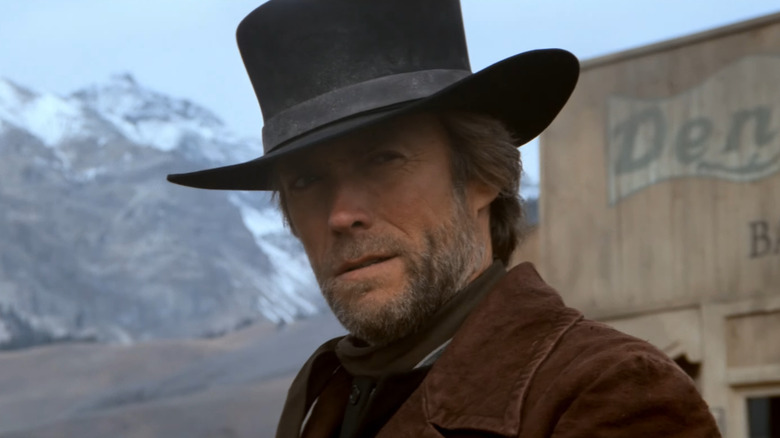
Eastwood cultivated his screen Western image in Leone's "Dollars" trilogy as the mysterious Man With No Name, a figure who ultimately becomes entangled with a situation he has nothing to do with, yet feels compelled to help anyways. In "Pale Rider," teenage Megan Wheeler (Sydney Penny) prays for a miracle in the wake of greedy mining leader Coy LaHood (Richard Dysart) sending his goons to terrorize local families, and receives one in the form of a man who goes by Preacher (Eastwood). Only the ruthless Marshal Stockburn (John Russell) seems to recognize the supernatural threat at hand, believing that the prospectors' new guardian angel is a man he once killed. "Pale Rider" is a lesser film compared to "High Plains Drifter" (more on that later), but it's still gorgeously photographed and one of the defining Westerns of the '80s.
For all of the ways in which Eastwood pays homage to the classic Alan Ladd western "Shane," he twists familiar genre archetypes in a way that feels fresh. Although this is one of those cases where Eastwood the filmmaker is a much stronger presence than that of his screen presence. There's a good balance between the intimacy of Preacher spending time with Michael Moriarty's Hull Barrett, and the violence he doles out. It's best exemplified in the frigid overcast that blankets a tense confrontation between Stockburn and a drunken prospector named Spider (Doug McGrath).
I'd hardly classify "Pale Rider" as a revisionist Western, as it often engages with the genre in a rather straightforward manner. But it's fascinating how Eastwood carries this supernatural aura around his presence as this uncanny spectre for whom violence is a last resort, yet all but inevitable for destructive men who willingly walk through the valley of the shadow of death.
4. Bronco Billy
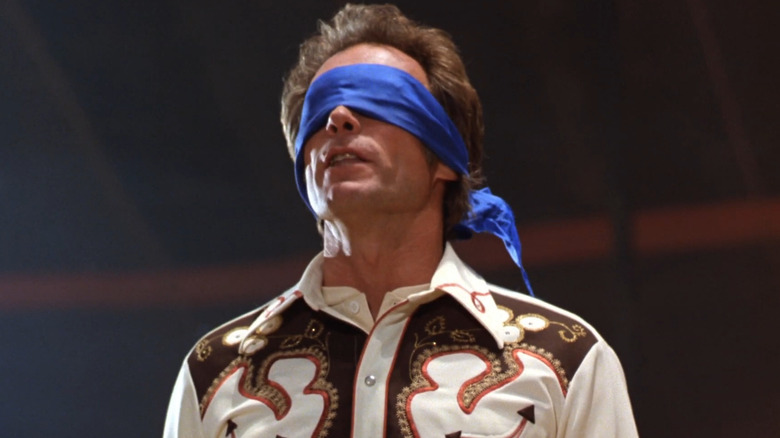
I can see some folks contesting "Bronco Billy" as a Western, but given how close it ties into Eastwood's demeanor as a cowboy showman in film and television, it absolutely deserves to be recognized as one. Under a big top tent in which spectators are enveloped by the iconography of American flags, "Bronco" Billy McCoy (Eastwood) is a trick shooter who operates a traveling wild west show as a way to live out his romanticized fantasies with an eclectic group of roadies who wouldn't have it any other way. Do the show, pack it up, and move onto the next town is how it's done in Billy's world. This is how he lives out his cowboy dreams. He knows he doesn't have a show without his emcee hypeman "Doc" Lewis (Scatman Crothers), nor his new assistant Antoinette Lily (Sondra Locke). Eastwood isn't going to outright portray Billy as a total relic, but part of what makes him a great filmmaker is that he allows his flaws to breathe out in the open. He's often a jerk, but a loyal one.
"Bronco Billy" is a really good film about chasing those moments you know won't last forever. This is best illustrated in one of the most surprisingly affecting sequences in Eastwood's directorial oeuvre where Billy proposes pulling a train robbery in order to make up for some monetary setbacks. He's got the horse, the bandana and the pistol he needs to live out his cowboy reveries. Even though the train proves to be too much of a contemporary behemoth to truly catch up with, the man out of time chases it anyway. "Bronco Billy" often gets lost in the shuffle of Eastwood's more prominent works, and I think it deserves a newfound recognition.
3. The Outlaw Josey Wales
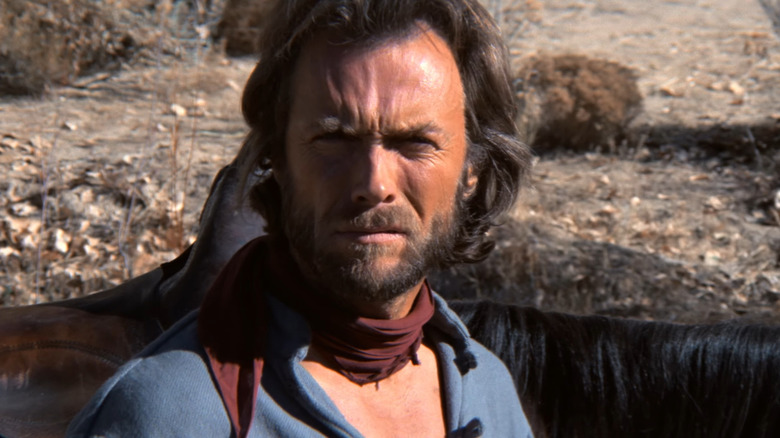
"The Outlaw Josey Wales" had nearly everything going against it being a success, whether it be the disturbing history of the novel's deeply racist author or Eastwood usurping Philip Kaufman from directorial duties in the middle of production. But against all odds, it ended up becoming one of Eastwood's most memorable films. The revisionist Western sets the stage for a traditional revenge odyssey with Missouri farmer Josey Wales (Eastwood) witnessing a Union paramilitary group slaughter his family and burn his home to the ground. Joining a crew of Confederate bushwhackers serves as his outlet for bloodshed, that is, until the end of the Civil War. The promise of a peaceful surrender turns sour after Wales' posse is mostly slaughtered in an ambush, forcing him to go on the lam. As Eastwood's anti-hero evades bounty hunters in his pilgrimage to Texas, he's presented with something he never thought he would get again: a path forward.
Eastwood boldly plays with a lot of thorny material surrounding the slightly sympathetic depiction of Confederate soldiers, yet never seeks to absolve them. "The Outlaw Josey Wales" is about coping with the varying degrees of loss, with the titular character being depicted as a morally complex drifter without a place in the world. The film really soars, however, once it becomes a touching tapestry of finding peace among the ashes. Wales' furious path blossoms into a tale of found family consisting of people from all walks of life who have been disenfranchised by the American establishment in some way. The cool head of Chief Dan George's Lone Watie is like a soothing balm next to the grizzled Eastwood as it's his presence that ultimately changes the film's temperature.
2. High Plains Drifter
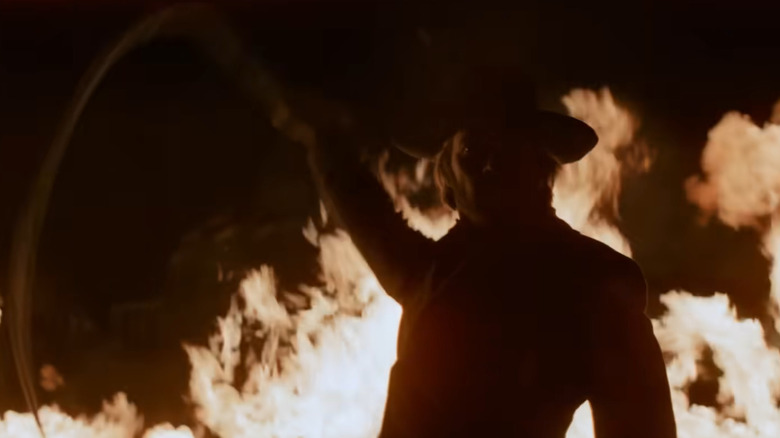
It's fascinating that Eastwood's sophomore effort in the director's chair sees him perverting the genre that made him famous into something so mesmerizingly cruel. The Stranger (Eastwood) is not an ordinary drifter so much as an unquestionable evil who descends upon the frightened town of Lago from the sweltering heat. Without proper law enforcement in place, the secluded mining town has no choice but to recruit their mysterious visitor as their protector against a dangerous band of outlaws who have a bone to pick with them. It's a shame Eastwood rarely dabbled in the horror genre because the apocalyptic imagery in "High Plains Drifter" is unbelievable. The image of Lago in the distance, bathed in the red of its overwhelming guilt of their past transgressions, is one of those haunting cinematic images I'll never be able to shake.
"High Plains Drifter" is a mean picture about bad people and even worse people trapped in a stasis of their own shame. The death of Marshal Jim Duncan (Buddy Van Horn) is a blight on Lago that swallows it from every direction, with every step to salvation being paved in his blood. Eastwood has such a way of letting you stew in uncomfortable feelings with how the Stranger ingrained himself among the townsfolk. The only catharsis is that of those few moments where the titular gunslinger isn't conjuring the color red. Even then, the Stranger's silence can be more foreboding than his fury. It's not only one of Eastwood's best Westerns bar none, it's one of his best films period.
1. Unforgiven
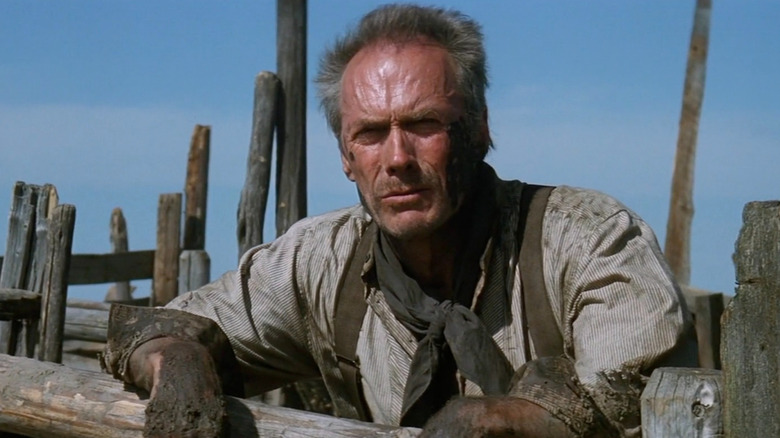
Every decade of Eastwood's career comes with a new way of reflecting upon his screen image and how it's shaped the cinematic archetypes we've come to be familiar with. His Western personas, more often than not, come with the threat of inevitable violence that he must inevitably engage in. The romanticization of cinematic gunslingers clearly weighs on Eastwood, which is why "Unforgiven" is one of the most quintessential Westerns ever made. William Munny (Eastwood) lives in a self-imposed exile after years of ruthless killings that's since turned the former outlaw into the stuff of legend. He only accepts the job brought forth by the Schofield Kid (Jaimz Woolvett) out of desperation to keep his patch of peace. What Munny finds in the abyss of death and gunsmoke is a personal reckoning of all the pain he's wrought upon himself and the world.
For as much as "Unforgiven" is associated with Eastwood, the Academy Award-winning film also features a murderer's row of talent like Morgan Freeman, Richard Harris and Saul Rubinek. It's the late, great Gene Hackman, however, who serves as the film's thematic lynchpin in a devious performance as 'Little' Bill Daggett. David Webb Peoples' screenplay is the guidebook for what is a perfect film about the legacies we leave behind. It sometimes feels strange that "Unforgiven" isn't Eastwood's last feature as it's as much a grand career denouement as any other. It will forever be among one of his great contributions to the genre and the form.