

Blade Runner 2099 Review: Hunter Schafer And Michelle Yeoh Star In The Best Sci-Fi Show In Years
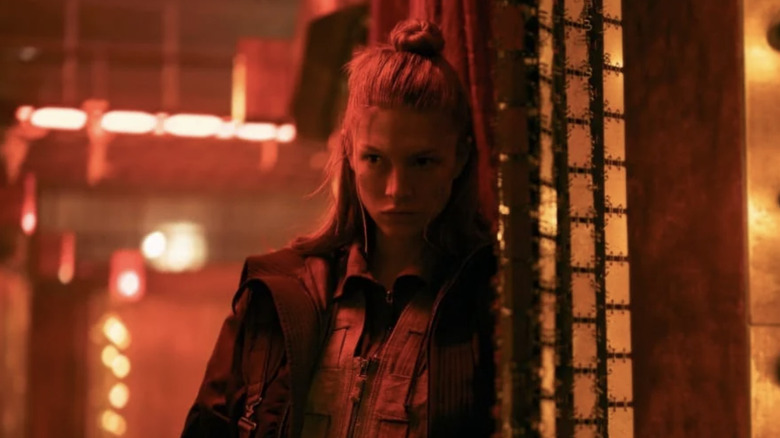
In the case of the "Blade Runner" franchise, the future seems to arrive right on time. It's no coincidence that both films in the series were made during periods of severe social and political anxiety in America, with their dystopias not just predicting our future but reflecting our present. Although Ridley Scott's 1982 masterpiece is still generally well regarded, it also feels a little underrated in terms of how massively influential it was. It not only still casts a shadow over the science fiction genre, but began a trend within Hollywood of more filmmakers utilizing the works of author Philip K. Dick, whose novel "Do Androids Dream of Electric Sheep?" served as the source material. It was instrumental in kicking off the cyberpunk subgenre, with so many tech-centric dystopias following in its wake. Meanwhile, Denis Villeneuve's decades-later sequel "Blade Runner 2049" is a masterwork in its own right, a sequel which has itself inspired pop culture.
As we endure this latest period of anxiety, along comes a new "Blade Runner" to mirror our malaise. We're in a particularly fertile period for dark sci-fi to emerge, with everything from the rise of AI to the failure of governmental and technical systems occurring around us. As such, it feels fitting that this new "Blade Runner" isn't another movie, but an 8-episode series: "Blade Runner 2099." As the title suggests, this isn't some lazy continuation, but is instead a leap forward within the series' parallel universe in which artificial humans known as Replicants exist. Showrunner Silka Luisa has put together something that's as unique and bold as it is in conversation with its franchise's past, making it a proud new addition to the saga. In many ways, "Blade Runner 2099" is the best sci-fi show in years.
Blade Runner 2099 is both a continuation and a stand alone
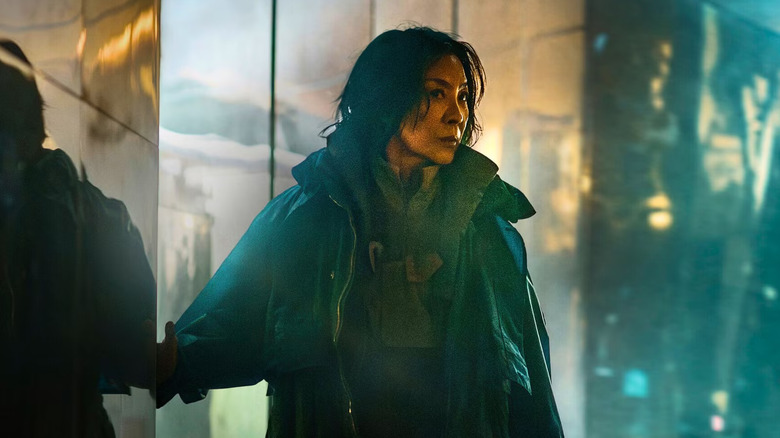
"Blade Runner 2099" introduces us to the surprisingly sunny but still noir-ish Los Angeles of 2099, a city which feels like Ridley Scott's overcrowded metropolis and Denis Villeneuve's stark landscapes have been merged. More than just paying homage to the past, this provides a fitting backdrop to an LA which exists after the Replicant uprising (which was hinted at toward the end of "2049"). Now the script has been flipped: Replicants are the dominant species on Earth, having subjugated the remaining humans. Those humans who cannot go (or are not sent) off-world occupy menial jobs, and any who exhibit resistance are retired by Replicant Blade Runners.
After the human Cora (Hunter Schafer) gets caught in a Blade Runner raid at her job where she's forced to run, she tries to use a human sympathizer, Bebeto (Dimitri Abold) to help her and her disabled brother Elias (Lewis Gribben) get to Mexico City, the last city on Earth where humanity has true freedom. Bebeto needs Cora to do something for him in exchange, which is to pose as a Replicant (and a Blade Runner) in order to obtain an object from LAPD lockup.
Upon attempting this, Cora is suddenly assigned to work with Olwen (Michelle Yeoh), a veteran Blade Runner whose predetermined Replicant death time is coming up shortly. With that, the series is off on its own unique sci-fi/noir trip. While there are several callbacks to prior elements of the franchise (things like the Voight-Kampff test and the JOI device make an appearance), these are part of its worldbuilding more than any fan service. "2099" is unquestionably a part of "Blade Runner," yet its reconfiguring of the world allows it to stand alone, too.
2099 emphasizes Blade Runner's themes while not sacrificing its aesthetic
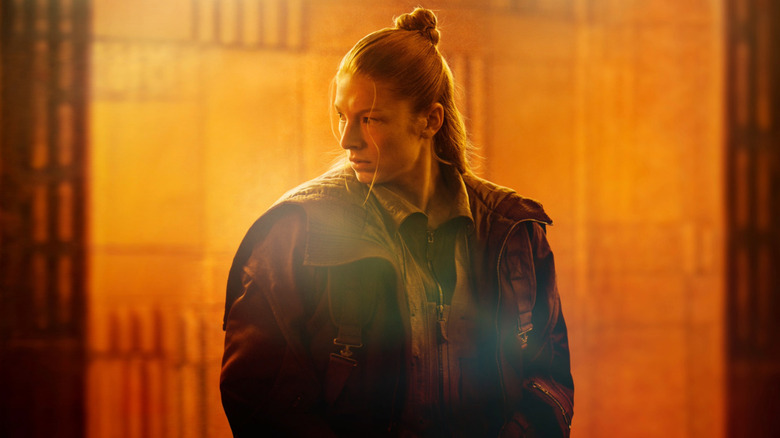
Right away, the franchise's themes of identity, existentialism, and morality come to the fore in the series, all of which showrunner Silka Luisa and company explore with aplomb. A big part of why it feels so fresh lies in the show's female leads, a development which feels natural rather than belabored.
Though the themes of "Blade Runner" have always been universal, the first two films do have notably masculine viewpoints. Here, Hunter Schafer and Michelle Yeoh bring a new feminine energy to the franchise which feels distinct from the men in the franchise but also from the previous films' women. Yeoh's extensive history with the action genre makes Olwen's strength almost second nature, while Schafer builds upon her excellent work in "Cuckoo" by making Cora a woman who is also slowly getting more and more in over her head. These layered characterizations are helped by the series' scripts, which are of a idiosyncratic, sci-fi-forward quality worthy of the franchise.
As great as the performances and writing are, the folks behind "Blade Runner 2099" are well aware that a large part of the series' fame is due to its visual design, and as such the series has not skimped in that department. "2099" utilizes its status as a series to take us to many more places in the "Blade Runner" universe than just LA and the surrounding areas, and the production design goes beyond Scott and Villeneuve as influences. In fact, one sequence feels worthy of mentioning in the same breath as Andrei Tarkovsky. Meanwhile, the series' cinematographers (led by Rob Hardy) maintain a consistently strong level of quality over the episodes, while composer Leopold Ross builds a hypnotically strange sonic tapestry that never reuses old themes.
Blade Runner 2099 is a show worth talking about for years to come
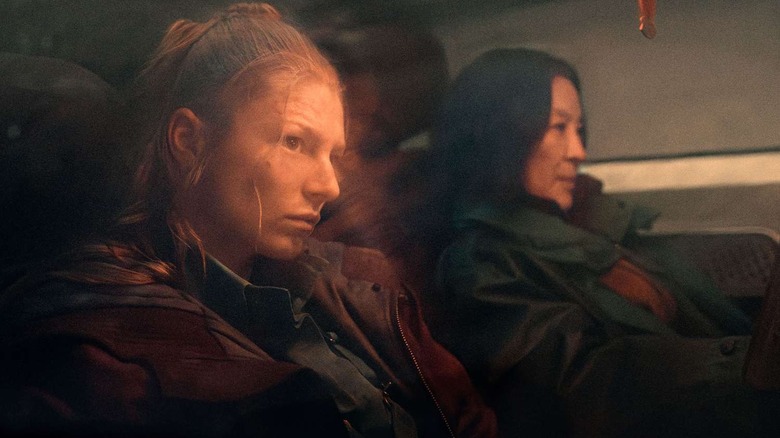
"Blade Runner 2099" is one of those shows that leaves you awed at how they managed to accomplish so much with it. If there is a flaw within, it's the usual issue with so many streaming series these days, which is that some story beats (and a few whole scenes) feel unnecessarily lengthened and padded out. It's also a shame that Prime Video is releasing the show all at once, as it feels like the series was produced to foster a week-to-week audience (similar to "Crystal Lake" from last month), and, given its rich material, could've likely grown one. That aside, "Blade Runner 2099" is a show that has a lot going for it, not the least of which is its intelligence and imagination.
It carries on the concepts and themes of Philip K. Dick while adding some wild new ideas. Its closest cousin in this way may be another Ridley Scott-backed series, the underseen "Raised By Wolves." Given its boldness, one wonders if the 8 episodes of "2099" are intended as the final word, both for itself and for "Blade Runner" in general. Whatever the future holds, I believe the show is the best sci-fi IP revival since Ronald D. Moore's "Battlestar Galactica." It's that intriguing, that layered, and that vibrant. In keeping with the original film's reputation, the various interpretations that the series' ending invites are enough to keep the show worth talking about for years to come. It may have been almost a decade since "2049," but "Blade Runner 2099" has arrived right on time.
/Film Rating: 9 out of 10
"Blade Runner 2099" premieres November 25, 2026 on Prime Video.