

Marvel's Vision Was Originally Intended As A Revival Of A Forgotten Superhero
We may receive a commission on purchases made from links.
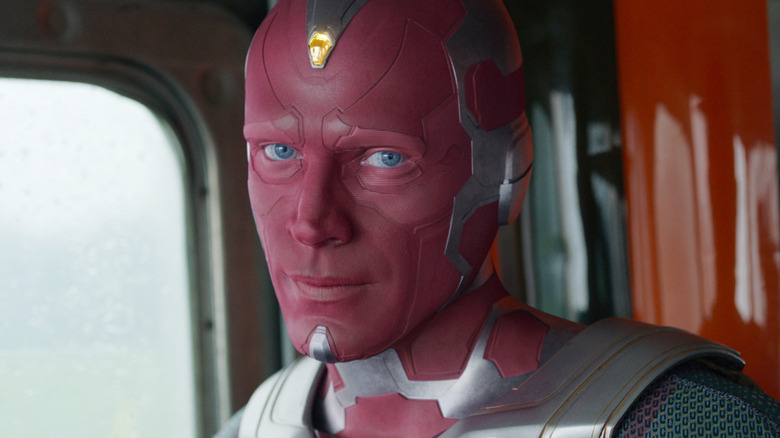
Since his introduction in 2015's "Avengers: Age of Ultron," the Vision (Paul Bettany) has become one of the most enduring Marvel Cinematic Universe characters. Not even getting his vibranium head crushed by Thanos (Josh Brolin) back in "Avengers: Infinity War" stopped him from returning in the TV series "WandaVision" — in which Wanda Maximoff (Elizabeth Olsen) conjures the life she wanted with Vision — and "VisionQuest," which revisits Vision's relationship with Ultron (James Spader), his "father."
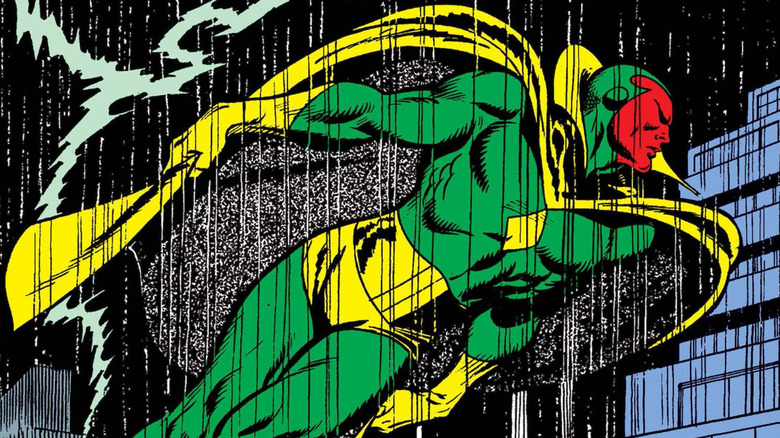
Created by Roy Thomas and John Buscema, Vision debuted in 1968's "The Avengers" issue #57. Unlike in the MCU, where Ultron creates Vision's "synthezoid" body for himself before the Avengers steal it, comic Ultron (then known as Ultron-5) created Vision as a conscious being to lure the Avengers to their doom. Vision then turned against his creator, and the following issue #58 saw him inaugurated as an Avenger.
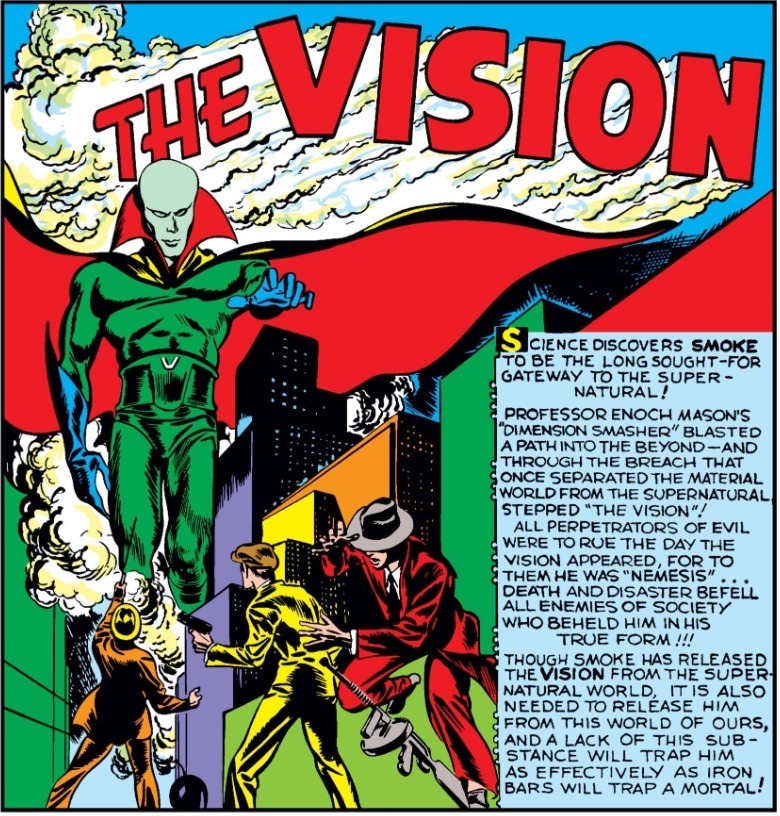
But Vision as we know him almost didn't exist. Thomas is a fan of the "Golden Age of Comics," aka the earliest period of superhero comics in the 1940s. Back then, Marvel was called Timely Comics, and its superhero stable included Aarkus, an interdimensional being named The Vision. Created in 1940 by Joe Simon and Jack Kirby (the same year that they created Captain America), the Vision debuted in "Marvel Mystery" #13. Summoned to Earth by scientist Enoch Mason, Aarkus hails from a supernatural dimension called "Smokeworld."
 Marvel Comics
Originally, Thomas wanted to bring back this Vision as an Avenger, as Stan Lee and Kirby had brought back Captain America in "Avengers" #4. But Lee (without giving a reason) insisted on an android hero instead, so Thomas and Buscema created a new Vision in the image of the 1940s one. Aarkus has made occasional reappearances, but he definitely sits in the shadow of the later Vision.
Vision's creator Roy Thomas wanted to bring back Golden Age hero Aarkus
Roy Thomas, who wrote "The Avengers" from issue #35 through #104, sometimes felt like he was playing in the minor leagues. Speaking to Yahoo in 2015, Thomas recounted: "Stan [Lee] kept taking Captain America, Iron Man, and Thor away from the Avengers. Every few months I would request to bring them back to the fold. I would say, 'You left me with a bunch of losers here.'"
When looking for a new Avenger, Thomas wanted to revive the Golden Age Vision because "[he] didn't like to create new characters for Marvel, because [he] wouldn't own them."
Vision's origin honored Lee's request to make the new Avenger an android, but Thomas and John Buscema's Vision still looks a lot like Aarkus. They share a mostly green color scheme, a high collar cape, a bald head, etc. Vision's intangibility powers also evoke Aarkus appearing and disappearing in plumes of smoke. There are some different details, granted. Vision has a "solar gem" on his forehead (which Thomas credits to Buscema, and which the MCU tweaked into one of the Infinity Stones), as well as red skin (unlike Aarkus' pale green).
Speaking with The Hollywood Reporter in 2015, Thomas surmised that Lee wasn't totally satisfied with the Vision, noting he disliked the hero's red color ("Red's not a good color!") and the "Vision" name. "It seems a little wimpy, but I felt Vision — it really means like a ghost or a mirage or an image," Thomas explained.
Nonetheless, history shows Vision's creation came with a huge ripple effect, reshaping "The Avengers" forever. Many of the book's core storylines go back to Vision, like his romance with the Scarlet Witch or Ultron's persistent efforts to destroy the Avengers, his son included.
The Vision changed the Avengers forever
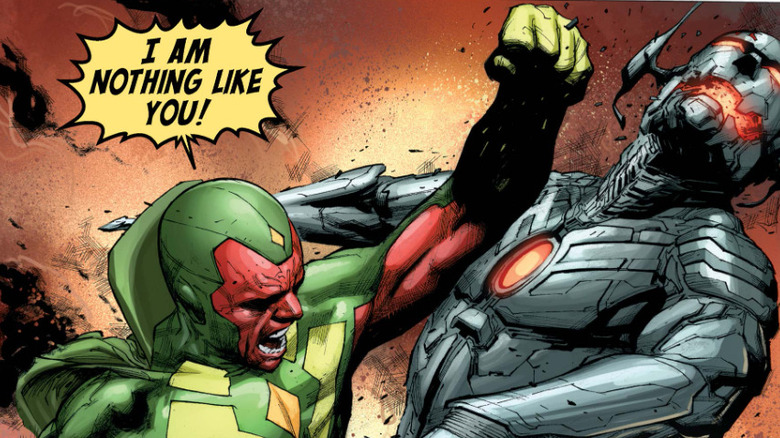
Ultron debuted only a few issues before Vision, in "Avengers" #54. Issue #57 saw Vision seemingly destroy his creator, while issue #58 revealed the Avenger Hank Pym/Ant-Man had created Ultron, leading to the robot rebelling and erasing his creator's memory. Roy Thomas told Yahoo, "I knew right away [Ultron] is a character you would bring back." So he did when, in "Avengers" #66, subliminal programming inside Vision makes him restore Ultron in a new adamantium body. As for Vision and the Scarlet Witch, Thomas told Syfy in 2022 that he paired them because Vision didn't have a solo title, so Thomas had sole control over Vision's story.
If Aarkus the Vision had become an Avenger, it's plausible he'd have filled a superficially similar role on the team. Perhaps he and Wanda would've even ended up together. But he'd lack the connection to Ultron, which would diminish the villain.
In a foreword to 2015's "Avengers: Rage of Ultron," former "Avengers" writer Kurt Busiek notes the Ultron-Vision thread running through "Avengers" is a family saga. The family theme also heightens the contradictions that make Ultron more than just a killer robot. He's literally inhuman, yet he behaves more like an angry and erratic child than a cold machine, closer to Frankenstein's Creature than Hal 9000.
This makes Thomas and John Buscema creating Vision, instead of resurrecting Aarkus, a lynchpin moment of entertainment history in the Marvel Cinematic Universe. Stan Lee, Thomas, and Buscema, when pumping out cheaply-printed "Avengers" comics in the 1960s and '70s, could've hardly predicted Vision would be a major character in the biggest blockbuster property ever. Nor that an entire TV series would rest on Vision and Wanda's romance, and then another on Vision and Ultron's antagonistic bond.