

The Best Ways For Star Trek Fans To Play Magic's New Set: A Guide For Beginner Players

When I sat down at my friendly local game store to participate in a pre-release drafting event for Magic: The Gathering's new "Star Trek" set, several players saw the Enterprise tattoo on my forearm and asked me the same question. If a longtime Magic player wanted to sample "Star Trek," what was the best place for them to start?
Ironically, I was there to ask the Mirror Universe version of that same question: If a longtime "Star Trek" fan wanted to sample the new Magic set, what's the best place for them to start?
I am new to Magic, having only picked up the game a few months ago to prime myself for the new "Trek" release. And one thing Magic and "Star Trek" have in common is that they're both absolutely daunting at first blush. One is a collectible card game with over 30 years of history and dozens of ways to play. The other is a sci-fi universe with nearly 1,000 episodes of television and 13 movies, with dozens of possible entry points.
I can answer one question immediately. "Trek" newbies should start with "Star Trek: Strange New Worlds," with its glossy production values and modern streaming sensibilities, before backtracking and sampling the various other shows and finding the one that connects with their tastes. (This is a sometimes controversial opinion, but I stick by it.)
But the other question involved some legwork, a lot of time spent at a gaming table, a great deal more time sorting through cards, and even a question proposed to the lead designers of the set itself. So, what is the best way for a "Star Trek" fan to sample the new Magic: The Gathering set? Here's what I learned.
Drafting and sealed events are the 'purest' form of Magic
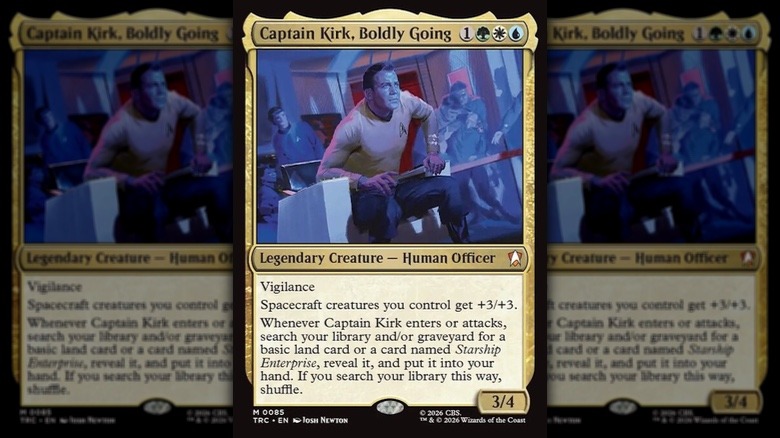
One thing I will not do here is explain the rules of Magic: The Gathering, which are intuitive and easy to learn, but challenging to master. There are countless online resources to learn before you try anything I recommend below. I'm writing this piece under the assumption you intend to seek those out on your own.
The best way to truly dive in headfirst is to visit your local gaming shop and participate in a sealed or drafting event. Naturally, this is dependent on your location and whether your local gaming shop is an inviting and safe space (shout out to Mothership Games in Austin, Texas for playing host to my first sealed event). If such a place exists for you, check the calendar and see what's on offer. The good news is that the "Star Trek" set is brand new and there should be plenty of opportunities.
At events like these, players are organized into one-on-one matches and construct their decks from scratch, tearing open booster packs, examine their cards, and trying to build the most effective strategy possible around a 40-card deck. While experienced players will have an edge, they can't bring finely honed and powerful decks from home to immediately wipe the floor with you. Everyone starts at square one. And "Star Trek" fans should take very easily to this format, since the characters you'd expect to be powerful tend to have cards that are powerful. It also leads to some amusing team-ups, like how my winning deck involved an unlikely alliance between Deanna Troi and Gul Dukat.
In a friendly shop with a friendly crowd, this is Magic at its purest: a direct, competitive game where tactics at the table are as important as the strategy behind your deck construction. And the mechanics in the "Trek" set are intuitive and mesh well, meaning that creating a deck that functions as needed is fairly straightforward, and going with your gut choices (i.e., building around characters you like) often leads to strong results.
But what if you want to play Magic's Star Trek set at home?
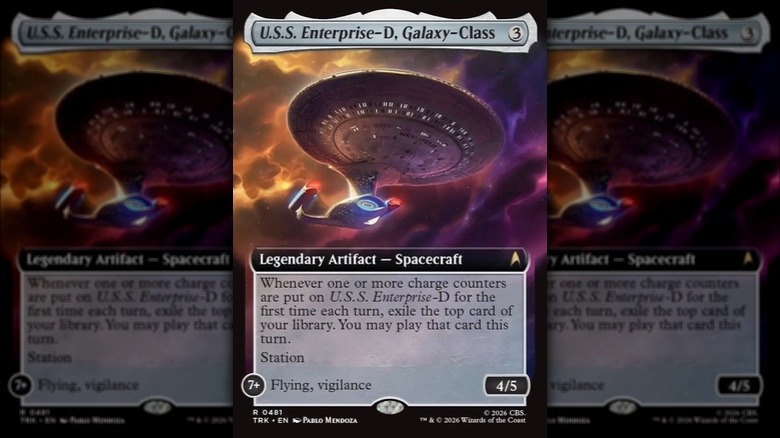
I can hear your next question: You don't have access to a local shop, or you don't feel comfortable going to one, so what's the best way to play at home? Once again, there are options.
You and a friend (or more) could always buy booster packs, tearing them open and building personal collections and constructing 60-card decks for standard play. However, I would recommend booster packs being the start of your collection, and once you have bought a few, track down single cards to complete your strategy rather than buying more and blindly hoping for strong pulls.
Another option is for you and a friend to buy a pre-release kit, as there are always plenty leftover after the initial week of special event. Use these to construct imperfect but fun starter decks to learn the game, and then grow and expand those decks as you see fit, doubling down on the characters and strategies you're enjoying.
However, the best at-home experience would be to pick up one of the set's Draft Night boxes, which are pricy but offer bang for your buck: enough cards for four friends to craft decks and go head-to-head for an evening, leaving everyone with enough cards to build upon in the future.
However, all of these options require tinkering, and suggest that you'll enjoy the process of building a deck as much as playing one. These options require additional legwork, additional financial investment, and even a bit of luck (although that can be mitigated by buying single cards from reputable online and brick-and-mortar shops). If you want to truly just dive into the game itself and skip the rest of the process, there is another way.
The designers behind Magic's Star Trek set have a suggested entry point
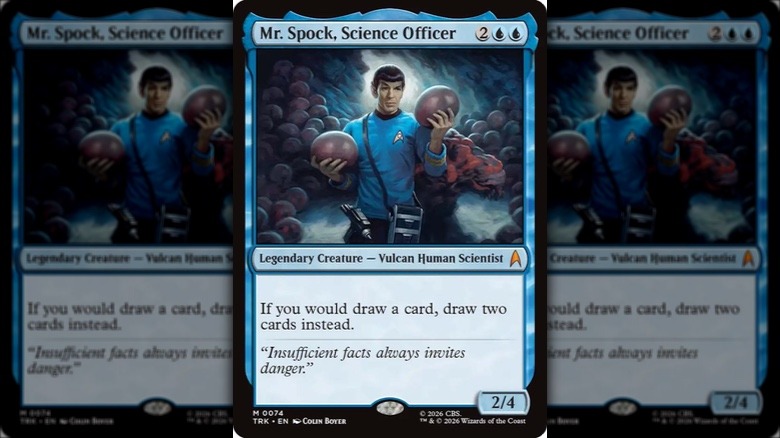
When I had a chance to speak to the key designers behind Magic: The Gathering's "Star Trek" set during a launch event in Los Angeles, I asked if the new set was friendly for "Star Trek" fans with no gaming experience, and if they had a recommendation on where to start.
First, they noted that the set was designed with new players in mind and puts narrative first. A card will generally behave like its counterpart in the "Star Trek" universe, so a fan knows that a Captain Kirk card will be a bit more headstrong and aggressive while Spock will allow for more wily, thoughtful strategy. This means a "Trek" fan should be able to grasp the new cards fairly quickly, using their existing knowledge as a crutch.
Second, they highlighted their recommendation for the best way to sample the game: the "Star Trek" commander decks.
Commander is the most popular format in Magic, where players utilize 100 card decks in four-player games that are slowly paced, socially driven, and generally take an entire evening to play. Think of them as more of a board game experience — or a nerd poker night — than a standard Magic set. Many Magic sets are accompanied by a few pre-constructed commander decks, which players can purchase, open, and play immediately without any prep. The "Star Trek" set has four of them: Federation Fleet, We Are the Borg, Klingon Fury, and Landing Party.
Specifically, the designers recommended the Federation Fleet commander deck as their choice for a "Star Trek" fan hoping to play the game.
I sampled Magic's Star Trek commander decks, and here's what I found
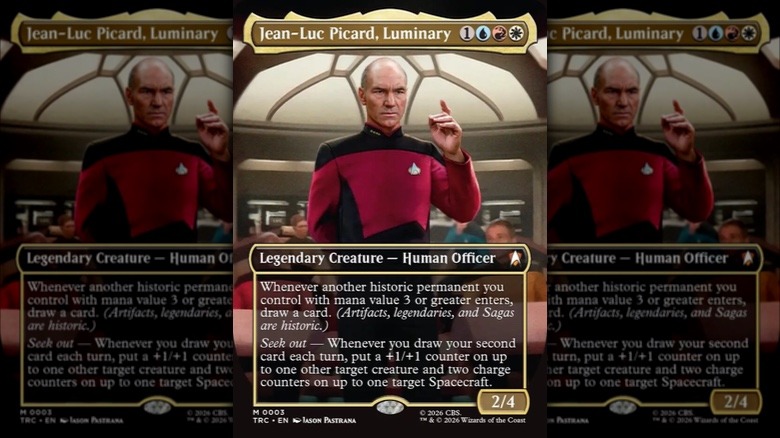
Naturally, the next step was to test the designers' suggestion. I rounded up three friends and assigned them each a different Star Trek commander deck, taking Federation Fleet for myself. It's easy to see why this one was recommended: With Picard on the cover and a deck full of '90s "Trek" staples, it's the most popular era of the franchise in one 100-card deck.
Our four-player game took over three hours, and frankly, it was some of the best Magic I've ever played, with all four decks interacting in surprising and wild ways that left everyone at the table screaming and laughing. The "Trek" fans were impressed by the thematic touches, and how the mechanics relate to character personalities and motives, while the Magic players simply relished in the new design elements. I squeaked out a win, but only after the Borg player staged a comeback that essentially wiped out the table. My victory told a story in of itself: Dr. Bashir threw himself at the Borg player, perishing, but in the process, activated his ability to resurrect Ro Laren from the dead, activating her ability and ending the Borg threat once and for all.
After seeing the commander decks in action, I'm inclined to agree with the designers' recommendation. The Borg deck is scary and powerful, but makes them an immediate threat the other players will team up against to defeat. The Klingon deck is pure aggression, which may work against a new player's inherent shyness. The Landing Part deck, with its focus on Original Series characters, is fairly straightforward, but has a lot of moving pieces to consider. The mechanical simplicity of the Federation Fleet deck, and its arsenal of beloved characters, makes it easy to grasp and understand quickly.
Much like with "Star Trek" itself, there are countless ways to get into Magic: The Gathering, and no incorrect way. Ultimately, I agree with the designers: the pre-constructed commander decks, and specifically the Federation Fleet deck, are the best point of entry. Ideally, you'd buy all four and learn with friends for the best possible experience.
But like with "Star Trek" itself, you should be warned: once Magic has sucked you in, be prepared to be sucked in for the long haul.