

The Hunger Games: Sunrise On The Reaping Review: Haymitch's Prequel Delivers

Suzanne Collins, the woman behind the young adult dystopian phenomenon known as the Hunger Games franchise, seems like she's pretty calculated with her prequels. I mean this as a good thing. Instead of pumping out endless content and prequels that don't really serve the original narrative (ahem, the apparently permanently unfinished Fantastic Beasts franchise), Collins sticks to stories that help us understand key characters and stories from the first three novels ("The Hunger Games" and its sequels "Catching Fire" and "Mockingjay").
This was true of the 2023 big-screen prequel "The Hunger Games: The Ballad of Songbirds and Snakes," which casts Tom Blyth as future Panem president Coriolanus Snow and explains how and why he grew into the villain faced by Jennifer Lawrence's Katniss in the original films (where he's played by Donald Sutherland). This is, thankfully, also true of the Haymitch Abernathy prequel "The Hunger Games: Sunrise on the Reaping," based on the 2025 novel "Sunrise on the Reaping."
Haymitch — a role originated by Woody Harrelson and played spectacularly by "We Were Liars" and "East of Eden" alum Joseph Zada in this new film — is sixteen during the Second Quarter Quell, a sort of demented "special edition" of the titular Games that take place every 25 years. For the 50th Games, the all-powerful Capitol in charge of Panem reaps double the number of tributes from each of the totalitarian nation's 12 districts, meaning that 48 kids will enter the arena and only one will survive. Frankly, this premise is immediately intriguing, but director Francis Lawrence and screenwriters Billy Ray and Michael Lesslie ensure that, beyond the shock value, this story remains human, emotional, and gripping from beginning to end. Much of that is also thanks to Zada, who delivers an unforgettable performance.
Sunrise on the Reaping succeeds partly on the strength of two of its lead performers

Playing an established franchise character — especially one originated by an incredibly famous and acclaimed actor — must be a tough undertaking, and I'll get back to the highlights and lowlights of that exact situation before long. First, though, I want to soundly and unrestrainedly praise Joseph Zada, an actor with a massive responsibility in this film. Without a good Haymitch, "Sunrise on the Reaping" fails.
Thankfully, Zada is more than up to the task, and the movie's extremely speedy — but not overly so — pacing means that he has to go through a massive emotional journey in a relatively short amount of time. Zada sells every second as Haymitch, whether he's promising his District 12 girlfriend Lenore Dove Baird (Whitney Peak) that he'll see her after the reaping to breaking down crying just before he enters an arena filled with, presumably, 47 kids who hope to kill him.
Zada is great, but much like Haymitch, he doesn't do it alone. Because, again, "Sunrise on the Reaping" moves at such a quick clip — to be fair, it packs 400 pages into about 2 hours and 40 minutes — he's the character we bond with the most, and the character Haymitch himself bonds with the most is arguably Maysilee Donner, his fellow District 12 tribute played by Mckenna Grace. Despite being enemies back home, where Maysilee is a sort of petty schoolyard bully, the two become unlikely allies who end up making it to the end of the Games together, and Grace brings a steeliness to her role that eventually falls away to reveal an understandably scared young girl. It certainly helps that Francis Lawrence and his team built an astounding world for his performers.
The world-building in The Hunger Games: Sunrise on the Reaping is exceptional
Joseph Zada and Mckenna Grace, the standouts among the tributes — with respect to Ben Wang, Molly McCann, and Iona Bell, the first of whom plays District 12 tribute Wyatt Callow and the rest of whom play Louella and "Lou Lou" McCoy, they, uh, aren't in the movie as much for reasons you can probably ascertain — deliver exceptional performances, but respect must be paid to Francis Lawrence's overall vision and the stunning world-building that he and his creative team deliver in "Sunrise on the Reaping."
When I spoke to Lawrence about the film and other dystopian teen movies he's directed (or is set to direct), he said, "I think the dystopian aspect of these worlds, a lot of it, for me, is about the world-building." This love of the game is evident, because "Sunrise on the Reaping" looks and feels phenomenal.
If you're familiar with the Hunger Games franchise, you know that we've gotten to see two very different eras of Panem, which come with understandably different technical developments. In "The Ballad of Songbirds and Snakes," everything is relatively primitive; beginning in "The Hunger Games," the tech is much more advanced after several decades. "Sunrise on the Reaping" falling pretty squarely in the middle here is particularly cool because of the small details of the world; one such example that I really appreciated is the tributes being lifted into the arena on small platforms as opposed to the tubes we see Katniss and other tributes enter years later. Without spoilers, the technical logistics of the arena play an outsized role in "Sunrise on the Reaping," and the world feels rich, full, and disturbingly real in the best way.
Huge actors play familiar Hunger Games characters in this prequel, with mixed results

"The Hunger Games: Sunrise on the Reaping" is chock-a-block full of characters you'll remember from previous installments like "The Hunger Games: Catching Fire" and both parts of "The Hunger Games: Mockingjay," and the results are ... a bit mixed. (It was confirmed, long before the film's release, that Jennifer Lawrence and Josh Hutcherson would reprise their roles as Katniss Everdeen and Peeta Mellark; how exactly that transpires will remain a secret until you sit down and see the movie.) I'm going to mention the breakneck pacing again here, and it's not a bad thing, but it does mean that a lot of characters are introduced and summarily disappear; this is also true of Billy Porter's larger-than-life Capitol stylist Magno Stift, though his legal wife and nemesis Drusilla Sickle, a plastic surgery nightmare gamely played by a vamping Glenn Close, gets much more play.
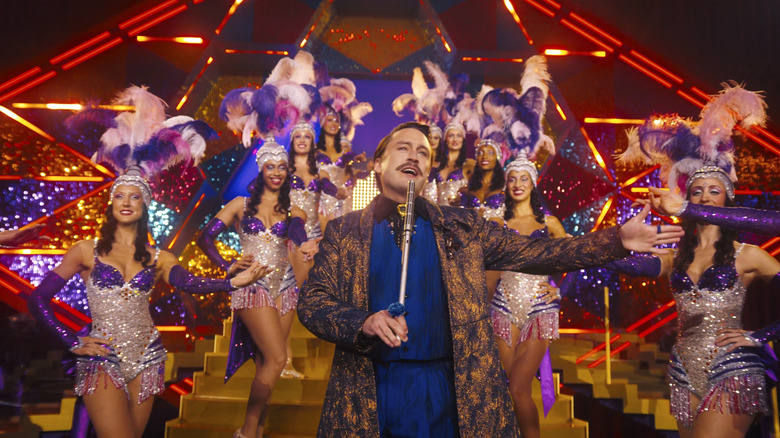
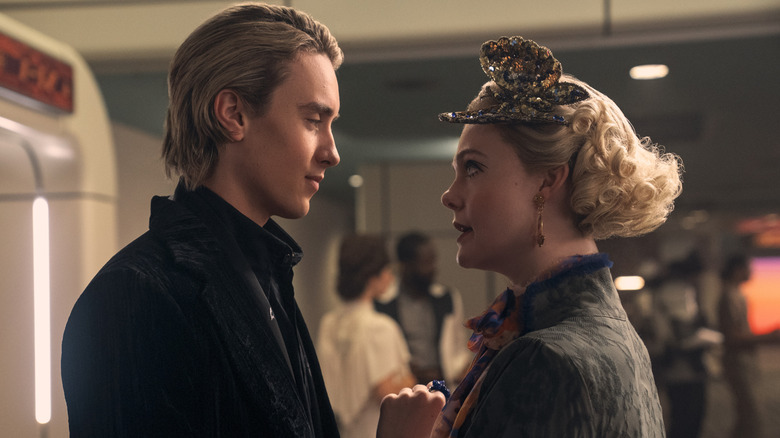
I wish we'd seen more of Elle Fanning's take on Effie Trinket, a character originally played by Elizabeth Banks, but she's reliably great in her scenes; Kieran Culkin plays a pre-Stanley Tucci version of Caesar Flickerman and is bombastic, over-the-top, and undeniably sharp and dynamic. Jesse Plemons does great work, as always, stepping into Philip Seymour Hoffman's shoes as the taciturn turncoat Plutarch Heavensbee, echoing Hoffman's performance while making it his own.
The best and worst performers behind recurring characters, though, are Ralph Fiennes and Kelvin Harrison Jr. Fiennes manages to bridge the gap between Tom Blyth and Donald Sutherland as Panem's president Coriolanus Snow, but Harrison Jr. is, I am sorry to say, doing a sort of "Saturday Night Live" impression of his predecessor Jeffrey Wright. I appreciate the ask here is big, but sadly, not every actor rises fully to the challenge.
If Sunrise on the Reaping falters, it's because the story requires so much exposition
If I have one big "nit to pick" in "The Hunger Games: Sunrise on the Reaping," it's a problem that affects a lot of adaptations: it over-explains a lot. Because the book is told from Haymitch's point of view, we learn a lot as he infers and gleans; the movie has to painstakingly say all of that. Still, it's a minor quibble.
Before the release of "Sunrise on the Reaping," I saw and heard chatter, anecdotally, that this movie would surpass "The Hunger Games: Catching Fire" in sheer quality. Respectfully, I have to disagree. Not only is "Catching Fire" the best Hunger Games movie by a long shot and just a really great and well-made movie in its own right — Francis Lawrence, thank you again for that incredible aspect ratio change as we enter the arena, and thanks to your cinematographer Jo Willems as well — but "Catching Fire" doesn't have to explain its narrative as intensely as "Sunrise on the Reaping" does. Still, this is simply a quirk of adaptation, and "Catching Fire" being able to narratively coast off of its predecessor is an unfair advantage.
"Sunrise on the Reaping" might not beat "Catching Fire," but it is a truly excellent addition to the Hunger Games film franchise — and it's one of the most thrilling action movies of the year. As this universe continues to expand (that is, if Suzanne Collins decides to write future books), if we keep Lawrence at the helm and keep casting top-notch actors, Hunger Games fans will remain in excellent hands.
/Film Rating: 8 out of 10
"The Hunger Games: Sunrise on the Reaping" opens in theaters on November 20, 2026.