

DC's Clayface Took An Important Cue From A Classic James Cameron Movie [Exclusive]

"Clayface," the new film from DC Studios, fully embraces the body horror elements promised by its titular character. Originally introduced in June 1940 in the pages of Detective Comics, the original Clayface was merely a B-movie actor who turned to crime, and only nominally changed his identity to do so. In the 1950s, a new version of Clayface named Matthew Hagen was introduced who gained shapeshifting powers upon being exposed to radioactive material. Other characters followed who donned the moniker of Clayface, and though many had different names, they all possessed some manner of shapeshifting ability, which got increasingly goopy in its depiction.
As such, the Clayface of this month's live-action film version, named Matt Hagen and played by Tom Rhys Harries, has been created in a classic horror mold. The film's visual and makeup effects deliberately recall the classic body horror movies of the 1980s, namely "The Thing" and "The Fly." When I had the chance to speak with the movie's director, James Watkins, and ask him about creating these effects, I expected him to namecheck those movies, along with '80s makeup legends like Rick Baker, Rob Bottin, and others.
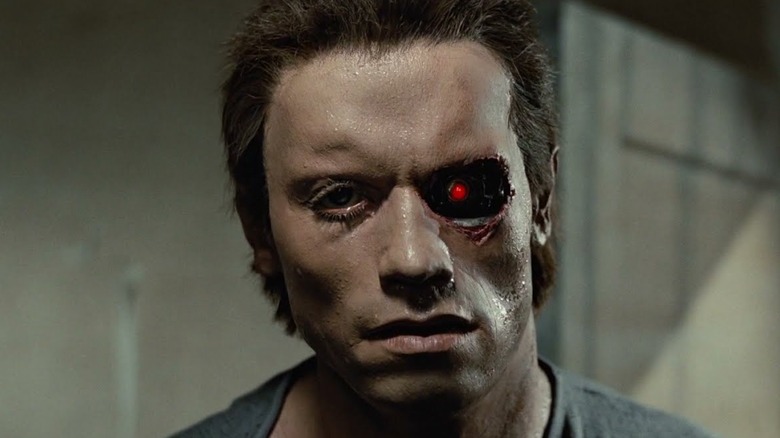
Surprisingly, while Watkins did obliquely shout out the legendary Stan Winston, it wasn't a pure body horror film of Winston's he was referencing. Instead, one of Watkins' main inspirations for the makeup effects in "Clayface" was James Cameron's "The Terminator." It's a movie that may not come immediately to mind while watching "Clayface," but its influence is there, especially in one grisly setpiece.
The effects in Clayface, like in The Terminator, are as much about implying as showing
I asked Watkins about how he calibrated the tone of the body horror effects in "Clayface," for while much can be done in comic books and animation, it takes on a new flavor when gory stuff is happening to real live humans. Apparently, Watkins and his crew didn't censor themselves too much:
"We didn't pull back a lot, but...I'm sure there's stuff on the cutting floor where we kind of go, 'Okay, we could show more.' But sometimes showing more isn't always [right]."
He then explained how James Cameron's work on "The Terminator" directly helped influence one of the most effective moments in "Clayface." It's all to do with the classic technique of letting the audience fill in the grisly blanks:
"There's a scene on an airplane in the bathroom, it's obviously the eye surgery scene. And actually I was very inspired by James Cameron with 'Terminator.' And if you see that scene when he cuts his eye or cuts his arm or any of that stuff, you do see some gnarly stuff, but also [the effect is] in the cutaways, the drops of blood in the sink, all that sort of stuff. So sometimes by implying more, actually you're not quite seeing as much as you think you see. I mean, I know we do show a lot, but at the same time, you want to leave people's imagination as well to help, to join in."
In the same way the low-tech magic of "The Terminator" helps it feel realistic, the "Clayface" scene becomes more effective in what is it you don't see. Essentially, Watkins handled the effects the way Clayface himself might, by disguising them effectively.
"Clayface" is in theaters now.