

Project Hail Mary's Emotional Goodbye Scene Was Inspired By Rocky's Mysterious Markings [Exclusive]
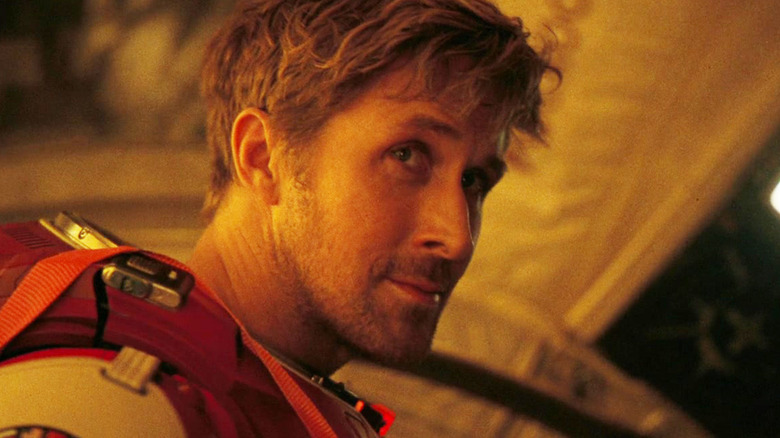
"Project Hail Mary" is full of hidden details and many of them go beyond mere Easter eggs. When it came time for Ryan Gosling's Ryland Grace to say goodbye to his alien friend Rocky, for instance, the latter bids him farewell by running one of his arms along his other arm to create a unique sound. Not only was that improvised on the day, it made use of Rocky's physical design in a way that the designers themselves never even intended.
Neil DeGrasse Tyson actually liked "Project Hail Mary," which is quite an accomplishment for directors Phil Lord and Chris Miller. The astrophysicist famously calls out movies for failing to get the science right, so when a sci-fi movie actually avoids his wrath, it's notable. But "Project Hail Mary" wasn't just sedulously-researched scientific accuracy. In fact, the film's selling point is that it somehow melded hard sci-fi with deeply affecting emotional moments to create a kind of live-action Pixar movie that would also hold up under scientific scrutiny.
One of the most memorable examples of the emotion in "Project Hail Mary" comes when Grace and Rocky have accomplished their mission to find a way of eliminating the light-eating microbe that threatens their home worlds. The two then say goodbye before departing on their respective ships, and it was at this moment that Lord and Miller devised an ingenious way to use Rocky's physiognomy to play up the emotion.
Rocky's design changed just prior to filming Project Hail Mary
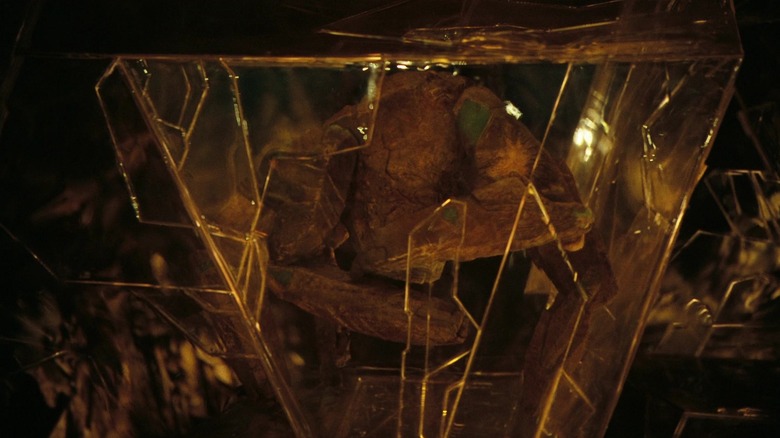
"Project Hail Mary" was a box office success, so clearly its mix of hard sci-fi and heartfelt drama was a winning formula. Rocky's goodbye to Ryland Grace encapsulates that very combination of practicality and heart.
The scene sees the pair saying their farewells in the Xenonite tunnel connecting their two ships. "How do you say goodbye back home?" asks Grace. "We don't," replies Rocky. "We do this." He then runs one arm along a ridged section of his other arm to create a sound that, on his home planet Erid, evidently conveys a farewells sentiment.
Rocky was controlled and voiced by actor and puppeteer James Ortiz, who spoke to /Film's Ben Pearson about Rocky's design. The craboid alien is covered in mysterious markings and tattoos (several of which aren't explained in the movie), and Ortiz explained how his goodbye gesture was directly inspired by those markings. "They had been designing Rocky for about a year before I was cast," he said. "So when I showed up, we had just landed on this silhouette, and I had about an eight-week rehearsal period." About half-way through this eight-week period, Ortiz was informed that Rocky's design had been updated. "They were like, 'We're adding tattoos,'" he recalled. "And I went, 'What?' So they showed it to us and it was really interesting."
The puppeteer went on to explain how many of the tattoos didn't have a specific meaning, allowing him and the crew to conceive of their own interpretations. Referring to the ridged section of Rocky's arm, Ortiz said, "It's almost like a Mexican güiro, that instrument, the gourd that you run the thing against. And we hadn't found a use for it." The farewell scene provided them with just that.
Rocky's goodbye highlights why Project Hail Mary was so successful
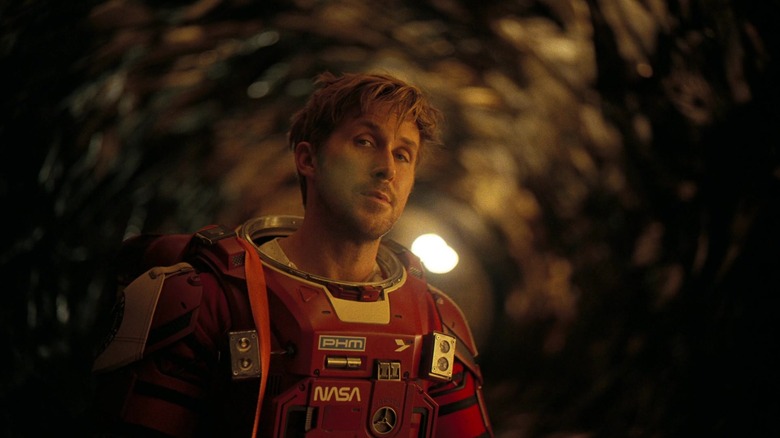
Ryland Grace and Rocky are reunited on Erid by the end of "Project Hail Mary." But earlier in the film, they believe they're saying goodbye for good. James Ortiz recalled shooting that scene as "really very tearful," and explained how he, Ryan Gosling, Phil Lord, and Chris Miller were improvising throughout. This led to Gosling saying the line, "So how do you guys say goodbye?" Ortiz continued:
"I just said, 'We don't.' Which of course, as an improv partner is not the best [tactic]. That is not a 'yes, and...", that's a 'no.' The scene was really beautiful and we were both very teary and it was working, but he was like, 'What do we do? How do I get out of this?' And Phil and Chris in an earpiece in my ear said, 'Use [the arm movement], that's your goodbye.' And he went, 'That's a great idea.'"
Ortiz went on to recount how, after the directors' suggestion, he and the other puppeteers made a slight adjustment to bend their control rod in order to perform the movement before going straight into shooting Rocky's goodbye. "That was just being inspired," he continued. "Great design should be inspiring to other artists, and that's exactly what it was in that case."
Ortiz also praised Lord and Miller for packing their film with visual information that isn't necessarily critical to the story but which provides more information about the world beyond the frame. "It's a movie that really rewards a re-watch," he said. Adding that sort of visual decoration is one thing, but using it to create one of the most emotionally impactful scenes of the film is one reason why "Project Hail Mary" is one of the best films of 2026.