

Leif Erickson Was In This Forgotten '50s Western Starring A Rarely Discussed Silver Screen Legend
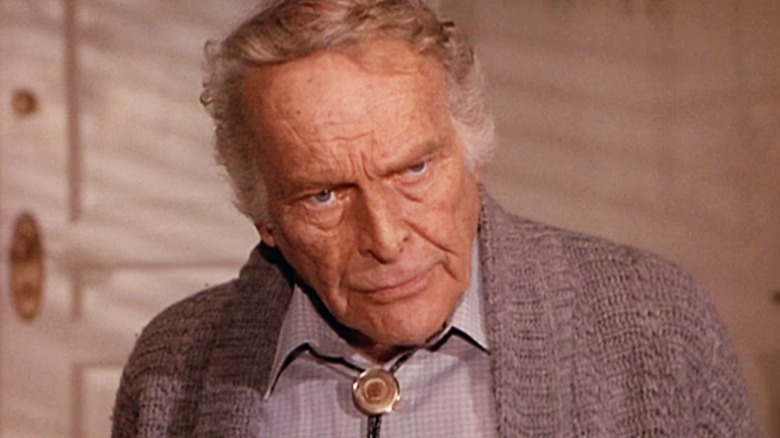
Though Leif Erickson is best known for his Western series "The High Chaparral," he had a successful and prolific movie career, too. The actor started out in the 1930s, debuting in "Wanderer of the Wasteland" in 1935 before appearing in multiple Oaters at a time when the genre's popularity was beginning to wane. That would, of course, change with the arrival of John Ford's 1939 classic "Stagecoach," which made John Wayne a star and revitalized the flailing Western.
Meanwhile, Erickson had established a nice little film career for himself, working with the likes of Greta Garbo on 1937's "Conquest" and Bob Hope on 1941's "Nothing But the Truth." In the late '40s, Erickson also appeared alongside Ingrid Bergman in Victor Fleming's historical drama "Joan of Arc." Clearly, then, had he never played Big John Cannon on "The High Chaparral," Erickson would still have been able to say he did pretty well for himself in Hollywood. That was no different in the 1950s, when he appeared opposite yet another screen legend, who for some reason isn't quite as well remembered as some of Erickson's other co-stars.
Glenn Ford was a Western veteran by the time he made 1956's "The Fastest Gun Alive." His first adventure in the Old West came via 1941's "Texas," in which he starred alongside George Marshall, William Holden, and Claire Trevor. It was the beginning of a lifelong association between Ford and the Western, which yielded some undeniable classics, including 1957's "3:10 to Yuma." A year prior to that, however, "The Fastest Gun Alive" had become arguably his best Western yet. Very much playing on Ford's reputation as being "the fastest gun in Hollywood," the movie saw him portray an unassuming man who's forced into a gunfight. Thankfully, he had Erickson to back him up.
Glenn Ford played a reluctant gunfighter in The Fastest Gun Alive
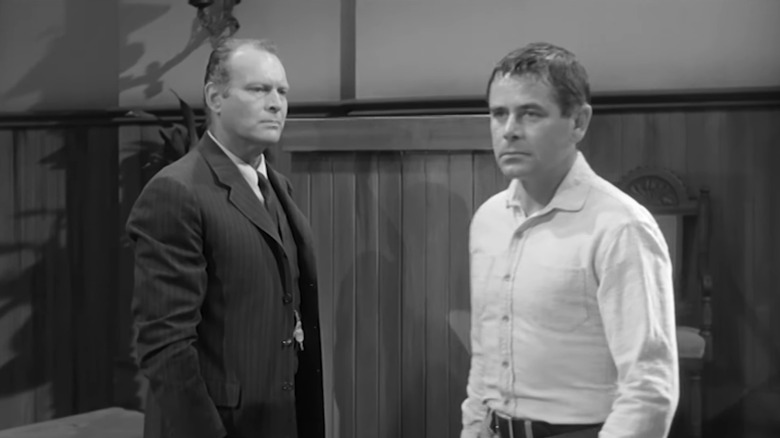
Like any actor working in the mid-20th Century, Leif Erickson notched up a fair few guest spots on classic Western TV series before going on to front one of his own. But he also had plenty of silver screen Old West adventures. "The Fastest Gun Alive" was one of the most notable examples, not only because it starred one of the biggest box office draws of the era in Glenn Ford, but because it was shot relatively quickly yet became a hit.
Directed by Russell Rouse, the movie follows Ford's George Kelby Jr., who's handy with a firearm but, since he learned all he knows from his sheriff father, hasn't actually ever been in a gunfight. Kelby certainly isn't looking for any shootouts, and along with his wife Dora (Jeanne Crain) moves to the town of Cross Creek to open a shop under a new identity. As George Temple, he runs the town general store and seems to have found the life of quietude he sought.
Every now and then, unbeknownst to his wife, Kelby sneaks away to practice his aim. Turns out, he needs the practice. It seems gunman Vinnie Harold (Broderick Crawford) has shot down Clint Fallon (Walter Coy), a man who was supposedly the fastest draw in the west. After Kelby drunkenly reveals his own gunplay skills to the townspeople, word gets back to Harold and he and his clan arrive in town to challenge Kelby to a duel. But having never drawn his gun on a man, Kelby is reluctant to say the least. Erickson plays Cross Creek resident and town leader Lou Glover, who sticks by Kelby throughout and even tries to take on Harold himself before Kelby intervenes.
Leif Erickson and Glenn Ford remain underrated today
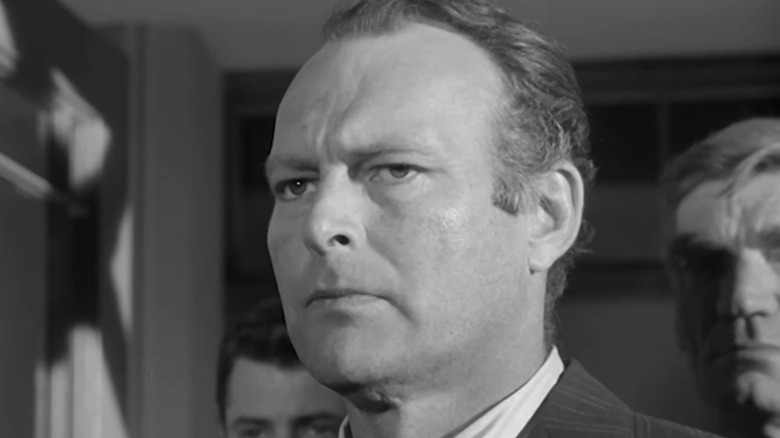
"The Fastest Gun Alive" was co-written by Frank D. Gilroy, who like Leif Erickson had a lot of experience on TV Westerns. In fact, he had written for some of the best Western TV shows ever made, including "Have Gun – Will Travel," "The Rifleman," and Steve McQueen's legendary Western series Wanted: Dead or Alive." "The Fastest Gun Alive" was his first screenplay, which he wrote with director Russell Rouse. It turned out to be a box office success, earning a positive review from Bosley Crowther of the New York Times in the process. The critic called the film "engrossing" and even mentioned Leif Erickson as one of several supporting actors who "weigh in with competent performances."
Soon after, Erickson starred in the 1956 drama "Tea and Sympathy" before appearing in the 1957 film noir "Istanbul." It would be another ten years before he debuted as Big John Cannon in "The High Chaparral." The show began airing in 1967, at which point Ford was still making Westerns, including "A Time for Killing" and "The Last Challenge," both of which also debuted in '67. After that, he appeared in many TV movies, though he did have a notable role as Jonathan Kent in 1978's "Superman."
For whatever reason, Ford didn't ever attain the kind of mythic status of other Western legends of his era. The Los Angeles Times described him as "an anti-star to the end," noting how he was never nominated for, let alone won an Oscar, and "never earned the big bucks that stars of his stature enjoyed." Even still, the actor was an undeniable box office draw in his heyday and remains just as esteemed as any of the other stars with which Erickson worked during his equally impressive career.