

Wild Horse Nine Review: John Malkovich And Sam Rockwell Are A Great Duo In Martin McDonagh's Subversive Modern Western
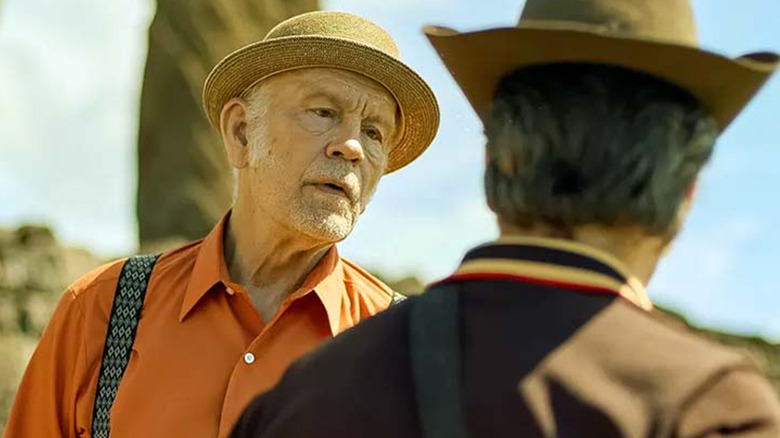
At this point in his 30-year career, playwright and filmmaker Martin McDonagh's auteurist tics are fairly well known. The British-born Irishman has become famous (if not infamous) for making copious use of fowl language and grisly violence on stage as well as on-screen, giving each sordid element a burly artfulness that's as much James Joyce as it is Quentin Tarantino. With the notable exceptions of the play "The Beauty Queen of Leenane" and the film "Three Billboards Outside Ebbing, Missouri," McDonagh's work typically features male protagonists navigating various stages of their interpersonal relationships. HIs most successful films in this vein, "In Bruges" and "The Banshees of Inisherin," not so coincidentally star the Irish actors Colin Farrell and Brendan Gleeson, both of whom take to McDonagh's verbose, pugilistic dialogue like ducks to water. The movies are a perfect marriage of filmmaker and stars, something that McDonagh hasn't quite cracked as well yet with American leads. "Seven Psychopaths," for instance, was an unfortunate casualty of the filmmaker's European sensibilities coming off too arch in American hands.
It turns out that the key to McDonagh making his American Western masterpiece was to simply transplant the actors/characters to a foreign location. His latest film, "Wild Horse Nine," follows CIA officers Chris (John Malkovich) and Lee (Sam Rockwell) as they embark to Rapa Nui (aka Easter Island) on one final mission. In a similar fashion to how the director juxtaposed the natural beauty of Ireland with the bitter bleakness of "Inisherin," McDonagh and cinematographer Ben Davis capture the beauty of the island as an ironic, bittersweet backdrop to what is essentially McDonagh's riff on sunset Westerns such as Clint Eastwood's "Unforgiven." "Wild Horse Nine" is a wonderfully written, beautifully performed elegy of a film, and is McDonagh's most emotional and incisive work to date.
John Malkovich and Sam Rockwell make a superlative McDonagh duo
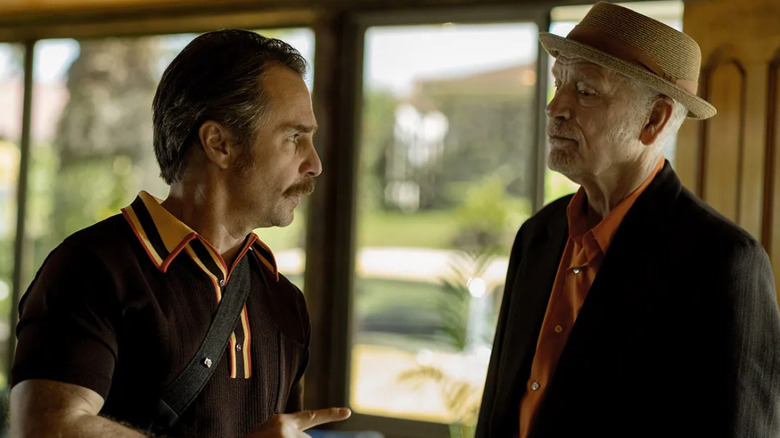
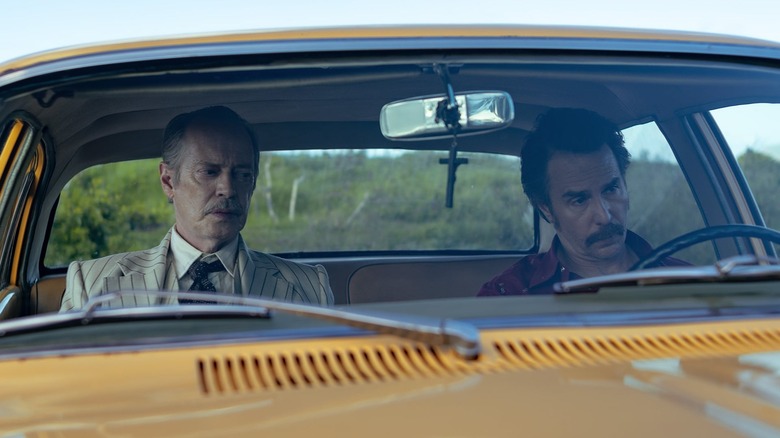
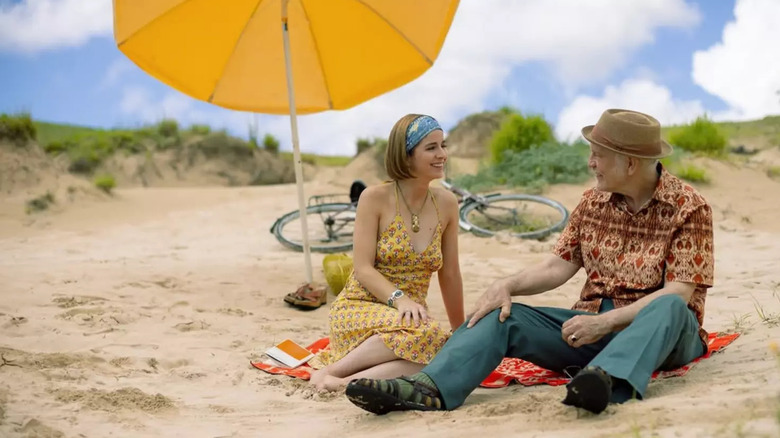
Simply put, "Wild Horse Nine" wouldn't work without the team of John Malkovich and Sam Rockwell. The film opens in Chile months before the coup d'etat of 1973, in which socialist president Salvador Allende was overthrown by the military. Malkovich's Chris, whom both Rockwell's Lee and CIA bureau chief MJ (Steve Buscemi) refer to as "big mouth," openly crows about the CIA's involvement in the upcoming coup to anyone, including a pair of liberal college students, Monica (Mariana di Girolamo) and Alicia (Ailín Salas). Initially, it seems as though Chris and Lee are being sent to Easter Island as a direct result of Chris' loose lips, with the implication that if Chris continues to act in this manner, he won't be going home.
However, Martin McDonagh begins peeling away layers to the characters and the story subtly but firmly, revealing that Chris may be all too aware of his fate for an entirely different reason. Malkovich is in lockstep with his director, presenting Chris initially as an obnoxious "ugly American" abroad only to gradually uncover the sympathetic tragedy of the man, his plight, and his past, which may or may not have included the assassination of John F. Kennedy. Where "The Banshees of Inisherin" looked into mysteries of the heart through its central duo's relationship, "Wild Horse Nine" tackles the mysteries of the soul.
Malkovich and Rockwell make for a superlative McDonagh duo, giving Colin Farrell and Brendan Gleeson a run for their money. To be sure, the rest of the cast are pretty fabulous, including Buscemi, di Girolamo, and Parker Posey as Lee's unscrupulous wife. Yet it's Malkovich and Rockwell's flitting between brotherly bickering and heartfelt tenderness that makes the film sing.
Wild Horse Nine is a brave and unique indictment of America and the CIA
For the most part, "Wild Horse Nine" feels like a more mature film when compared to McDonagh's first few features. There are flashes of the old provocateur throughout: a slur here, a problematic cuss word there. Yet where the younger McDonagh could've been accused of being edgy and cheeky, the McDonagh of this film feels mellowed out in that respect. Instead, the filmmaker has reserved his surliness for the movie's social and political commentary, which is the richest of his career. Unlike the abrasive nature of "Three Billboards," the indictment of the American government in "Wild Horse Nine" is a slow poison, a last-minute lament of the country's misdeeds by a character who was highly instrumental within them. It's a very "Catholic guilt" approach to the material, and McDonagh making Chris a Catholic allows the film to be movingly spiritual while indulging in bleak bitterness and dark comedy.
"Wild Horse Nine" seems to posit the actions of the CIA during the 1960s and '70s as betrayals that broke the country and the world, and maybe even assassinated it. It's a movie that's as angry as Paul Greengrass' "The Uprising," even though it's less incendiary. Yet as much as the film feels like the work of a more grown-up and sober artist, there's still some McDonagh cheek included. The movie seems to be winking at the films of Martin Scorsese, John Ford, and Clint Eastwood, but also, unsurprisingly, Quentin Tarantino. "Wild Horse Nine" co-opts The Rolling Stones' "Out of Time," a song used so memorably in Tarantino's "Once Upon a Time...in Hollywood," and nearly steals it.
Wild Horse Nine is a chamber piece first, genre film second
True to Martin McDonagh's roots as a playwright, "Wild Horse Nine" is a film that is primarily a chamber piece featuring a small ensemble of characters. This means that the movie is dialogue heavy, it isn't built around setpieces or action beats, and its plot is unraveled more through character than anything else. As with any film that has a more theatrical presentation, "Wild Horse Nine" asks for patience, especially when it comes to John Malkovich's performance, which can feel genuinely off-putting in the movie's early scenes. The film also contains many potentially alienating spy movie hallmarks — characters engaging in doublespeak, having ambiguous motivations, etc. — without the payoff of spectacle. It's similar to the recent "Black Bag" in that way. Ironically, as faithful as McDonagh is to the spy drama, he also makes the film a slyly subversive Western. Yet McDonagh ultimately isn't betraying the genre traditions he's playing with. He's just cleverly folding them into, well, a Martin McDonagh movie.
There are folks who'll still consider "In Bruges" or "The Banshees of Inisherin" to be McDonagh's masterpiece, and those films are indeed fantastic. "Banshees" in particular feels like the quintessential Martin McDonagh movie, the one I'd show to someone unfamiliar with his work. Yet I can't get over how much "Wild Horse Nine" feels like a culmination. Perhaps McDonagh's the rare artist who miraculously keeps finding ways of topping himself. More likely, the wry melancholy and moral ambiguity of "Wild Horse Nine" appeals so directly to my sensibilities that, for my money, it will stand as the filmmaker's towering achievement.
/Film Rating: 9 out of 10
"Wild Horse Nine" opens in theaters on November 6, 2026.