

40 Years Ago Today: A Genre-Defining Neo-Noir Mystery Movie Changed Hollywood Forever
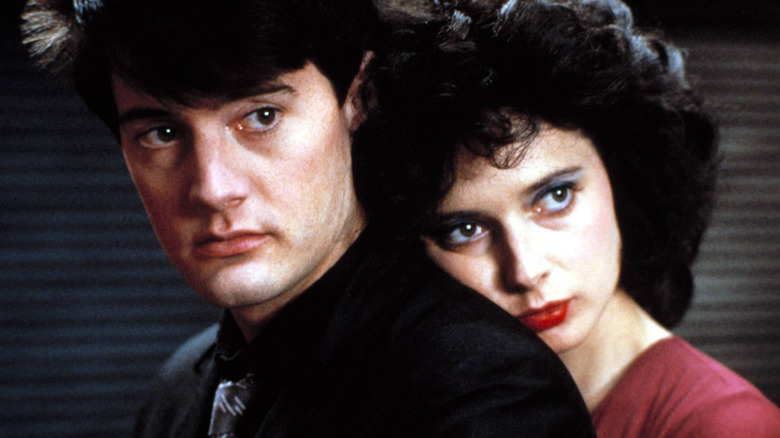
Film noir, like all great narrative genres, is a malleable one, yet it most often straddles the line between mystery and horror. From the former, it takes the structure of a character or characters solving a puzzle, usually a crime. From the latter, it borrows the transgressive nature of human behavior, of people's flaws, dark secrets, and misdeeds. When put together, noir fiction uses the seductive lure of the procedural to take its protagonists (and its audience) into the seedy underbelly of the city, modern life, and/or the soul. In this way, noir stories work in a fashion close to fantasy: the real world falls away, replaced by a foreign and ominous space that must be either vanquished or contended with.
Although numerous works of cinematic noir elicit and explore these themes, one film feels like a perfect encapsulation of them: "Blue Velvet," written and directed by David Lynch. When the movie was released in theaters 40 years ago today, it seemed unassuming on the surface. After all, the 1970s and '80s saw a rise in neo-noir films, the movie didn't feature any huge new stars, and the biggest names going for it prior to release were Lynch and Dennis Hopper, both of whom were perceived as unsuccessful due to Hopper taking odd jobs like "My Science Project" and "The Texas Chainsaw Massacre 2" and Lynch being stuck with the debacle of 1984's "Dune." "Blue Velvet" didn't just turn around the fortunes of those men, however. It also kickstarted the careers of Kyle MacLachlan, Laura Dern, and Isabella Rossellini. Moreover, the film was such a brazen, brilliant work of satire and surrealism in addition to neo-noir that it became a massive influence on cinema in general, thus changing Hollywood forever.
Blue Velvet woke Hollywood up with its skewed look back at the '50s
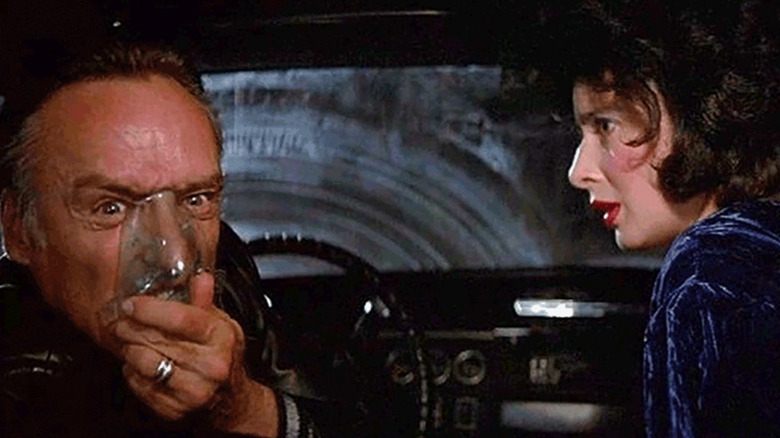
In contrast to the depressed, bleak view of America that was popular in Hollywood cinema during most of the 1970s, the pop culture of the 1980s was generally more optimistic. That doesn't mean it was uncritical. In fact, now that the Baby Boomers were the primary adult generation working in Hollywood, much of their work saw them take a satiric, skewed look back at their childhoods during the 1950s, as seen in films from "Back to the Future" to remakes of '50s genre fare like "The Thing," "The Fly," and "The Blob." "Blue Velvet" is set in contemporary times, yet so many of its pop cultural touchstones come from the '50s, from the titular Bobby Vinton song on down. It's David Lynch evoking the era as a shorthand for supposed small town American wholesomeness and safety, only to have the scales of that certainty fall from our eyes along with Jeffrey Beaumont (Kyle MacLachlan).
Lynch's ability to deliver images and sounds that evoke deep, resonant feelings is at its height in the film. The director was inspired by emotions and images remembered from his childhood, making the movie not just a thematic coming of age story, but a passionately emotional one, too. The dark corners of "Blue Velvet" aren't discovered by a mature, seen-it-all city detective, but by a wide-eyed college boy who doesn't understand the real darkness out in the world (as well as within himself) before he's enveloped by it. For the film's characters as well as for a pop culture that generally looked back at the 1950s with rose-colored glasses, or still considered small town America to be more wholesome than those evil big cities, "Blue Velvet" was a wake-up call.
Blue Velvet allowed David Lynch to finally come into his own
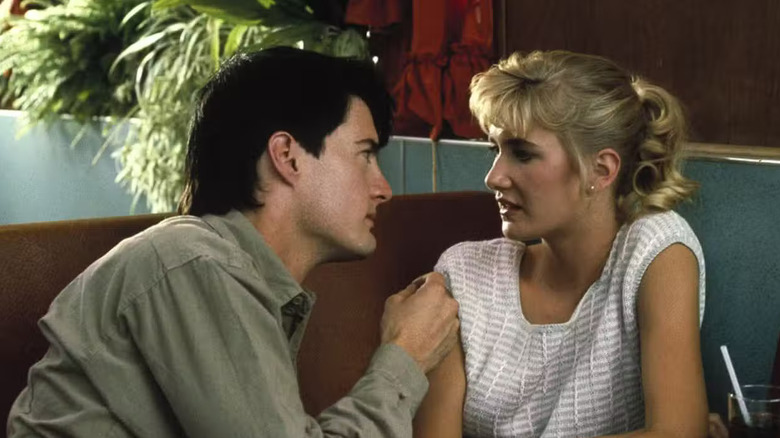
In addition to how "Blue Velvet" and its vision of the beauty and ugliness in small-town America became so influential, the film also fully allowed David Lynch to come into his own as an auteur filmmaker. Sure, Lynch arrived nearly complete with "Eraserhead," yet that film never really permeated the mainstream. His subsequent efforts, "The Elephant Man" and "Dune," certainly bear his hallmarks, but are still notably "for-hire" films rather than visions born wholesale out of Lynch's brain. His future films would be wilder and weirder, yet "Blue Velvet" feels like the moment in which Lynch was able to smuggle his brand of surrealism inside a fully formed cinematic package. While it's fun to theorize endlessly about the various meanings and supernatural happenings within "Twin Peaks," "Lost Highway," or "Mulholland Dr.," the world of "Blue Velvet" is just as surreal yet far more tangible.
"Blue Velvet" is such a quintessential Lynch film that, though it wasn't his first movie, it functionally operates as a touchstone work. It brought together several folks who would become frequent collaborators, pointed the way toward future projects (there likely wouldn't have been a "Twin Peaks" without "Blue Velvet"), and proved his worth not just as an artist but as an actor's director. One great indicator of cultural impact and change when it comes to films is impassioned, widespread debate, and "Blue Velvet" found itself at the center of a firestorm of discourse (pre-social media, too!). David Lynch had both celebrated his small-town American youth while bursting the conservative bubble of '80s nostalgia for the '50s, and he'd done it on his own terms. For him, and for America, nothing would ever quite be the same again.