

Tim Curry's Best Performance Came In A Beloved Box Office Flop
Our loss of some luminaries of stage and screen has tragically continued this week with the passing of actor Tim Curry. As is usually the case when a legend leaves us, people go back over their body of work and debate which performances stand out most, which are still underseen or underrated, which should be considered the best, and so on. Curry's filmography is especially tricky for this, as his appearances in film and television are intimidatingly great (to say nothing of his stage work or numerous credits as a voice actor). The man helped make "The Rocky Horror Picture Show" iconic, worked with iconoclastic directors such as Allan Moyle and Ridley Scott, built an incredible portfolio of villains in films like "The Hunt for Red October" and TV's "It," and appeared in beloved comedies like "Home Alone 2: Lost in New York." He was the human star of "Muppet Treasure Island," and didn't so much treat the Muppets like fellow thespians as he did treat himself like a fellow Muppet.
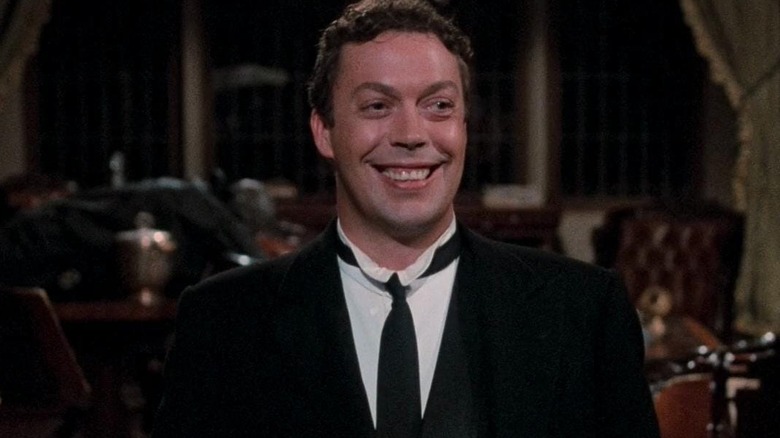
So, while the contenders for Tim Curry's best performance are many, there's one that feels like it should come out on top, both for its overall excellence and because the movie it's in was a box office flop at the time of its theatrical release. We're talking about Curry's turn as the butler Wadsworth in "Clue," a performance and a movie now revered. Sadly, the film only made $14.6 million at the box office when it was released in December of 1985, coming in just shy of its $15 million budget. Despite that failure, "Clue" has gone on to enjoy acclaim and popularity over the ensuing 41 years, largely due to Curry's gloriously theatrical work in it.
Tim Curry's Wadsworth is the definitive murder mystery butler
The game "Cluedo" (later known, especially in the U.S., as simply "Clue") was created in 1943 by British board game designer Anthony E. Pratt as an encapsulation and homage to detective fiction and murder mystery games that were rampantly popular at the time. Pratt sought to boil the genre down to its essence in game form and seemed especially influenced by the works of Agatha Christie, whose seminal 1939 novel "And Then There Were None" must've provided Pratt with a workable blueprint. As such, a movie version of "Clue" was always going to be archetypal in its structure and basic characterizations. Director and screenwriter Jonathan Lynn embraces these qualities at every turn in the film. It even begins on a literal dark and stormy night!
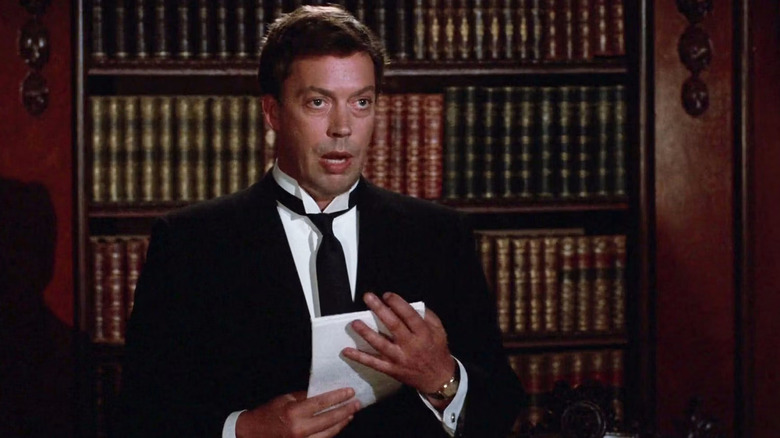
Being a consummate, savvy performer, Tim Curry certainly realized this and leaned into it as well. That's not to say his fellow ensemble cast members didn't; quite the opposite, as each of them delivers performances that are just as quintessential as Curry's. However, while folks like Madeline Kahn (as Mrs. White) and Martin Mull (as Colonel Mustard) had more freedom to dig into the caricatures of their characters, much of the film depends on Curry's choices, given that he's the movie's de facto host and leading man. Thus, the actor brings a delightfully manic, twisted emcee energy to Wadsworth, often delivering exposition while literally on the run.
The combination of a butler's obsequiousness and Wadsworth's nervousness about being a potential victim, and, alternatively, his excitement at putting together the clues, makes Curry the most dynamic character in a film full of eccentric, hilarious people. He is, for all intents and purposes, the definitive murder mystery butler.
Tim Curry led the Clue cast through essentially three movies in one
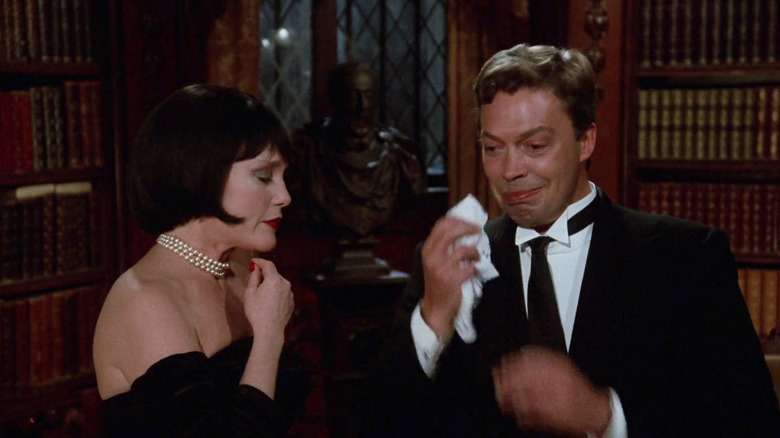
If becoming the definitive butler archetype wasn't enough, Tim Curry had several jobs on top of that while making "Clue." As most fans know, the movie sports not one but three (and almost four!) different endings. Most lovers of the movie discovered it on home video or cable, where all three endings were presented one after the other, turning the film into a meta-joke on the various outcomes of the "Cluedo" game. However, this was not how the film was originally conceived and released. Rather than each ending happening in a row (thus rendering all endings a little inconsequential), a random ending was shown at each screening. This means that each ending had to serve as a fitting conclusion to the mystery and the film itself, with no red herrings (except, of course, communism).
As a result, the cast had to keep an eye on their performances throughout the film, making sure they didn't contradict any of the three endings. It was an ambitious idea that could've fallen apart had the actors not been up to the task. Thanks to his theatrical background and inherent understanding of his character and the material, it's Curry who helps make this experiment flawless. He's so natural in making the multiple endings seamless that sometimes, if you're rewatching the film with just one ending, it takes a moment to realize just which ending you're seeing.
Perhaps all this high-wire work was much ado about nothing for the jaded audiences of 1985, who considered a movie based on a board game somehow cheap. Yet for those of us who know it's all about the craft no matter the source, "Clue" and Curry's legendary performance in it will be eternal.