

Star Trek: Strange New Worlds Season 4 Brings Back The Very First Klingon Villain
Spoilers for "Star Trek: Strange New Worlds" Season 4 Episode 4 "A Case of Chiaroscuro" follow.
The latest "Star Trek: Strange New Worlds" takes the Enterprise into Klingon territory. A mission to recover a Federation probe sees Una (Rebecca Romijn), Uhura (Celia Rose Gooding) and Dr. M'Benga (Babs Olusanmokun) trapped on a plant occupied by the Klingon Empire, where they fall into helping the local resistance. The episode's noir, old Hollywood thriller vibe is complemented by being presented in literal black and white (justified in-universe as a result of the light emitted by this system's star).
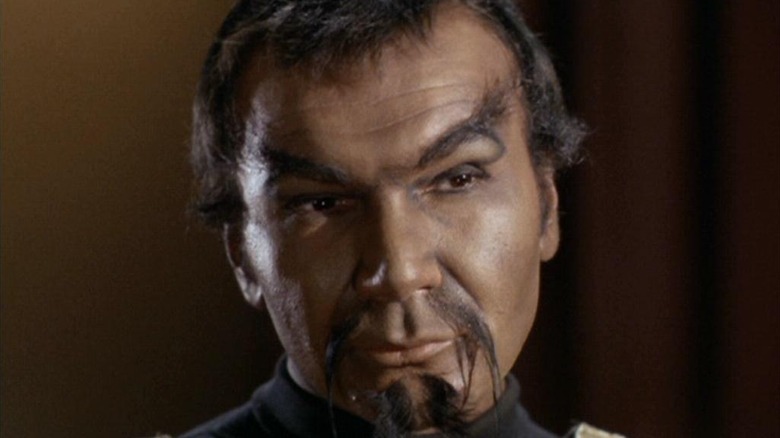
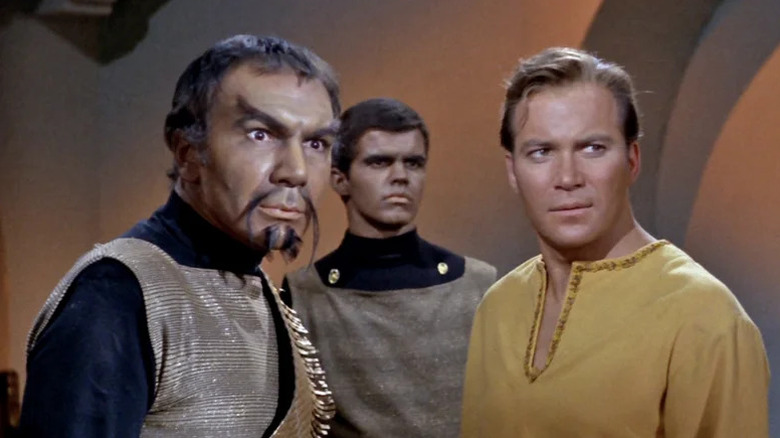
There's a familiar face spearheading this occupation: Klingon Commander Kor (Demore Barnes), aka the very first Klingon villain in all of "Star Trek." Kor debuted in the original series episode "An Errand of Mercy," played by John Colicos in one of the best "Star Trek" guest spots. This was the first episode to ever depict the Klingons, establishing them as adversaries of the Federation and the show's go-to villain for Cold War-allegory episodes. In this episode, the Federation and Klingons are contesting the planet Organia, occupied by the Klingons; Captain Kirk (William Shatner) and Spock (Leonard Nimoy) go undercover on the planet to sabotage Kor's occupation.
It's well known "Star Trek" trivia that the Klingons went from simple villains in the original series to honor-obsessed warriors in "The Next Generation" on. Really, though, those more noble qualities were there from the beginning with Kor; he recognizes Captain Kirk as an adversary worth respecting, one who he'd wished to meet in battle. Yet, he never did. Plans to bring Colicos back as Kor in Season 3 episode "Day of the Dove" fell through (hence Michael Ansara stepping up as a different Klingon commander, Kang), though obviously Kor's legacy did not end there.
Kor's role in Star Trek, from TOS to DS9, explained
Kor appeared in an episode of "Star Trek: The Animated Series," "The Time Trap." "The Animated Series" was famously stingy with voice actors (Walter Koenig was dropped from the cast, and Nichelle Nichols and George Takei would've been too if Leonard Nimoy hadn't put his foot down). So, rather than bringing back Colicos, "The Time Trap" had James Doohan (Scotty) pull double duty as Kor.
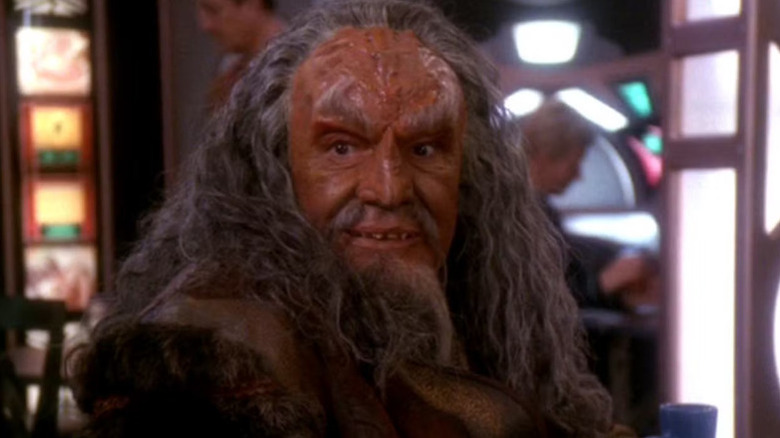
Thirty years after the original "Star Trek" ended, John Colicos himself returned as an older Kor on "Star Trek: Deep Space Nine" (around the time he was also voicing Apocalypse on "X-Men: The Animated Series"). By the 24th century, when "Deep Space Nine" was set, the Federation and the Klingons had become allies, completing a prediction made by the Organians at the end of "An Errand of Mercy." Kor was thus recast from villain to a living legend. "DS9" deepened Kor's character and backstory, such as revealing him to be a descendant of the Klingon royal family. Kor's pride in that made him, long ago, spurn a lowborn Klingon cadet named Martok (J. G. Hertzler), who then rose up to become chancellor of the whole empire and looked on Kor with disfavor.
Kor's appearance in "A Case of Chiaroscuro" marks the first time the character has appeared in live-action and not been played by Colicos. The episode does call back to story details from his original debut in "An Errand of Mercy," though. He's cast in essentially the same role, leading a Klingon military occupation. Kor is also shown subjecting Uhura to interrogation via a "mind scanner" device, something he threatened to put Kirk through in "An Errand of Mercy."
Kor in Star Trek: Strange New Worlds complicates Klingon continuity
Bits of Kor's biography and family history as established in "Deep Space Nine" make it into some exposition about his character... as does one other later detail that creates a continuity hiccup.
In the original "Star Trek," Klingons looked like humans, just with some (rather orientalist) bronzed skin. In the movies and "Star Trek: The Next Generation", the Klingons gained a more alien look, particularly bony ridges on their foreheads.
"Star Trek: Deep Space Nine" episode "Trials and Tribble-ations" canonized the disparity; when the crew of the U.S.S. Defiant travel back in time, they don't recognize the 23rd century Klingons as Klingons, and Worf (Michael Dorn) explains it's "a long story." Now, "Trials and Tribble-ations" is a lighthearted, self-referential episode that literally revisits an episode of the original series ("The Trouble with Tribbles"), so it's easy to laugh that off as a joke.
But the prequel series "Star Trek: Enterprise" complicated that. Set in the 22nd century, 115 years before the original series, "Enterprise" featured Klingons with the forehead ridges. Then, in the fourth and final season, it was revealed Klingons suffered a viral plague that made them look more human. The implication was the plague's effects endured into the mid-23rd century before being eventually cured.
Now, "Strange New Worlds" and parent show "Star Trek: Discovery" have blown up that explanation. This new depiction of Kor is especially canonically problematic; Kor apparently had his forehead ridge in 2260, lost it by 2267, and then regained it by his twilight years. Modern Trekkies' perception of what a Klingon looks like includes the forehead ridges, though, so for "A Case of Chiaroscuro" itself, depicting Kor with them was the easier choice.
"Star Trek: Strange New Worlds" is streaming on Paramount+.