

Project Hail Mary Writer Andy Weir Has A Great Book Recommendation For Alternate History Readers

We may receive a commission on purchases made from links.
Andy Weir, the author of "The Martian," "Artemis," and "Project Hail Mary," loves to read. Starting in 2015, Weir has been interviewed many, many times about sci-fi literature, his favorite books, and even his favorite sci-fi movies. 2015 was a banner year for the author, you see, because Ridley Scott adapted "The Martian" into a hit film starring Matt Damon. Here in 2026, Weir is in the public eye again, as Phil Lord and Christopher Miller adapted "Project Hail Mary" into one of the best films of the year. This means Weir gets to talk about books again, and he doesn't seem to mind.
So one can find various outlets where Weir has recommended his favorite sci-fi-tinged political thriller (the "Red Rising" books), his favorite sci-fi authors (he has a weakness for the legendary Isaac Asimov, Arthur C. Clarke, and Robert A. Heinlein), and even his favorite movie (surprisingly enough, it's "The Lion in Winter"). Like many, he feels that "Star Trek II: The Wrath of Khan" is the best "Star Trek" movie.
Back in 2021, Weir was interviewed by the Amazon Book Review, and he gave yet another recommendation that readers and sci-fi fans might appreciate. The book in question was of the "alternate history" subgenre, which Weir admitted that he wasn't always a big fan of. This time around, though, something about Mary Robinette Kowall's book "The Calculating Stars" got his heart beating fast. "The Calculating Stars" was the first part of the "Lady Astronauts" series, and Weir admitted that he loved it for its high concept and its scientific accuracy. The books cover an alternate version of the 1950s in which humanity has to speed up the timeline of their space program, dictating a universe where we made it to Mars by 1960.
Andy Weir likes the Lady Astronauts book series
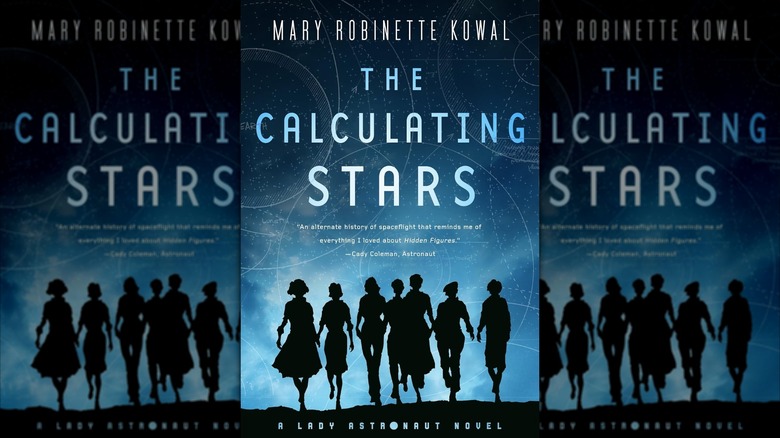
About the first book in the Lady Astronauts series, Andy Weir said:
"I don't normally like alternate-history stories. I can't explain why, but they're just not my thing. The Lady Astronaut series [...] overcame my grouchiness and absolutely captivated me. It's a story in which our early space program is forced to expand at a breakneck pace, far faster than we managed in real life. Not only is it solidly based in real science, it's firmly based on the technology available in the late 1950s and early 1960s. So it's both a great piece of fiction and a lesson in real scientific history."
Which definitely sounds up Weir's alley. His sci-fi movies, while fictional and sometimes fantastical, are based heavily on the real ins and outs of space travel. It seems that Mary Robinette Kowal has deep knowledge of the history of the United States space program, which will make aerospace junkies very happy.
The alternate universe of "The Calculating Stars" begins in 1951 when a meteorite hits the east coast of the U.S., killing then-president Thomas Dewey and several other key administration officials. The real-life secretary of agriculture, Charles F. Brennan, becomes president. The main character of the novel is Elma York, a fictional character who figures out that the meteorite strike will make Earth uninhabitable within the decade, and the world needs to step up its space program in a major way in order for humanity to flee the planet and re-settle elsewhere. Part of the book involves putting on an all-female air show for the public, as women are still discriminated against and there is a need to drum up support for women in the space program.
The Lady Astronaut series is currently four books long
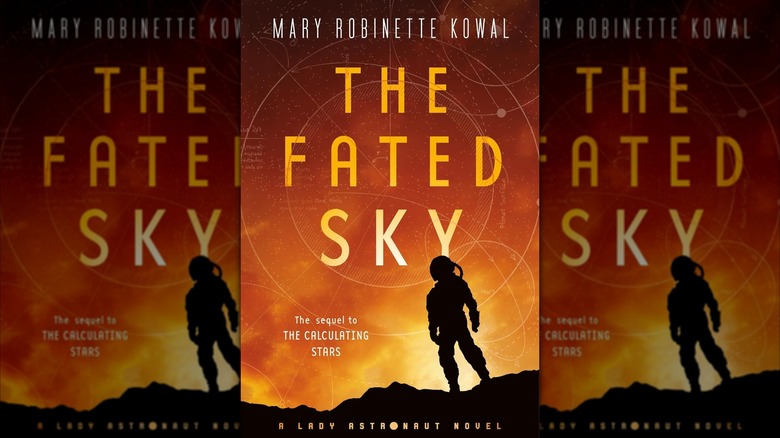
The Lady Astronaut series began as a short audio presentation called "The Lady Astronaut of Mars," released on Audible in 2012. It was presented in print on Mary Robinette Kowal's personal blog in 2013 and subsequently nominated for a Hugo Award. There was, it seems, some controversy about the story, as the Hugo nominating committee felt that the print version contained stage directions and was only eligible under the "Best Dramatic Production, Short Form" category, and not under the "Best Novelette" category that it was initially nominated for. It didn't have enough votes to be nominated as a short dramatic production, and its nomination was rescinded. It was reprinted and won in the novelette category the following year.
All four novels in the series take place after the initial novelette. The first, as mentioned, was "The Calculating Stars" from 2018, and its sequel, "The Fated Sky," was published the same year. The third book, "The Relentless Moon," came out in 2020, and the most recent installment, "The Martian Contingency," hit shelves in 2025. A review in The Verge pointed out that the Lady Astronaut series was of the "punch-card-punk" subgenre, fetishizing and going into great detail about the computer details of the late 1950s. It's like Steampunk, but 80 years later. Yeah, I can definitely see why Andy Weir liked these. Maybe we need these Kowal books to be adapted into movies, too.
Imagine if "Hidden Figures" took place in an accelerated sci-fi version of humanity, and it seems you have a good idea as to what the Lady Astronaut series is all about. Weir seems to be on the nose about these ones.